


High borrowing costs, supply-chain volatility and surging demand for water are reshaping the way Gulf governments fund infrastructure projects. Across the Mena region, new capital strategies are taking shape; a variety of privately funded models and partnerships allow investors from around the globe to capitalise on opportunities
In Saudi Arabia alone, contract awards worth almost $154bn were signed over the course of 2024 – the highest annual tally ever recorded. It underlines Riyadh’s determination to keep capital spending on track despite tighter global money markets and tightening oil prices. And it points to a wider story: drastic changes in the funding mix. Instead of leaning on the sovereign balance sheet, ministries across the Middle East and North Africa (Mena) region are looking increasingly to the private sector to help deliver their project programmes.
One lever is the rapid roll-out of public-private partnerships (PPPs). From airports to pipelines, from hospitals to schools, projects are being re-packaged so that private developers design, build, finance and operate assets in partnerships with governments in contract concessions that may span decades. Consider the Saudi Arabian aviation authority’s ongoing Abha International airport concession, which illustrates the trend. Bidding has been extended to allow international consortia to propose a comprehensive solution, complete with sewage treatment and renewable energy components.
Another lever is the use of sovereign and quasi-sovereign credit wraps. The Public Investment Fund, National Development Fund and a network of sector regulators now provide backstops to potential revenue risks. As a result, Saudi Arabia alone carries $184.6bn of power and water schemes at the bidding stage – the deepest deal pipeline anywhere in the Middle East.[1]


Finally, green-labelled debt is coming of age. Because many assets replace fossil fuel with renewables, they qualify for sustainability-linked loans and bonds. Under Basel III regulations, green exposures receive favorable treatment — allowing banks to strengthen liquidity ratios while securing long-term stable returns.
Altogether, it adds up to a capital toolkit that is broader – and cheaper – than ever before. For investors both inside and outside the region, the opportunities are immense. Mena infrastructure is poised to become the next big success story in international finance.
 Where the money is flowing
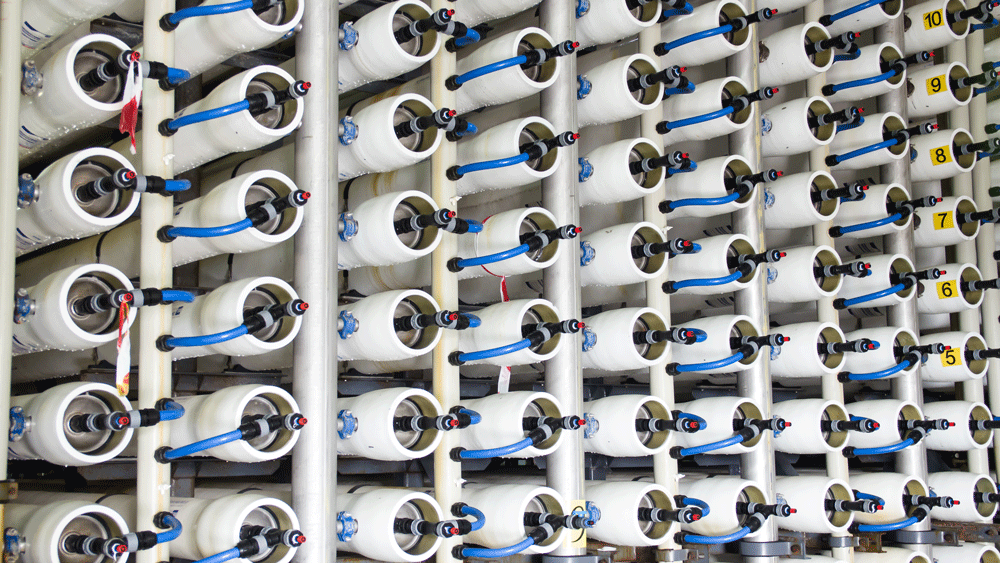
As a case study in the possibilities from this financial re-engineering, consider Mena’s water sector. The region – not blessed with an abundance of natural freshwater supplies – is brimming with new water desalination, transmission and strategy storage projects, almost all of which will be implemented through the PPP model. It now accounts for the single largest slice of Saudi Arabia’s $387bn power and water project market. This includes the $137.5bn already under construction and a further $249.5bn moving through design and tender (also encompassing the $184.6bn of power and water schemes at the bidding stage cited above).[2]
Awards spiked in 2024, when power and water contracts cleared $68bn, triple the 2023 total. Digging deeper, the past 10-year ledger shows water pipelines absorbing $27.6bn, desalination plants $14.8bn and treatment facilities $11.1bn. It proves that many investors have already priced in the potential rewards pouring forth from the region, and are moving to capitalise further.
These activity levels are just the start. A sweeping capacity plan released by the Saudi Water Partnership Company (SWPC) – Saudi Arabia’s principal buyer of all produced water from both public and private sectors – is set to turbocharge water sector investment. Desalination capacity is scheduled to reach 8.1 million cubic metres a day (cm/d) by 2032, driven by coastal clusters such as Rabigh 4 (under construction) and a brace of mega-plants now in the transaction phase. Wastewater treatment will climb to 2.6 million cm/d by 2030, supported by a collection network of 11,550 kilometres that threads through every major population centre. And transmission pipelines are being laid at break-neck speed. 1,640 km of new trunk lines – including the landmark Jubail-Buraydah and Riyadh-Qassim concessions – will deliver 2.43 million cm/d of potable water by 2029. All of above capacity will be executed through the PPP module.
MEED data shows that the Jubail-Buraydah pipeline alone carries a capex tag of $2.27bn and is already attracting bids from blue-chip developers. On the treatment side, the Al-Haer sewage plant is moving through construction tenders at 200,000 cm/d, while desalination’s next wave – Ras Al-Khair 2, Al-Rais 2 and Tabuk 1 – is slated to close financing in 2026. The water sector’s momentum is clear, and the attraction for international capital is obvious.
A sweeping capacity plan released by SWPC is set to turbocharge water sector investment
Why Saudi Arabia is setting the pace
The entire Mena region is an international success story in investment innovation over recent decades. Now, however, Saudi Arabia stands out. Scale is the first attraction, with the value of all known, planned and unawarded projects in the pipeline now totalling $1.57tn. Vision 2030 has hard-wired multi-year spending into fiscal planning, insulating infrastructure budgets from commodity price swings.
Investors prize revenue certainty. That is exactly what SWPC provides. As Saudi Arabia’s single bulk water buyer, it is able to cement 25- to 35-year offtake agreements and handle potential hurdles like regulatory uncertainty and currency logistics on behalf of developers. For example, while SWPC pays in Saudi Riyals, the tariffs are denominated in USD at a fixed exchange rate, ensuring long-term currency stability and revenue predictability for international investors. It currently oversees 49 live projects, 10 million cm/d of desalinated output and 600,000 cm/d of treated waste-water – a portfolio large enough to diversify operational risk across plants, geographies and technologies.
Last, the macro backdrop is impossible to ignore. GlobalData estimates suggest Saudi energy and utilities construction will grow at an average 5.8% per year between 2025 and 2028, powered by renewables and water infrastructure. MEED lists PPP expansion, net-zero commitments and record FDI targets among the top four drivers of the Gulf project market. Policy, demand and finance are all pulling in the same direction.
Higher interest rates may have made infrastructure finance a harder game worldwide. But the Gulf is writing its own rule-book. By putting innovative capital strategies at the heart to smooth the road ahead for investors, SWPC has already unlocked billions in liquidity for a booming water market. For global investors hunting both scale and resilient cashflows, it is an opportunity that cannot be ignored.
[1] MEED report, Saudi Arabia Projects H2 2025, July 2025.
[2] Ibid.
You might also like...

Egypt discovers more gas in its Western Desert region
26 March 2026

Iraq gas field project disrupted by regional conflict
26 March 2026

Qiddiya tenders east village south construction
26 March 2026


A MEED Subscription...
Subscribe or upgrade your current MEED.com package to support your strategic planning with the MENA region’s best source of business information. Proceed to our online shop below to find out more about the features in each package.
Take advantage of our introductory offers below for new subscribers and purchase your access today! If you are an existing client, please reach out to your account manager.