


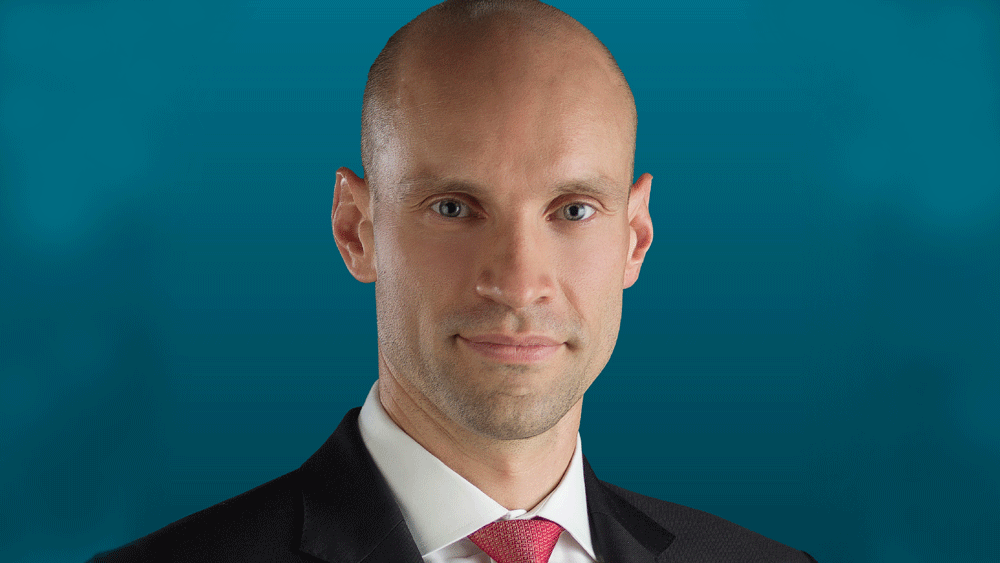
In this edition of MEED’s CXO Spotlight series, Ruya CEO Christoph Koster shares how the UAE-based digital Islamic bank is taking a steady, control-first approach to growth anchored in trust, regulation and operational readiness
In March 2023, Silicon Valley Bank (SVB) collapsed under the weight of its own growth model. The US-based bank, which had rapidly expanded by catering to tech startups, failed to diversify its depositor base or manage interest rate risks on long-duration bonds. When market sentiment shifted, SVB suffered a $42bn bank run in just 48 hours, triggering the second-largest bank failure in US history.
The fall of Germany’s Wirecard in 2020 was no less dramatic. Once hailed as a European fintech champion, Wirecard imploded when auditors discovered that €1.9bn in cash was missing from its accounts. Its growth-first narrative concealed serious governance failures that had been overlooked for years.
Meanwhile, high-profile digital challengers have faced mounting pressure. Revolut’s delay in securing a UK banking licence stemmed from concerns about its internal controls and audit procedures. Only in July 2024, more than three years after the fintech firm lodged its application with regulators, did it secure a UK banking licence, although with restrictions. Australian neobank Xinja surrendered its licence in 2020 after failing to raise sufficient capital to sustain its growth.

These cases reveal a common flaw: a rush to scale that outpaces governance, risk management and operational readiness. And the problem is not limited to new entrants. In February 2025, HSBC suffered a widespread outage that prevented UK customers from accessing online and mobile services. The disruption came days after similar failures at Barclays, Lloyds and Halifax.
According to GlobalData, despite massive ICT budgets, legacy banks continue to struggle with digital performance, exposing weaknesses in their infrastructure and opening the door for digital-native competitors. These examples show that when infrastructure and oversight fail to keep pace with growth, even the most well-funded banks can falter.
A measured approach to scale
One of the UAE’s youngest digital banks, Ruya launched in 2023 with a specialised banking licence as Islamic Bank by the Central Bank of the UAE. Since then, it has onboarded more than 60,000 customers—adding around 9,000 to 10,000 new accounts each month. Rather than chase hypergrowth, the bank is positioning itself as a long-term, resilient player.
“For newer entrants, the lesson is clear: scale is not an end in itself,” says Christoph Koster, CEO of Ruya. “We are not chasing scale for the sake of growth. Our focus is on building a foundation of operational excellence, customer trust and regulatory resilience first. Only then will we expand in a way that is controlled, sustainable and aligned with long-term success.”
From the outset, Ruya invested heavily in its back-end infrastructure and compliance framework, aligning closely with the UAE Central Bank’s evolving expectations. This reflects a broader view on regulation, not as a constraint but as a driver of innovation. “Regulation does not have to follow innovation; it can lead it,” says Koster. “We have worked proactively with the UAE Central Bank to ensure alignment from day one.”
This strategy reflects a wider industry trend. According to S&P Global Market Intelligence, sustainable profitability in digital banking hinges on maintaining a balance between customer lifetime value and acquisition costs, underscoring the need for measured growth and operational discipline. Meanwhile, regulatory bodies across markets are intensifying expectations around cybersecurity, operational resilience and ESG compliance, prompting digital banks to invest more heavily in internal controls and governance frameworks.
Promoting financial inclusivity
As a digital-first Islamic bank, Ruya also operates at the intersection of enhanced cybersecurity expectations and sharia compliance. In an environment increasingly shaped by digital identity frameworks such as UAE Pass and rising fraud risks, the ability to protect customer data is as critical to trust as it is to operational resilience.
Ruya’s digital-first approach is paired with a community-based model. The bank has established “community centres” or physical spaces designed not as transactional branches but as experiential hubs where customers can learn, engage and build trust.
“Our community centres are like Apple Stores designed for experience, learning and support,” says Koster. “They are a space where customers can understand what we stand for.”
He explains that while the majority of Ruya’s customers interact digitally, the physical experience is a deliberate trust-building strategy. “Realistically, we will never talk to 80–90% of our customers as most will experience the brand through their mobile phones,” says Koster. “But when it comes to money, trust is critical and if something goes wrong, people don’t want to speak to a chatbot. They want a human.”
Koster adds that the centres allow people to “see, feel, touch and talk to actual human beings,” especially when dealing with technical issues or moments of financial concern.
“One area where we are adamant is that we will never replace humans in customer service,” says Koster. “These situations require emotional intelligence and contextual thinking from our colleagues to solve specific customer issues. I don’t want an AI to do that—I want our people to do that
This commitment to inclusivity is also evident in Ruya’s embrace of Islamic finance principles, which are not seen as exclusive to Muslims but as universal values. “Islamic banking is not just for Muslims,” says Koster. “These are principles that apply to everyone. In today’s environment, trust-based, inclusive finance is what people expect.”
Koster adds that the growing preference for values-based banking mirrors broader consumer shifts. While he avoids the buzzwords, his emphasis on fairness, transparency and risk-sharing resonates with the global movement toward ethical financial practices.
Islamic finance is gaining popularity among non-Muslim investors, businesses and governments due to its stability and ethical approach. Non-Muslim countries such as the UK, Luxembourg, Hong Kong and South Africa have issued Sukuk (Islamic bonds), recognising the system’s benefits in promoting financial stability. In the UK, non-Muslims are increasingly attracted to sharia-compliant products. In 2014, the UK became the first western country to issue sovereign Sukuk and followed it with £500m in Sukuk in 2021.
These pillars form the foundation of a model designed to build resilience, not just growth.
The shift from speed to sustainability is not merely philosophical. It reflects a broader transformation in the industry landscape, as rising interest rates, tighter regulations and higher consumer expectations force banks to recalibrate. Institutions that fail to establish resilient, well-governed foundations now risk reputational damage, customer churn and regulatory penalties later.
“This is about strategic patience,” Koster says. “We are not here to win a race in year one but to be resilient over decades.”
Looking ahead
As digital banking matures, so too does the demand for seamless, real-time access to investment products from conventional savings to cryptocurrency. Several Mena markets have seen a surge in interest around digital assets and tokenised finance, prompting regulators to explore licensing frameworks that support innovation without compromising security. At the same time, platform banking is becoming a defining strategy, allowing financial institutions to embed or distribute third-party products and services within a unified digital environment.
Ruya is positioning itself to meet these evolving expectations. “We have built our core banking and operational stack to function as a platform bank,” says Koster. “The ambition is to add a broad range of financial services, from investment products to virtual assets, commonly known as crypto, so customers can interact with everything through one interface.”
Artificial intelligence (AI) and automation are also high on the agenda, particularly for backend efficiency.
As the digital banking sector matures, the region’s institutions face a strategic crossroads. Success will depend not on how quickly banks can grow, but on how effectively they can scale without compromising integrity. Smart growth, not hypergrowth, is the defining challenge of the next phase of digital banking.
You might also like...

Qiddiya tenders east village south construction
26 March 2026


Emaar Properties approves $2.4bn dividend distribution
26 March 2026


A MEED Subscription...
Subscribe or upgrade your current MEED.com package to support your strategic planning with the MENA region’s best source of business information. Proceed to our online shop below to find out more about the features in each package.
Take advantage of our introductory offers below for new subscribers and purchase your access today! If you are an existing client, please reach out to your account manager.