


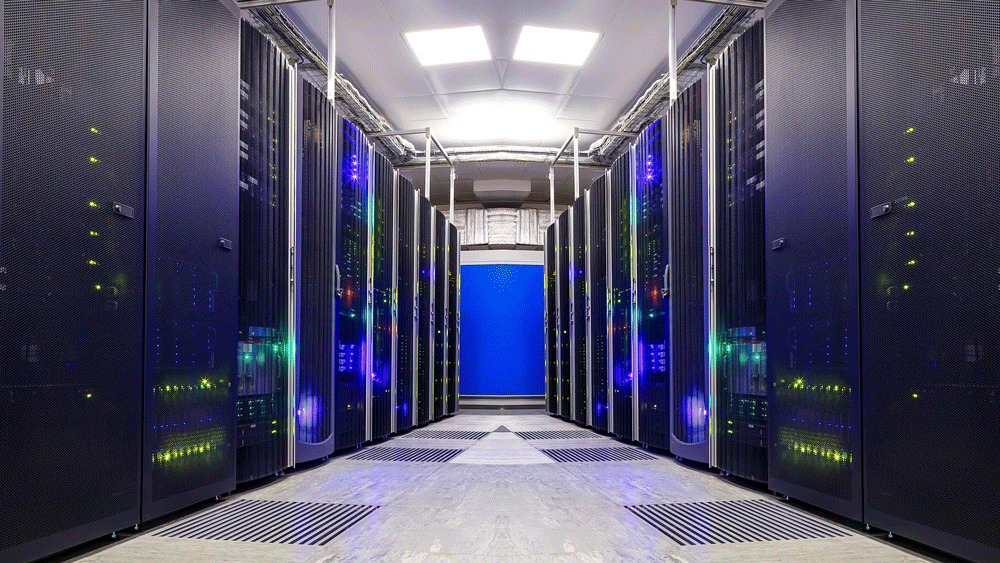
US cloud giant Amazon Web Services has reported outages at two UAE data centres amid Iranian attacks, raising fresh concerns over the security and resilience of hyperscale facilities



Amid ongoing Iranian missile and drone attacks on GCC states, US cloud provider Amazon Web Services (AWS) has reported service outages following separate incidents at two of its UAE data centres.
“At around 4.30AM PST [16.30 UAE time on 1 March], one of our Availability Zones (mec1-az2) was impacted by objects that struck the data centre, creating sparks and fire,” AWS said in an operational update on 1 March.
At 10.46 UAE time on 2 March, the company announced a further update, saying that another of its three UAE Availability Zones had gone down.
“We can confirm that a localised power issue has affected another Availability Zone in the ME-CENTRAL-1 Region (mec1-az3),” it said in the latest update. “Customers are also experiencing increased EC2 APIs and instance launch errors for the remaining zone (mec1-az1). At this point, it is not possible to launch new instances in the region, although existing instances should not be affected in mec1-az1.
“Other AWS services, such as DynamoDB and S3, are also experiencing significant error rates and latencies. We are actively working to restore power and connectivity, at which time we will begin to work to recover affected resources. As of this time, we expect recovery is multiple hours away.”
Regional footprint
The company, part of the US’ giant Amazon group, is one of the world’s largest data centre and cloud operators. It operates three data centres in the UAE – one in Dubai and two in Abu Dhabi – and provides critical IT services to government and private sector operations and systems.
Its Availability Zones consist of infrastructure in separate geographic locations, spaced far enough apart to significantly reduce the risk of a single event affecting customers’ business continuity, yet near enough to provide low latency for high-availability applications that use multiple zones.
The targeting of the two data centres – and potentially others if the conflict continues – highlights the strategic importance of these types of facilities. The AWS attacks are believed to be the first time a data centre has been targeted in a conflict and are likely to drive a reconfiguration of future campus designs to account for similar risks.
Such changes could include increased redundancies – particularly in power provision – enhanced structural resilience, and potentially a reconsideration of the location and clustering of data centre facilities.
Historically, data centres in the region were largely smaller enterprise facilities dedicated to storage services for organisations such as banks. Their locations were often confidential and in areas that were difficult to target, making them harder to disrupt.
However, the emergence of large in-region hyperscale data centres – with IT loads of 200MW or more and larger physical footprints – may necessitate a rethink of how such infrastructure is delivered, not just in the GCC but worldwide.
According to MEED Projects data, there are believed to be about 185 data centres in the region, each with an estimated capex investment value of more than $10m, of which about 99 are either planned or under construction.

You might also like...

Aramco selects contractors for five offshore tenders
23 October 2026

Contractor wins $599m Ras Al-Khaimah hotel construction deal
23 October 2026
Adnoc Onshore seeks bids for Bab gas cap well tie-in project
23 October 2026

Focus turns to the Northern Emirates
23 October 2026


A MEED Subscription...
Subscribe or upgrade your current MEED.com package to support your strategic planning with the MENA region’s best source of business information. Proceed to our online shop below to find out more about the features in each package.
Take advantage of our introductory offers below for new subscribers and purchase your access today! If you are an existing client, please reach out to your account manager.