


World Cup infrastructure makes Qatar a rich market for lenders
Qatar has approximately $180bn-worth of infrastructure projects under development in the next four to five years as the country races to get ready for the Fifa World Cup in 2022 and fulfil the governments Vision 2030.
The hydrocarbon-rich country will be able to pump a lot of its own money into the pipeline of schemes currently planned or under way.
Its small population, high level of reserves and income from gas exports have provided more economic shelter than some of its neighbouring states in the new low oil price environment.
Yet, given the number and size of the projects, there will be an increasing role for bank finance to play. Fortunately, Qatar has ample bank appetite to help support local and international contractors and project developers looking to work on its stadiums, metro, rail, roads, hotel and water projects.
Bank capacity
Qatars bank market is remarkably liquid, particularly due to its fast-growing local sector. Total bank asset growth rose by 11.6 per cent in 2013 and lending volumes continue to rise, although the rate of growth dipped slightly in 2013.
Most of the countrys banks also reported healthy results for 2014.
Qatar National Bank, the countrys largest lender by assets, grew by 10 per cent on 2013 to reach QR486bn ($133.6bn) last year, and its loan book increased by 9 per cent to reach QR338bn.
Similarly, Commercial Bank of Qatars (CBQs) lending rose during 2014, up 9 per cent to QR70.7bn at the end of September, compared with QR64.9bn in the same period of 2013.
CBQ, along with its associates and subsidiaries, delivered a net profit of QR1.6bn for the first nine months of 2014, a 19 per cent increase on the same period the previous year.
Against this backdrop of high bank liquidity and a government keen to push forward with its infrastructure developments, contractors and companies working on projects of strategic importance, such as those in the transport and power sectors, should not struggle with accessing finance.
Indeed, competition is increasingly tight among banks, making available finance competitively priced for borrowers. Qatars ambitious transport schemes are providing plentiful opportunity. Digging and boring work has commenced in Doha as the city builds its metro system.
The project is being developed by government-backed Qatar Rail and the tendering of construction packages for each line has provided ample opportunities for banks to provide financing support all along the bid process.
Local and international banks have stepped in to provide bid bonds to potential bidders, and then extended performance bonds and contractor financing facilities to the winning contractors. Last year, CBQ provided QR1.2bn-worth of contract finance to support the Doha Metro project, covering the phase 1A Msheireb station and phase 1 tunnel package.
There are several IWPPs planned that will require more complex project financing structures
Qatar is also investing heavily in its road network. The Al-Rayyan road project is one major development under the Public Works Authoritys (Ashghals) expressway programme. It will connect the south of Doha to the north, east and west, and improve the flow of traffic to help the city accommodate the influx of visitors for the World Cup.
Several local banks have provided substantial financing to support this project.
Earlier this year, Al-Khalij Commercial Bank and The Commercial Bank of Qatar arranged a financing facility of QR1.26bn in support of a Turkish joint venture of Dogus Insaat ve Ticaret and Onur Taahhut Tasimacilik ve Ticaret.
This followed a similar contract financing facility raised by Al-Khalij Commercial Bank in November last year in favour of a joint venture of local Boom Construction Company and Six Construct Qatar.
Water and power
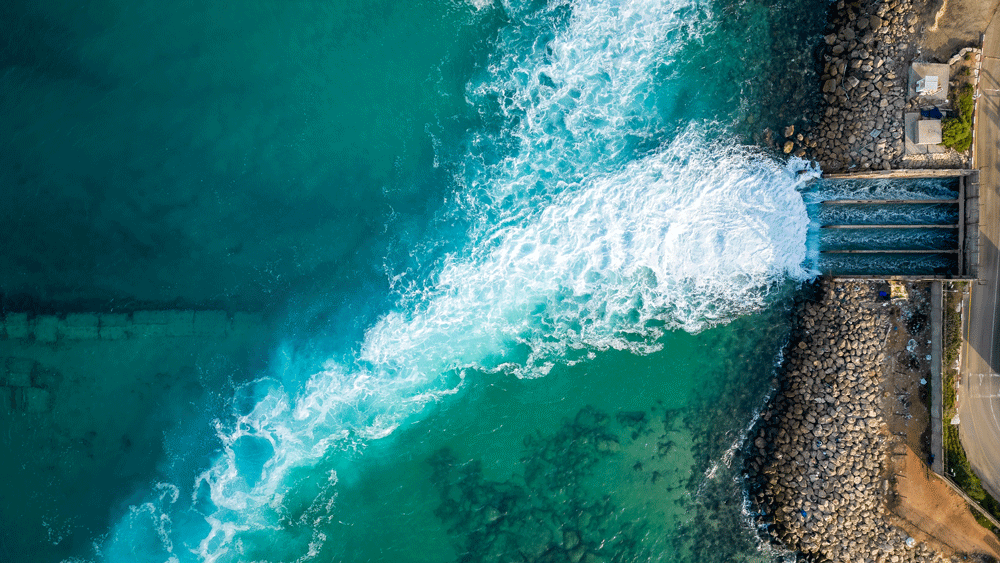
Banks are also awaiting the award of the main construction contracts for Qatars $3bn Water Security Mega Reservoirs project, hoping to provide the winning bidders equipment and contract financing.
The project, which will involve the construction of five reservoirs, is intended to provide seven days of strategic water storage to prevent disruptions in supply.
Sources suggest contracts will be awarded by the end of March, with bids having been submitted to Qatar General Electricity & Water Corporation (Kahramaa) last September.
This is a key infrastructure project with an undoubted project sponsor, so appetite across the banking sector should be competitive, says a Doha-based banker.
Local and international banks have already supported earlier contracts awarded by Kahramaa. HSBC signed QR1bn-worth of contract-related finance with Al-Jaber Engineering Company in mid-2014.
There are several independent water and power projects (IWPPs) planned that will require more complex project financing structures. It is here that international banks play a key role providing financial advice and experience, although local lenders are beginning to play a bigger part in these deals.
The next IWPP being developed by Kahramaa is known as Facility D. The project is edging towards awarding final contracts, with the last three bidders asked to resubmit prices in January. Facility D is estimated to require $3bn-worth of investment, with a large proportion of this to be project financed by banks.
Q&A: Al-Khalijis Mohamed Abdelkhalek
The local Al-Khalij Commercial Bank had a busy 2014, financing contractors on some of Qatars major infrastructure projects. Group chief business officer Mohamed Abdelkhalek talks to MEED.
How strong is demand for infrastructure financing in Qatar? Has demand been dampened by oil price concerns?
Current demand is high. Although falling oil prices are having an impact on the budgets of some countries, the Qatari government is continuing with its major projects that have been identified as priority projects. So the Doha Metro remains on track.
Youll find that the road projects are not delayed or scaled down.
Non-priority projects might be implemented in phases or delayed, but none of the key projects should be affected.
Over the past year, we supported the construction of the Al-Rayyan Road project, providing contractor financing. We have also been supporting contractors working on the expansion of Ras Laffan port, as well as working on power plants and the financing of the stadium constructed for the world handball tournament in Doha.
We also exclusively financed the developer behind the new Kempinski The Pearl hotel in Doha.
What projects are you hoping to support this year?
Contractors are bidding on new road packages. We expect some of our clients to win some projects, hopefully in the second quarter. There are some packages yet to be awarded on the metro. We already have some exposure on contractors working on the metro and I expect we will become more involved.
I expect the bank to remain successful. We have adequate liquidity to accommodate our growth plans. Pressure on banks net interest margins will continue in 2015 as they compete for business.
Do you plan to raise additional funding to support your growth?
We continue to diversify our funding sources. Not only just to fund growth, but also to ensure we have access to different pools of liquidity.
As soon as there is a need to support and further borrow from international markets we will consider that.
We issued our debut bond of $500m in the fourth quarter of 2013. We have an established Euro Medium Term Note programme and we are considering enhancing this programme and increasing the amount.
Q&A: HSBCs Richard Keery
Richard Keery, Qatar head of commercial banking at HSBC Middle East, speaks to MEED about opportunities to finance Qatars infrastructure boom.
What are the opportunities in Qatar in terms of supporting the infrastructure drive?
There is a significant amount of spending on infrastructure already under way in Qatar. In Doha there is tunnel-boring equipment working on the new metro. The mega-reservoirs project is under way. There are many projects progressing, and a lot in the pipeline as well.
Since the new airport opened last year, things seem to have really picked up. We are also seeing some interesting new joint ventures being formed with European or Chinese companies looking to tie up with local companies.
Have these opportunities been dampened by concerns about oil prices?
The oil price has been up and down for the past 15 years and gas prices havent declined as much in comparison. Of course, the oil price is important, but in Qatar it is about the long-term story. The projects being developed are for the 2022 World Cup and the governments 2030 vision, so it is unlikely many projects will be cancelled. There isnt anything being developed that is not an essential project. Nothing is a trophy.
One thing Qatar will need to be careful of is the availability of raw materials to prevent any bottlenecks in supply. They will need to ensure the resources for projects are in place, including manpower.
Have you seen an increase in business volumes over the past year?
We have definitely seen an increase in the provision of bonds and guarantees for companies working on infrastructure projects in the first three quarters of last year.
Our major project last year was working with AlJaber Engineering on Kahramaas [Qatar General Electricity & Water Corporation] mega-reservoirs project. HSBC signed QR1bn-worth of contract finance facilities for the company in mid-2014. Aljaber is working on the pipelines that will connect the reservoirs.
What opportunities are there for HSBC in 2015?
We are looking at supporting large Qatari family [businesses] with a strong trading arm and working with them to support them on their construction contracts.
We are looking to support companies working on the mega-reservoirs project at the main contractor level, among many other projects.
There are well over $100bn-worth of bank-able projects being implemented over the next five to seven years.
How competitive is the market? Is there a possibility that companies could borrow too much?
Competition is fierce. The local bank market is very liquid. When dealing with joint ventures, the foreign companies involved may have access to funding in their home country.
But that is where our international network can help and we can help [to connect] international players with local players.
Although it is a competitive market, you can command a premium if you are offering a quality service.
People do need to be mindful of being a responsible lender and responsible borrower and structuring the deals in a way that does not expose you, or the business, to financial risk. But people have generally learnt lessons from the financial crisis of 2008-09 and are more cautious in their lending or borrowing.
I dont think there are any major obstacles in terms of the provision of financing.
In terms of obstacles to the success of projects, the availability of raw materials, the inflation of material costs and the appropriate scheduling of projects is something that needs to be considered.
Stay informed with the latest in the Middle East
Download the MEED app today, available on Apple and Android devices
You might also like...
Building around the strait
04 June 2026

Fitch cuts global airport outlook on Iran war
04 June 2026
A MEED Subscription...
Subscribe or upgrade your current MEED.com package to support your strategic planning with the MENA region’s best source of business information. Proceed to our online shop below to find out more about the features in each package.
Take advantage of our introductory offers below for new subscribers and purchase your access today! If you are an existing client, please reach out to your account manager.