


Demand for low-cost housing in the capital continues to tax the Egyptian government, which is creating new towns and villages.
Modern Cairo has always defied urban planners. The city was designed and built under Khedive Ismail in the mid-19th century to accommodate more than 2 million people - a city to match the engineering miracle of the Suez canal. But the expansion of the metropolis has been relentless. Twelve million people now live in its sprawl, with a further 3 million commuters squeezing in every day.
And in Cairo, as everywhere else in Egypt, demand for new residential properties continues to soar. Birth rates are high, and the number of married couples is rising. Yet despite a revival of the private construction sector, new housing is still in short supply.
The construction sector is Egypt’s seventh largest industry, representing about 5 per cent of gross domestic product (GDP) and absorbing 8 per cent of the labour force - as well as indirectly related jobs, such as furniture manufacturers. At present it attracts 48 per cent of new investment throughout the economy.
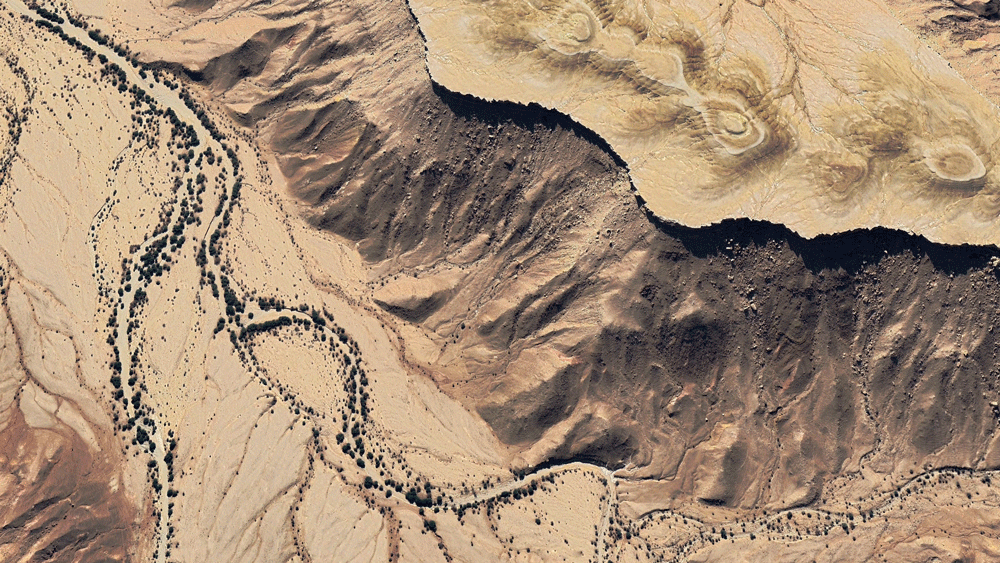
Yet today, construction of new urban housing is estimated to be little more than 60 per cent of the total required. As the population climbs ever higher and remains concentrated in areas covering only 5 per cent of the total land area - especially Cairo and the region around Alexandria - there is an increasingly serious shortage of homes for low-income groups. This is exacerbated by a high rate - more than 25 per cent - of properties lying vacant.
The appearance and quality of the built environment, particularly in the informal settlements, suffer from the inevitable deterioration brought about by a lack of investment, co-ordinated planning and the pressure of too many inhabitants. This unmanaged sprawl is beginning to threaten some of Egypt’s historical sites. The ramifications of such a shortfall are obvious and have moved the government to action.
Amr Ezzat Salama, chairman of the Housing & Building National Research Centre, is one of those leading the effort to encourage new major infrastructure and building projects in Cairo and throughout the country, and to identify some of the major underlying problems. “Of course, it is a big job and we are all very busy,” he says. “But so far we are all doing well. And there really is a huge need for new housing.”
PPPs
In line with the liberalising thrust of the government of Prime Minister Ahmed Nazif, the Housing, Utilities & Urban Development Ministry is looking to attract contractors - and more international investors - by expanding the role of the private sector through the creation of public-private partnerships (PPPs). However, the ministry will try to direct contractors away from the high-income housing schemes that have traditionally attracted them.
According to the government’s own figures, more than 76 per cent of all housing demand is from those with low or very low incomes. By 2017, it estimates a total of more than 2 million new housing units will need to have been built, at a rate of around 200,000 a year. “We are working to achieve a rough rate of about seven new housing units for every 1,000 people across the population,” says Salama.
The ministry is increasing its build-operate-transfer (BOT) and build-own-operate-transfer (BOOT) projects across its three main areas of responsibility - housing; waste and wastewater utilities; and new urban communities.
Salama explains that a top policy is to upgrade existing residential areas in cities. More than 1,100 areas have been identified, which at present house 12 million people - or 40 per cent of the total urban population - across 24 governorates. Eighty-one of the areas were deemed to be beyond help and are to be demolished and their inhabitants moved. Salama says that about £E 4,000 million ($697 million) has already been allocated by the government to improve infrastructure in these areas.
But the ministry has also been tasked with finding and founding new towns. The housing strategy calls for the creation of 44 new communities outside the Nile Valley and the Delta, which when completed will house about 20 million people. Plans are under way to build a new valley, linked to the Red Sea, to the west of the Nile Valley. Including the development of several ‘growth corridors’, as well as one major linking corridor, the new valley will cross seven governorates. Its first stage will involve the creation of 21 new villages, but the scheme will eventually see 400 new villages on the map.
Salama is pleased with progress so far and is encouraged by the knock-on effect it will have on the construction sub-industries. “The establishment of these new cities will provide more than 5 million new jobs, as well as yielding much-needed housing units for low-income families,” he says. “And we are making encouraging progress. Already 20 of these have been constructed, five are in the planning stage and we are studying proposals for another 19, which we expect will be built before 2017.”
The ministry’s plan has already brought about 500,000 new housing units into the market and created 300,000 new jobs. Projects such as the Toshka development to the south of the Nile Valley and the new 6 October City are well advanced. Plans are already afoot to link 6 October with the Cairo metro by building a new rail line using private finance on a BOT basis. But perhaps the most ambitious of the ministry’s plans are those, such as the new valley, to attract the rural population towards Egypt’s desert areas. President Mubarak’s election pledge to create 500,000 new homes by 2011 will be rolled out across the country, but particularly in Upper Egypt.
It would be unfair to say this drive for new private sector investment and involvement is a completely new phenomenon. Of 3 million new housing units built since 1982, the vast majority of which targeted low-income families, 2 million were built by private sector finance. But the ministry’s priority is to increase this contribution and open Egypt’s doors to foreign contractors at the same time. “With the government’s programme of liberalisation creating a favourable investment environment, we see plenty of large foreign companies investing in Egypt,” Salama says. “And I do not expect the construction industry to be any different.”
Strong market
However, Ian Luke of the UK’s Skanska Cementation International, highlights a couple of difficulties for foreign contractors looking towards the Egyptian market. “It is hard for foreign companies to seriously enter the Egyptian housing construction market, simply because it is hard for us to add value,” he says. “Egypt already has plenty of competent engineers and contractors. The problem often occurs at the bidding stage, mainly because we are usually more expensive than the local firms.” Three factors influence international companies’ decision to go for a project: the competitiveness of the bid, the likelihood of winning and the likelihood of being paid. And often, Luke says, it simply isn’t attractive. However, this is certainly not always the case, and Skanska is already working on a number of water and infrastructure projects in the country, proving that the Egyptian market is certainly attractive.
The ballooning demand for property in Egypt is certain to continue and could even grow on the back of such new developments as the widespread introduction of mortgages. And as the ministry continues to streamline the bureaucracy and process - for example, recently submitting a new housing law to standardise planning, housing management and regulation and the 20 codes of practice introduced under this government - both contractors, particularly local ones, and the government will be hoping the supply side of the equation starts to catch up.
You might also like...

Adnoc builds long-term oil and gas production potential
07 April 2026
Contractor wins Oman housing substation contract
07 April 2026

UAE reviews $1.63bn fourth federal road project
07 April 2026
Kingdom Holding Company signs Riyadh project deal
07 April 2026



A MEED Subscription...
Subscribe or upgrade your current MEED.com package to support your strategic planning with the MENA region’s best source of business information. Proceed to our online shop below to find out more about the features in each package.
Take advantage of our introductory offers below for new subscribers and purchase your access today! If you are an existing client, please reach out to your account manager.