How an initial failure to properly communicate its gigaprojects programme continues to weigh on Saudi Arabia’s ambitions


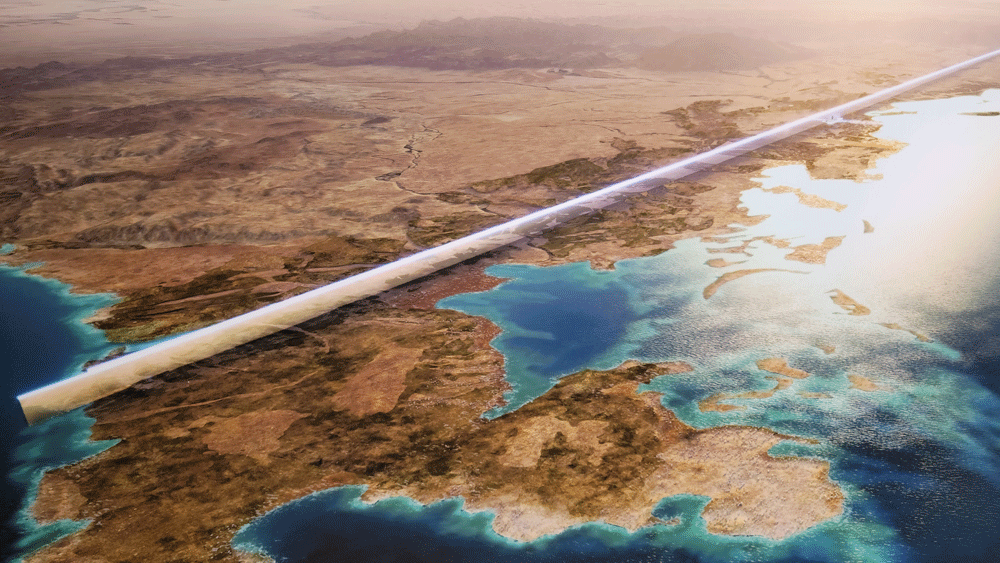
It is hard these days to escape the influence of Saudi Arabia’s gigaprojects. Residents and visitors to London, New York and Paris are bombarded by roadside and metro billboards advertising many of them. One of the UK capital’s biggest malls even has one of the world’s largest LCD screens displaying images of Neom and its key component, The Line.
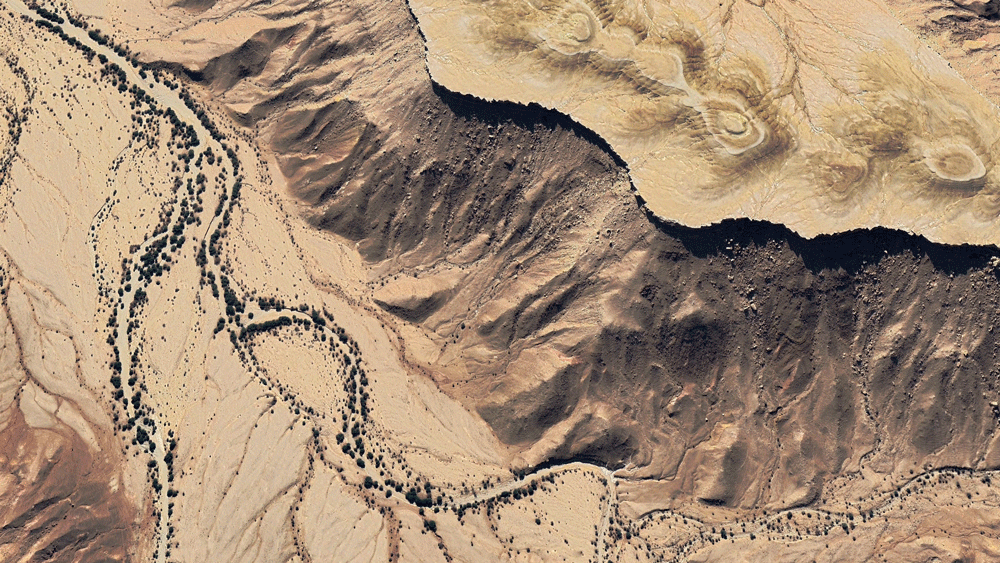
In the digital space, social media sites TikTok and Instagram are filled with film reels on the kingdom’s various developments. Teenagers globally talk excitedly about some of the projects and the futuristic visions they provide.
To this extent, there is no doubt that Saudi Arabia has successfully instilled its gigaprojects message around the world, particularly among younger generations.
Yet despite the hype, the kingdom has arguably to date failed to meet many of its initial objectives on its massive capital expenditure drive. While many people globally talk enthusiastically about it, there is still little progress in attracting foreign investment into the programme. There are multiple reasons put forward for why this has been the case, but all of them eventually return to Saudi Arabia’s inability to properly communicate its gigaprojects vision from the start.
The initial gigaprojects were first made public with grand fanfare in 2017, a year after the launch of the Saudi 2030 Vision. Crown Prince Mohammed Bin Salman Al-Saud himself announced Neom at the Future Investment Forum in October that year, just a few months after the announcements of the Red Sea and Qiddiya schemes.
But the projects lacked detail from the beginning. In many instances, the first iterations of their websites provided only vague information on what they were, what they would eventually be, and, in some cases, even where they would be located.
The only consistent messaging was their ultimate size – an almost unfathomably large $500bn in the case of Neom – and a link to the Saudi Vision and its 2030 completion date.
In hindsight, the lack of detail was due to the fact that their masterplans had either not been completed or approved, which meant that specific project elements could not be publicised. For example, the Red Sea project was first announced in mid-2017, but it was not until early 2019 that its masterplan was approved and more details could be revealed.
“In retrospect, we announced ourselves too early,” says one of the dozens of communications professionals who have worked at gigaproject companies to whom MEED has spoken over the past 18 months. “By being overeager with the initial announcement of huge numbers for total investment, we were hamstrung by not being able to follow up with more details on how this investment was comprised.”
As more gigaprojects were announced over time, the picture became even more confusing as the market struggled to grasp what they entailed. A steady drip of announcements on key elements of each project complicated the picture, as did some core project components that were quietly dropped.
A lack of clarity even extended to the phrase ‘gigaproject’ itself. Because there is no standard definition of the term and its usage with regard to large projects in Saudi Arabia only really began in earnest in 2018, the market and public as a whole conflated various projects under the catchall ‘gigaprojects’ tag.
Defining ‘gigaprojects’
Officially the Public Investment Fund (PIF) describes only five of its developments – Neom, Qiddiya, the Red Sea, Roshn and Diriyah – as gigaprojects, with the latter promoted to the label in 2022.
The sovereign wealth fund says the gigaprojects “are designed to stimulate the economy and their benefits are expected to expand significantly beyond the real estate and infrastructure sectors, helping to diversify the economy away from oil, especially given their sheer scale”.
However, the same could be said of other PIF project subsidiaries like New Murabba, Jeddah Central and King Salman International airport, which are arguably as large or even larger than some of the official gigaprojects, and with the same diversification benefits.
As a result, when people speak of ‘gigaprojects’, they often refer to the plethora of large-scale PIF developments, as well as those not directly under it but of a similar size such as King Salman Park and Riyadh Sports Boulevard.
Combined with this ambiguity around definition and scope were statements or announcements of ambition that would prove difficult, if not impossible, to achieve.
For example, on their launches in 2017, the Red Sea Project had a first phase completion date of late 2022, while Qiddiya said it planned to open in 2023, targets which both subsequently have missed.
Perhaps the most self-evident miss of all was The Line, which, in its 2021 announcement, claimed to target a population of 1.5 million by 2030. In early 2024, it confirmed that its plans had been scaled back to just a fraction of its original 170-kilometre length and that its first phase would accommodate only 80,000 people.
Seasoned observers of the regional projects market were unsurprised that completion targets were not met. The sheer size of the projects alone in a market that did not have experience in delivering at that scale meant that the timeframes were all but impossible to achieve on time.
“We made a mistake at the beginning by outlining the full scale of The Line up front and did not make clear it was a decades-long project,” says one communication professional who worked on the project at launch.
“It’s clearly a long-term vision, but we set ourselves up to fail by using numbers like the 9 million population target and total length that could never be hit in the immediate future. Now, it looks like they are backtracking by reducing the first phase to only four of five modules as reality takes hold.”
In fairness, Neom itself never attached a timeframe to The Line and claims that the initial official numbers are still its long-term objectives.
“The Line is like Marmite; you either love it or hate it,” says one senior Neom executive, referring to the English malt-based paste that is famous for being liked or detested in equal measure.
“Even with its first phase scope, we are still looking at billions of dollars of construction investment and a hugely ambitious engineering challenge. You also have to remember that it is not for the older generation today. It’s geared toward the younger generation of tomorrow. They will be the ones living and working there, not us.”
Regardless, the perceived scale down and the lack of clarity around many of the gigaprojects enabled the international media to control the narrative around the programme, Neom in particular. This narrative was invariably negative, with a stream of reports criticising the programme, and provided additional ammunition when The Line clarified the scale of its first phase.
“Our unwillingness to provide concrete details since launch, reluctance to reveal details of Neom as a whole and lack of engagement with the media, especially the international press, created an information vacuum that newspapers were more than willing to fill with their own conjecture and rumour,” says the former The Line communications professional. “Basically, we set ourselves up to fail in our messaging.”
Managing expectations
All this matters because the gigaprojects programme is predicated on attracting foreign and domestic private sector investment to help fund its development. But to date, there have been very few takers, barring the notable exception of Air Products’ $9bn green hydrogen plant at Neom.
There are many opinions on why this is the case, but the lack of clarity on the programme, what the projects stand for, and what they involve has no doubt been a factor. For many, especially outside the region, they remain an abstract concept even if work on the ground continues apace.
This is particularly concerning as budget pressures continue to mount and there are few signs of private investment looking at the gigaprojects in a different light.
Recent developments suggest that the gigaproject developers recognise this and are adopting a new approach in their efforts to attract investment. There has been a noticeable change in their appetite to discuss their ambitions, invite media and banks to project sites, and generally be more forthcoming on their long-term plans.
In April 2024, Neom hosted more than 50 financial investors on-site to highlight overall progress. In December 2023, Diriyah launched its Bashayer event, which focused on unveiling its projects, and developers such as Jeddah Central and New Murabba have upped their presence at various local and international exhibitions and events. Across the board, there have been noticeable improvements to project websites, outlining more fully what each gigaproject involves.
“It’s simple, we need investment,” says another communications professional at one of the gigaprojects. “If we don’t begin to be more open, it will never happen.”
There is still some way to go, however. Clarity on specific future elements of some of the gigaprojects remains obscure, with announcements of extensive future expansion plans without much in the way of definition, details or timeframes, the absence of which will not provide investors much encouragement.
And although there has been some success with the project companies raising bank finance, question marks remain over the gigaproject programme’s ability to complete all its plans.
But based on the premise that bad news is better than no news at all, the gigaprojects have already achieved part of their goals. As one PIF executive says: “Whether it’s positive or negative coverage, Saudi Arabia is being talked about and is increasingly in the public consciousness. And in that regard, we’ve already achieved some of the gigaprojects’ objectives.”
You might also like...
Egypt plans $27bn Cairo mixed-use project
20 April 2026
A MEED Subscription...
Subscribe or upgrade your current MEED.com package to support your strategic planning with the MENA region’s best source of business information. Proceed to our online shop below to find out more about the features in each package.
Take advantage of our introductory offers below for new subscribers and purchase your access today! If you are an existing client, please reach out to your account manager.