


Governments across the region are looking to improve healthcare delivery, with $17bn of hospital projects under construction. Saudi Arabia is the most active market
With governments striving to improve the provision of healthcare services, there is a boom in hospital construction in the Middle East. At present, there are $17bn of hospital projects under execution in the region, with a further $14.5bn due for delivery by 2016, according to regional projects tracker MEED Projects.
The most active market is Saudi Arabia, which has $4.6bn of projects under construction and another $11.4bn planned. Kuwait and Iraq are also emerging as important markets for hospital build and Oman is set to follow.
Leading market
Saudi Arabia is increasing investment in hospitals to ensure adequate access to healthcare facilities across the kingdom. At present, residents in rural areas have to travel to Riyadh for specialised treatment and there is an acute lack of community hospitals. Key to addressing this shortage is the construction of five medical cities around the country at a cost of SR16bn ($4.2bn). The US’ Hill International is providing project management services for two of the planned medical cities.
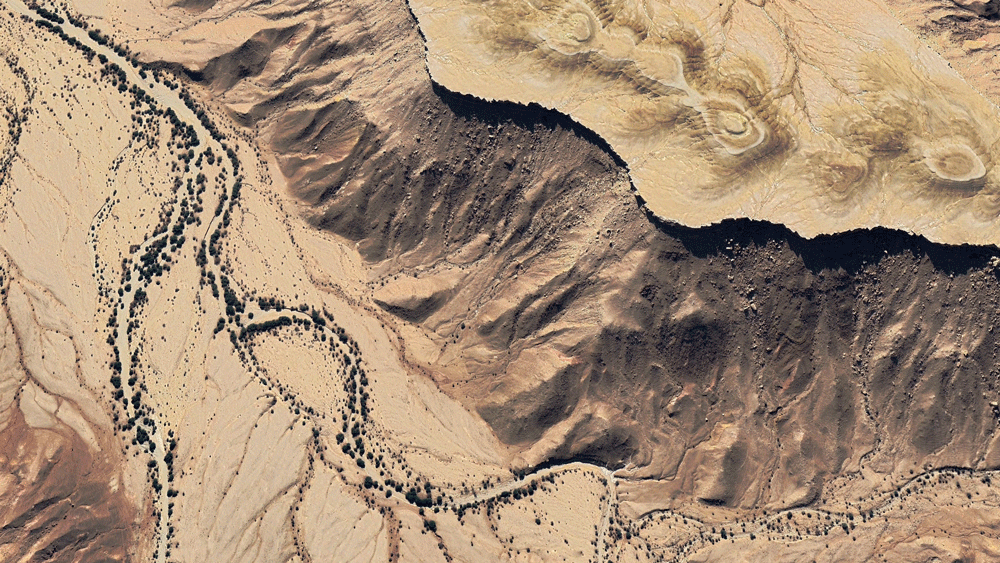
Key to addressing the shortage [of health facilities in Saudi Arabia] is the construction of five medical cities
The estimated $1.1bn King Faisal Medical City is being built to serve the southern province and will have a 1,350-bed capacity, while the Prince Mohammed bin Abdulaziz Medical City will have 1,000 beds and will serve the northern region. For the other projects, the US’ Aecom was awarded a $27.9m contract in July to provide architecture, engineering design and production services for the 1,500-bed King Khalid Medical City to be built near Damman. King Abdullah Medical City in Mecca meanwhile, will comprise three hospitals and 10 medical centres with a total of 1,350 beds. A new 500-bed medical city will also be built in Al-Jouf and the existing King Fahad Medical City in Riyadh is to be expanded. In addition to this, more than 130 hospitals are under construction with a combined capacity of about 25,000 beds.
Having not built a hospital in more than 20 years, Kuwait is making good progress with plans to construct nine hospitals by 2016. The Public Works Ministry has invited prequalified contractors to submit bids by 23 September for the contracts to build three facilities: Al-Razi Hospital, the Pediatric Hospital and IBN SINA Hospital. The schemes are worth a combined $1.5bn. This followed an earlier invitation for bids by 16 September for the construction of a 600-bed maternity hospital in the Al-Sabah district of Kuwait. The Public Works Ministry is already overseeing the construction of the $1.1bn Jaber al-Ahmed al-Sabah Hospital in Surra, a district in Kuwait City. A joint venture of the Kuwait Arab Contractors Company and Egypt’s Arab Contractors (Osman Ahmed Osman & Company) was awarded the main construction contract for the 1,050-bed hospital in late 2009. The hospital is scheduled for completion in December 2013.
Kuwait’s Health Ministry is also undertaking a programme to expand nine existing hospitals. In April, it awarded a KD98.1m ($347m) contract to the local Associated Construction Company for the main construction package on the project to expand the Al-Amiri Hospital. In June, it approved the award of an estimated KD173m contract to the local Alghanim International General Trading & Contracting to expand the Kuwait Cancer Centre. In total, there are $7.3bn of healthcare projects planned or under way in Kuwait.
As Iraq’s reconstruction gets under way, investment is being poured in to its healthcare system, with $2.7bn of hospital projects under way and $2bn more planned. In April, Iraq’s Higher Education & Scientific Research Ministry awarded a $5.2m, three-year contract to Hill International to provide design and construction management for a 600-bed teaching hospital in Baghdad. In June 2010, the Turkish firm Acarsan began the construction of five hospitals in Iraq, which are due to be handed over to the Health Ministry this year. The hospitals, located throughout the country, each have a capacity of 400 beds. Denmark’s Delphi-Gruppen is financing and building four hospitals, at Halabja and Koya, in the northern Kurdistan region, and Baiji and Tikrit. The Baiji hospital will have 150 beds, while the others will have 300 each. They are due for completion in 2017.
Oman hopsital schemes
Having focused attention in recent years on developing primary healthcare services, Oman is now preparing to launch several hospital projects. Muscat’s eighth five-year national health plan, which was ratified on 1 January 2011, gave the Health Ministry the go-ahead to build two new regional referral hospitals and several smaller facilities.
The referral centres will be built in Muscat and Salalah. The estimated cost of the Muscat facility is RO140m ($364m), while that in Salalah is RO48m. The two hospitals will operate a combined 1,200 beds. The spending plan also includes the construction of new hospitals at Al-Suwaiq, Mahout, Sinaw, Dhalkut and Muzyunah, at a total investment of RO55.5m. In addition, RO10m has been allocated to upgrade the Samail hospital, along with RO8m for the construction of new health centres in Oman.
In numbers
$4.6bn: Value of hospital schemes under construction in Saudi Arabia
$11.4bn: Value of hospital schemes in the planning stage in Saudi Arabia
Source: MEED Projects
You might also like...
Saudi Arabia plans Mecca airport project
02 April 2026

Adnoc’s XRG and OMV establish chemicals giant
02 April 2026


A MEED Subscription...
Subscribe or upgrade your current MEED.com package to support your strategic planning with the MENA region’s best source of business information. Proceed to our online shop below to find out more about the features in each package.
Take advantage of our introductory offers below for new subscribers and purchase your access today! If you are an existing client, please reach out to your account manager.