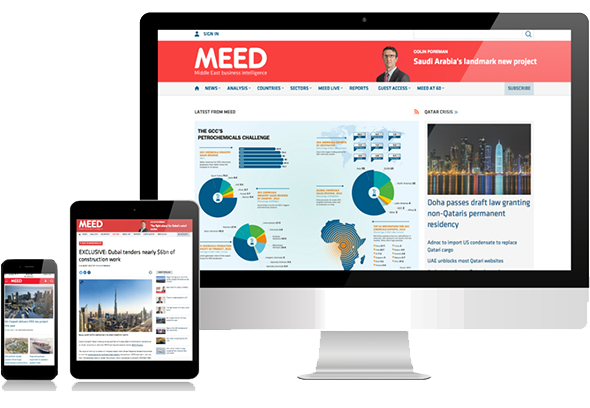




Latest report from MEED and Oracle Construction and Engineering discusses why digitalisation is integral to the delivery of the region’s strategic projects

With some $4.2tn of capital projects planned or underway across the Middle East and North Africa (Mena), there is no doubting the scale of the ambition in the region.
National strategies such as Saudi Arabia’s Vision 2030, UAE Centennial 2071, and Egypt Vision 2030 are providing road maps to transform outmoded, state-centric economies into dynamic, competitive markets that will meet the needs and expectations of growing populations.

And while the details of the visions vary from country to country, the central pillars are the same: improving the quality of life, economic diversification, delivering sustainable growth and increasing inward investment.
To achieve the objectives of the national visions, governments are prioritising the development of transport & logistics infrastructure, renewable energy, oil & gas facilities, and ultra-fast broadband networks, as well as social infrastructure and water projects.
But simply delivering vast engineering and construction projects is no longer enough. The changing expectations of people and governments are placing new demands on project delivery teams.
Three factors are changing the needs of the region’s project sponsors. First, weakening government finances as a result of population growth and long-term uncertainty over oil revenues mean that projects must be delivered more efficiently without overruns on time and cost.
Second is the demand to decarbonise economies and eliminate greenhouse gas (GHG) emissions in order to limit the impact of climate change.
The third change factor is the need to increase the volume of local content in projects. This means developing local supply chains for materials, and investing in the development of local staff.
The key enabler that cuts across all of these requirements is data. Harnessing digital data through the life cycle of projects will improve efficiency in project construction and operations, and help track and reduce the carbon footprint of a project.
 Secure, common data platforms can increase collaboration between project parties and help eliminate waste. And investment in the development of a generation of data scientists, along with data-ready project managers, designers and engineers will accelerate localisation.
Delivering digital transformation is not easy, however. Aside from the need to invest in new technology and remodel traditional practices, enhanced regulations and governance are required to ensure data quality and security.
But the biggest challenge of all is changing mindsets. From the most senior executives at the biggest clients, to junior employees at the smallest subcontractor, everybody must be ready to do things differently.
It will not be easy. But, inspired by the ambitions of the national visions, there is nowhere in the world that is better placed to deliver transformation.
Data Driven Visions looks at the challenges and opportunities facing project stakeholders in the Middle East, as they turn to digitalisation and data-driven decisions to improve efficiency and productivity.
Featuring insights from industry experts including Oracle, Mott MacDonald, Metito, Acciona, Tatweer Building Company and SNC-Lavalin, the report seeks to highlight the role of technology in achieving the long-term ambitions of the region.
You might also like...

Bidders get more time for Jebel Ali sewage EPC contract
29 April 2026

UAE’s departure from Opec marks a tectonic shift
29 April 2026
Procurement advances for Jeddah Metro project
29 April 2026
Discipline required in fast-changing construction market
29 April 2026



A MEED Subscription...
Subscribe or upgrade your current MEED.com package to support your strategic planning with the MENA region’s best source of business information. Proceed to our online shop below to find out more about the features in each package.
Take advantage of our introductory offers below for new subscribers and purchase your access today! If you are an existing client, please reach out to your account manager.