


The regions political compass has shifted over the past 12 months
During the 29-year rule of former president Hosni Mubarak, Egypt historically maintained a neutral position on regional foreign policy. That position allowed Cairo to hedge its regional and international support, often claiming to be mediator for regional conflicts.Despite the success of this position, the make-up of the region has changed since the uprisings in 2011. New challenges face Cairo as it looks to reconceptualise its foreign policy amid increased tensions between Riyadh and Tehran, and Moscow and Washington. Senior analyst at UK-based risk management firm Other Solutions, Ahmed Ghoneim, breaks down the key components making up Egypts current regional and international position.
Egypt-Saudi Arabia
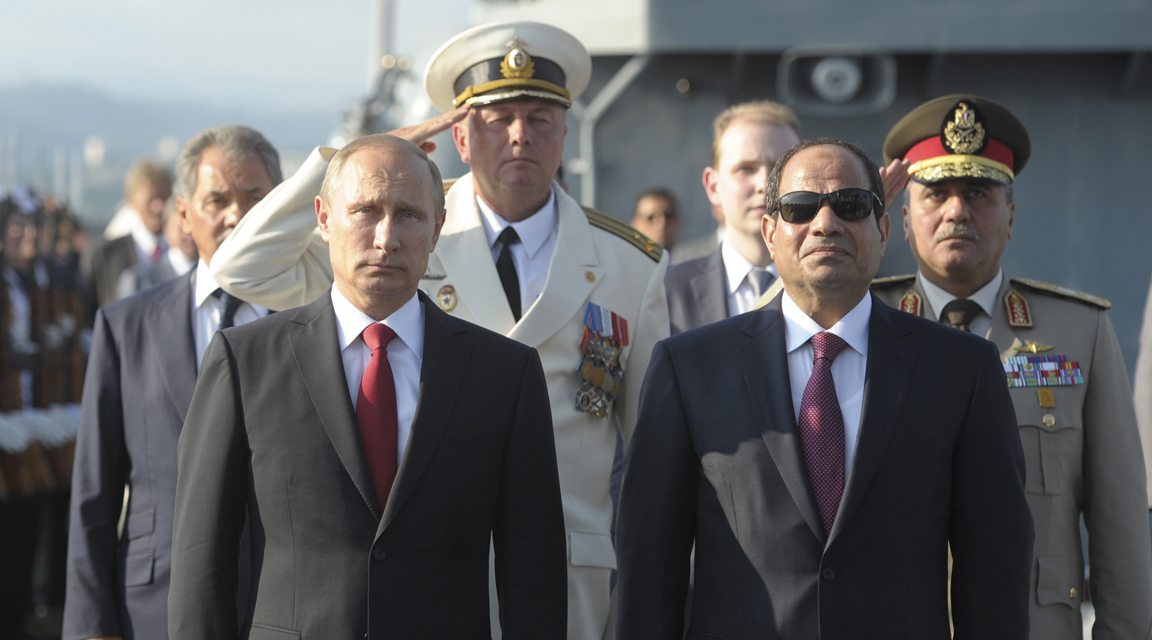
Despite the kingdoms endorsement of the military establishment after the removal of Mohammed Morsi and the Muslim Brotherhood, tensions between Cairo and Riyadh have started to appear specifically in both nations foreign policy agenda. Starting from the voice recording leaked last year when then Field Marshal Sisi essentially mocked the plethora of money his Gulf partners possess by stating They have money like rice; rifts between Saudi Arabia and Egypt became more distinct. Adding more fuel to the fire during an Arab league summit in April 2015 Egyptian President Abdul Fattah al-Sisi asked for a letter written by Russian President Vladimir Putin to be read out, drawing the ire of the then Saudi Foreign Minister Saud al-Faisal, who lashed out against Russia.
The Syrian opposition was also not invited to the summit hosted in Sharm al-sheikh which may also be interpreted as an attempt by Egypt to further court Moscow. Both Egyptian and Saudi diplomats reassured the public that relations remained strong and that media coverage of diverging interests between the two Arab powers was mere speculation. However signs of frustration and tension after the release of the recordings started to show amidst the Yemen crisis, where Egypt has not been an insider in terms of Gulf Cooperation Council talks
Egypt - Russia
Egyptian relations with Russia are an integral point to perceive the lack of foreign policy consensus between Cairo and Riyadh particularly in the Syrian theatre. After 2013 and Washingtons short-lived disagreement with Cairo surrounding the supply of a dozen F-16 aircraft; Al-Sisi started diversifying the countrys sources and sought out different alliances. Egypt purchased Rafaele jets from France last year and it has been rumoured that Russia would start to supply MiG-29M/M2 fighters to Egypt in 2016. In total the deal includes more than 50 fighters whilst the delivery should be completed by 2020. This signed contract is the largest contract in the history of military-technical cooperation in the post-Soviet period. However contrary to what some observers have stated, this does not represent a revival of Nasserism or an escape from the shadows of Washington but rather a pragmatic move by the Al-Sisi administration.
It is noteworthy that Egypt-Russia relations have not reached the same heights as during the Nasserite period but are definitely getting warmer as events unfold. It is likely that Cairo by diversifying its sources of arms and developing closer relations with Moscow; it will in turn entice a reaction by the White house which would fear losing a key strategic partner in the region. The recent visit of Egypts foreign minister Sameh Shoukry to Washington arguably reflected US concerns over Egypt-Russia relations. During the visit John Kerry characterised Egypt as a leader of the Arab world and highlighted the need for the two countries to maintain their close relationship to address the enveloping crises in the Middle East region. More importantly the Obama administrations budget proposal (on 9 February) that seeks to roll back restrictions Congress has placed on foreign aid to Egypts government and the sale of crowd control weapons to emerging democracies, speaks volumes on the success of Al-Sisis strategy.
Moreover, Egypt, Jordan and the UAE view Russias role in Syria in a different light than Saudi Arabia. Egypt on its part views most, if not all Syrian rebels as terrorist elements not better than the Islamic State and the Muslim brotherhood. Thus, Russia current campaign works in Egypts favour by eliminating groups that could become a problem to Cairo in the future. Bashar al-Assad himself has previously stated that communication between Syrian and Egyptian intelligence services did not stop even during the short-lived Morsi era. The reality is that Al-Sisi and Assad represent the same rhetoric of totalitarian nationalist governments that view the tide of the Arab spring as a conspiracy that has only contributed to the proliferation of terrorism and militancy in the region. Also, working against Turkish and Qatari interests in Syria is another bi-product or benefit of supporting Russias ongoing military campaign. Saudi Arabia on the other hand sees the Assad-Hezbollah-Iran-Russia axis as a severe threat to its regional influence and wholeheartedly opposes Russias intervention and support of al-Assads regime and Tehran.
In this way it has become clear that the Syrian crisis changed the rules of the game as now the enemy of my friend is not necessarily my enemy. In other words the changing dynamics of the Syrian conflict particularly after the Russian intervention have split alliances formed during the start of the Arab spring.
Saudi Arabia - Muslim Brotherhood
Saudi Arabia had deemed any political affiliation with the Muslim brotherhood as an act of terrorism in 2013. Cairo was assured by Saudi Arabia that it has its full support in it fight against the Ikhwan (Brotherhood). However after visits from Hamas, the Tunisian al-Nahda party, and the Yemeni al-Islah party; talks of the kingdoms détente period with the brotherhood are not misplaced. This is not a stab in the back to Egypt, or even a tit-for-tat affair, however Riyadhs policies do need the support of the Brotherhood. The objective of creating a Sunni coalition that would resist Iranian or Shia expansion in the region would be unachievable without the support of the largest and most organised network of Sunni Islamists across the Middle East.
In Yemen for example, Al-Islah is perhaps the strongest force fighting alongside the coalition against the Iranian-funded Houthi rebels. This is not the first time Saudi Arabia has worked with the Brotherhood, in the 1950s and 1960s the kingdom became a place of refuge for key figures from the Muslim Brotherhood who were being targeted by Nasser in Egypt, and Baathists in Syria and Iraq. Also during the Soviet invasion of Afghanistan in 1979, the Kingdom and the Brotherhood upheld a united front to export US-sponsored Mujahedeen to fight the invasion.
In this case Saudi Arabia has chosen to give weight to the Brotherhood to contain Tehrans influence and eliminate the threat of Iranian exported democraticstyle Islamic revolution albeit frustrating their friends in Cairo.
Arab force
The realisation of an Arab NATO is an unrealistic project that does not have an appropriate framework of implementation. Billions of aid and investments sent to Egypt by Saudi and its Gulf neighbours were understood by some as a means to preserve Egypts military and ensure its support in the event of war. However as in 1990 when Egypts forces liberated Kuwait from Sadaam Hussein, the Arabs did not act alone but rather under the umbrella of US instructions and promises (Egypt was then promised to be relieved of half its foreign debt).
Today a coalition would largely need to depend on Egypts armed forces that are by far the largest, most equipped and experienced from its Arab counterparts. However, Egypts army is not modernized to the point that it would be able to respond to multiple threats across the Middle East. Egypts current struggle to contain the Sinai-based insurgency that has spilled over into the countrys mainland and tourist hubs is sufficient evidence of that. In reality despite the affordance of gulf funding and efforts to revive a sense of panArab unity, Arab countries have too many differences to be able to operate an effective force such as NATO.
Moreover Cairo is not seeking confrontation with Iran and would rather aim to keep its neutral stance in regional affairs to prosper more trade partnerships and good diplomatic relations with Tehran. It is to be mentioned that Cairo is also not adamant about creating a pan-Sunni force that would involve any Turkish involvement as hostility between the two nations remains high.
You might also like...



A MEED Subscription...
Subscribe or upgrade your current MEED.com package to support your strategic planning with the MENA region’s best source of business information. Proceed to our online shop below to find out more about the features in each package.
Take advantage of our introductory offers below for new subscribers and purchase your access today! If you are an existing client, please reach out to your account manager.