

Oil major’s move has puzzled observers and angered many in Baghdad
US oil major ExxonMobil has signed a raft of oil exploration and production blocks with the semi-autonomous Kurdistan Regional Government (KRG) prompting threats of being blacklisted by members of the federal government in Baghdad.
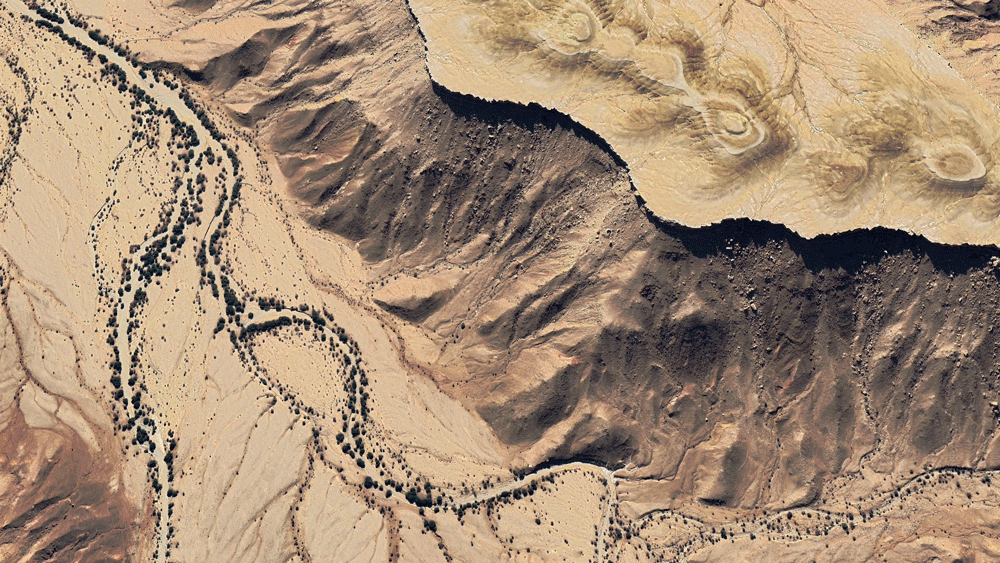
Six blocks were signed in northern Iraq on 18 October. The signings were confirmed by Ashti Hawrami, natural resources minister at a conference in Irbil on 13 November.
| ExxonMobil’s exploration and production blocks in Kurdistan | |
|---|---|
| Block name | Location |
| Al-Qush | West of Shaikan block, operated by Gulf Keystone (UK) |
| Baeshiqa | South of Ain Sifni block, operated by Hunt Oil (US) |
| Pirmam | North of Mala Omar block, operated by OMV (Hungary) |
| Betwata | East of Harir block, operated by Marathon Oil (US); south of Shakrok, operated by Hess (US) |
| Qara-Hanjeer | South of Chemchemal gas field, operated by Dana Gas (UAE) |
| Unnamed | North of Arbat, operated by Shamaran (Canada), next to Iran border |
| Source: MEED | |
ExxonMobil, considered the largest international oil company in the world is already working on the development of one of Iraq’s most prized assets, the 8.6 billion barrel West Qurna Phase-1 oil field. It has now become the first oil firm already working in the country to ignore the Oil Ministry’s repeated warnings over dealing with the KRG.
Barham Saleh, the KRG’s prime minister, told MEED in an interview in mid-October, just before the contract signing, that “major international companies are becoming interested in the development of Kurdistan’s oil reserves and this is a testament to the fact that we are on the right path, that we are in an economically and legally viable way of developing our oil reserves” (MEED 21:10:11).
ExxonMobil could not be reached for comment.
Baghdad has long held that only the federal government has the authority to sign oil deals with foreign firms and has previously blacklisted companies signing deals with the semi-autonomous Kurdish region. About 40 companies have signed production sharing agreements with the KRG since 2007.
During his time as oil minister, the now Deputy Prime Minister for Energy Hussain al-Shahristani banned any firms that signed deals with the KRG, preventing them from future oil deals in the rest of the country, including the removal of Spain’s Repsol and the US’ Hess from Baghdad’s fourth licensing round, planned for March 2012 (MEED 4:9:11).
Statements from Shahristani’s office in response to the news of Exxon’s deals show his stance has not changed with his new position.
ExxonMobil is one of more than 40 firms prequalified to bid for oil and gas exploration blocks in September, but it will now be disqualified. According to some reports, it was warned at least three times of the consequences before the KRG made its dramatic announcement.
According to one source at the Oil Ministry, Exxon will also be removed from its development of the West Qurna-1 field where it holds a 60 per cent stake, along with UK-Dutch Shell Group. It also leads the development of the $12bn common seawater supply facility (CSSF), a giant piece of infrastructure critical to meeting the water injection needs of the southern oil fields. Progress on the scheme has been held up by disagreements over financing and the distribution of costs.
Swaying such a huge firm to its direction is certainly a massive coup for the Kurdish region and its ambition to pursue its own hydrocarbon development. But with such high stakes, Exxon’s move is puzzling and industry experts have speculated over the company’s reasoning.
According to one source close to Exxon, the company “wanted this for a long time and [has been] extremely frustrated with the Oil Ministry for a few years now”.
ExxonMobil and Shell are expected to hit more than 2.8 million barrels a day (b/d) by 2017, from only 279,000 b/d when the contract was signed in late 2009 in return for a fee of $1.9 a barrel. It is currently producing about 375,000 b/d, but sources close to Exxon continue to bemoan the slow pace of contract approval and payment.
“Having such a deal in the KRG coupled with a growing frustration of the pace in Baghdad created a situation whereby Exxon had nothing to lose in playing a game of chicken,” says the source.
Iraq’s cabinet is to meet on 15 November, when it could make a decision on how to deal with the matter.
You might also like...
UAE bank asset quality hinges on property market
03 April 2026
Safety and security matters
03 April 2026
Saudi forecast remains one of growth
03 April 2026
A MEED Subscription...
Subscribe or upgrade your current MEED.com package to support your strategic planning with the MENA region’s best source of business information. Proceed to our online shop below to find out more about the features in each package.
Take advantage of our introductory offers below for new subscribers and purchase your access today! If you are an existing client, please reach out to your account manager.