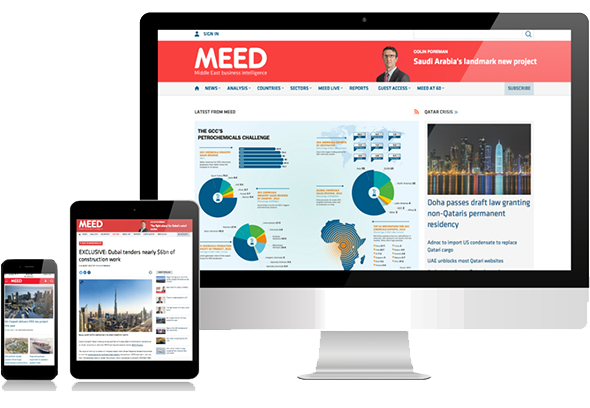




The market has recorded a 40% drop when compared to the same period last year



The value of new awarded contracts in the GCC fell by almost 40% year-on-year in the first five months of 2025 as the market slowed on the back of the pause in Saudi gigaprojects spending and a fall in overall expenditure across the region.
In the period January-May, just $67bn of contracts were awarded across the GCC, a fall of 39% on the $110bn awarded over the same period in 2024, according to regional projects tracker MEED Projects.

Every market, bar Kuwait, experienced a year-on-year decline, with Saudi Arabia seeing the biggest total fall of $34bn. Conversely, the UAE has continued to perform well, almost matching its 2024 number, which has seen it take the lead in total project spending among the six states.
On a sector basis, the largest decreases were in the construction and oil segments, although all segments, save power and petrochemicals, witnessed a decrease in year-on-year contract values.
The sharp reduction in project awards follows two years of record spending as the region invested in large-scale oil and gas projects and the $1tn-plus gigaprojects programme.
However, with the completion of major contract awards on the former and the recalibration and rationalisation of the latter, the market appears to be running out of steam as it struggles to deliver the $600bn-plus amount of work let over the past three years.
The situation has been compounded by the recent fall in oil prices and uncertainty caused by the US’ imposition of global tariffs.

The slowdown in activity levels is most acute in the Saudi gigaprojects programme. After growing exponentially each year up to 2023 to almost $33bn, awards on the programme declined to just under $25bn in 2024 and have collapsed almost completely this year.
Just $4bn of work has been let in the first five months, which on a pro-rata basis would indicate that new gigaproject contracts could be just a quarter of the 2023 figure.
Of the main gigaproject clients, only Diriyah Company and Roshn Group have awarded any major contracts by value in 2025. The much-discussed programme has been hit by cost overruns and a lack of foreign investment, forcing the government to re-evaluate its spending priorities, particularly in light of event-driven projects such as the Riyadh 2030 World Expo and the 2034 Fifa World Cup, which must both be completed on time.

 READ THE JUNE 2025 MEED BUSINESS REVIEW – click here to view PDF
Gulf accelerates AI and data centre strategy; Baghdad keeps up project spending, but fiscal clouds gather; Banking stocks rise despite lower global oil prices
Distributed to senior decision-makers in the region and around the world, the June 2025 edition of MEED Business Review includes:
> AGENDA 1: Data centres churn investments > AGENDA 2: Gulf seizes AI opportunities > MEED TOP 100: Middle East stocks defy lower oil prices > SAUDI ARABIA: Riyadh confirms capital expenditure cuts > INTERVIEW: Mena crucial to Veolia’s growth plan > GULF PROJECTS INDEX: Gulf projects index leaps 4.3% > CONTRACT AWARDS: Region sees third month of weak awards activity > ECONOMIC DATA: Data drives regional projects > OPINION: Dealmaking trumps the Truman Doctrine |
To see previous issues of MEED Business Review, please click here
You might also like...
Opec Fund approves $645m in financing across 14 countries
18 September 2026

ADES completes acquisition of Saipem’s Saudi drilling business
18 September 2026
Circularity shapes sustainable cities of the future
18 September 2026
Bilfinger wins feed contract for Oman marine fuels terminal
18 September 2026
A MEED Subscription...
Subscribe or upgrade your current MEED.com package to support your strategic planning with the MENA region’s best source of business information. Proceed to our online shop below to find out more about the features in each package.
Take advantage of our introductory offers below for new subscribers and purchase your access today! If you are an existing client, please reach out to your account manager.