


Washington’s Iran war has raised uncomfortable questions about regionally hosted US military infrastructure
Iran’s retaliation for Operation Epic Fury extended to five GCC countries within 48 hours of the initial strikes. Bases were hit in Bahrain, Kuwait, Qatar, Saudi Arabia and the UAE – even as their host governments maintained publicly that their territory was not being used in the US operations.
Between Gulf statements and the reality of the conflict lies an emergent sovereignty problem for the governments of the GCC in the extent and nature of the US military presence hosted in the region.
The standing partnership frameworks were not built for and did not anticipate a US war of aggression – without UN authorisation – in which decades of accumulated US military infrastructure would be co-opted against the express wishes of host nations.

The defensive ledger
The US military presence across the GCC is not a wartime deployment; it is the product of numerous agreements signed incrementally since the 1990-91 war with Iraq – each individually defensible, but collectively transformative.
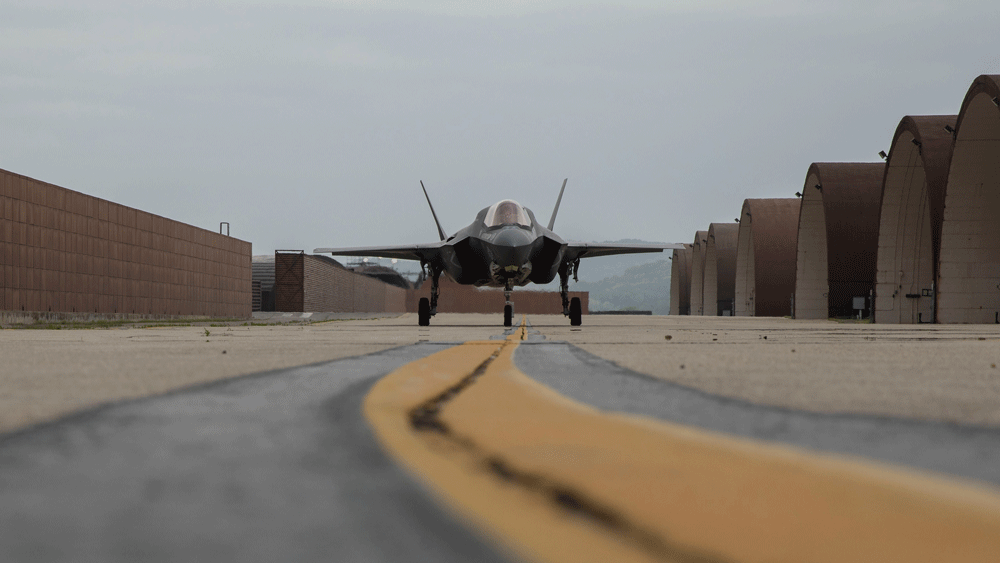
The likes of Al-Udeid Air Base in Qatar, the Fifth Fleet headquarters in Bahrain, Camp Arifjan in Kuwait, Al-Dhafra in the UAE and the Prince Sultan airbase in Saudi Arabia together constitute one of the most extensive overseas military infrastructures the US has ever built outside a formal treaty alliance.
Most of these are host-nation bases with designated US operational compounds and assets within them – with the US presence operating under the various legal carve-outs balancing the host-state’s sovereignty with the need to enable US operational authority.
The bases were sold on a deterrence and defence rationale: that forward US presence would deter regional adversaries, and in the event of conflict provide a measure of protection to the hosts bearing its political cost.
Operation Epic Fury tested that rationale and found it partial, with the presence of these facilities maintained during the war becoming, in one important respect, a reduced one – with these bases acting as targets first and shields only second.
In the days before fighting began, hundreds of US personnel were evacuated from Al-Udeid and Bahrain, with dependents and non-essential staff pulled out under what the Pentagon described as precautionary measures.
The bases then maintained their role as surveillance and command nodes, but with vastly reduced function as forward defensive presences for their hosts – exposing the fundamental vulnerability in the deterrence value that politically justified them.
That reduced defensive function in a time of actual threat has left the hosts of these bases holding onto theoretically strategic assets whose value turns out to be at least partly illusory.
The strategic lock-in
What is also distinct about the GCC’s US military hosting is the depth of the entrenchment.
No one decision locked this in for any country; the US presence came about through a narrowing of options as infrastructure accumulated and dependencies deepened.
The consequence of this was nevertheless that GCC governments found themselves arriving at 28 February with objections that they could not enforce and US forces already in position under their own command authority.
That Washington gave no advance notice of the operation to states it had designated Major Non-NATO Allies or Major Defense Partners was the logical consequence of a situation in which Gulf objections – however sincere – carried no operational weight.
GCC governments have subsequently countered that no territory or airspace was used for offensive operations, but this claim has always been narrower than it appears.
No Gulf air base appears to have served as a launchpad for the strike aircraft that opened Operation Epic Fury on 28 February – that much appears to be accurate. But what followed is not.
US refuelling tanker aircraft were seen at bases on satellite and tracked operating over the Gulf in March in flight patterns that have been widely assessed as consistent with refuelling support for B-1 and B-2 bombers engaged in strike missions.
These Gulf-hosted refuelling aircraft – an estimated 33% of the entire US aerial refuelling fleet at the peak of operations – were force-multipliers in an active targeting chain and the key difference between strike aircraft reaching Iran and not reaching it.
Whether this Gulf logistical hosting and support for US operations constitutes active involvement in operations continues to be litigated in newsrooms and on social media.
However, under customary international law, codified in the 1907 Hague Conventions, neutral states are obliged to prevent their territory from being used to support belligerent operations, with the explicit inclusion of military refuelling and transit.
The reassessment
The clear sense of US entitlement in the conflict and its ramifications has naturally sharpened attention on the thin line between respected and sovereign US partner and mere US host. It has also triggered a serious rethink across Gulf capitals.
The demand that could now emerge from GCC capitals is for a significantly tightened conditional framework in which hosting is contingent on consultation before any US military action that could trigger retaliation on host territory.
We have now also potentially seen the first instance of a Gulf state restricting US operational access – with reports indicating that Saudi Arabia suspended the use of Saudi airspace after Trump announced Operation Project Freedom on 4 May.
This was originally sourced to anonymous US officials, but has since been corroborated far more widely, even as Riyadh has avoided formally confirming the suspension.
Key to the friction was the announcement of Project Freedom via Truth Social and, per reports, without prior consultation with the relevant Gulf states.
The episode is an early hint of what an alteration of the conditions that made the Gulf’s war objections unenforceable on 28 February could look like.
Long before any formal US acceptance of constraints on its operational latitude in the Gulf becomes apparent, an unspoken rebalancing is more likely to come into effect.
The geopolitical mileage of individual GCC members in compelling a superpower conducting a time-critical operation to seek prior permission will likely vary.
The only mechanism that can give any GCC member ironclad leverage is the credible threat of revoking access – as it has been intimated occurred at the outset of Project Freedom – but that option becomes harder to exercise the deeper the dependency runs.
The war has nevertheless laid bare the asymmetry of an alliance built over a generation: the region hosts the infrastructure, risks the retaliation and is liable to bear the economic consequences of conflicts initiated solely at Washington’s prerogative.
Restructuring that imbalanced relationship is now explicitly on the agenda.
You might also like...
Adnoc Refining and Technip Energies sign pair of agreements
22 October 2026

AI data centre boom strains the foundations of construction
22 October 2026
Brent hits $112 a barrel following Saudi oil field attack
22 October 2026





A MEED Subscription...
Subscribe or upgrade your current MEED.com package to support your strategic planning with the MENA region’s best source of business information. Proceed to our online shop below to find out more about the features in each package.
Take advantage of our introductory offers below for new subscribers and purchase your access today! If you are an existing client, please reach out to your account manager.