


Recent disruption has tested the Gulf’s trade routes. It has also strengthened the case for more resilient corridors across ports, roads, rail, logistics zones and strategic industries, write Oliver Wyman’s Andre Martins and Alessandro Tricamo


When disruption hits Gulf trade routes, the first question is whether cargo can still move. The more consequential one is how quickly the system can adapt.

This has been the real test in recent weeks. Exposure to maritime chokepoints remains central, but the more revealing story lies in how ports, customs authorities, road networks, rail operators and logistics companies have responded under pressure.
What has emerged is a practical effort to keep trade moving through rerouting, overland transfer, customs facilitation and a more deliberate use of multimodal options.
Oliver Wyman’s recent analysis of the conflict’s supply-chain impact identified three main transmission channels: energy, critical industrial inputs and transport disruption.
For Gulf economies, the effects run wider still. Delays in imported materials, equipment and consumer goods carry immediate consequences for inventories, project delivery, industrial activity and the pace of development in the region.
Keeping trade moving
The immediate response has been operational from the outset, with a broader corridor logic shaping Saudi Arabia’s strategy.
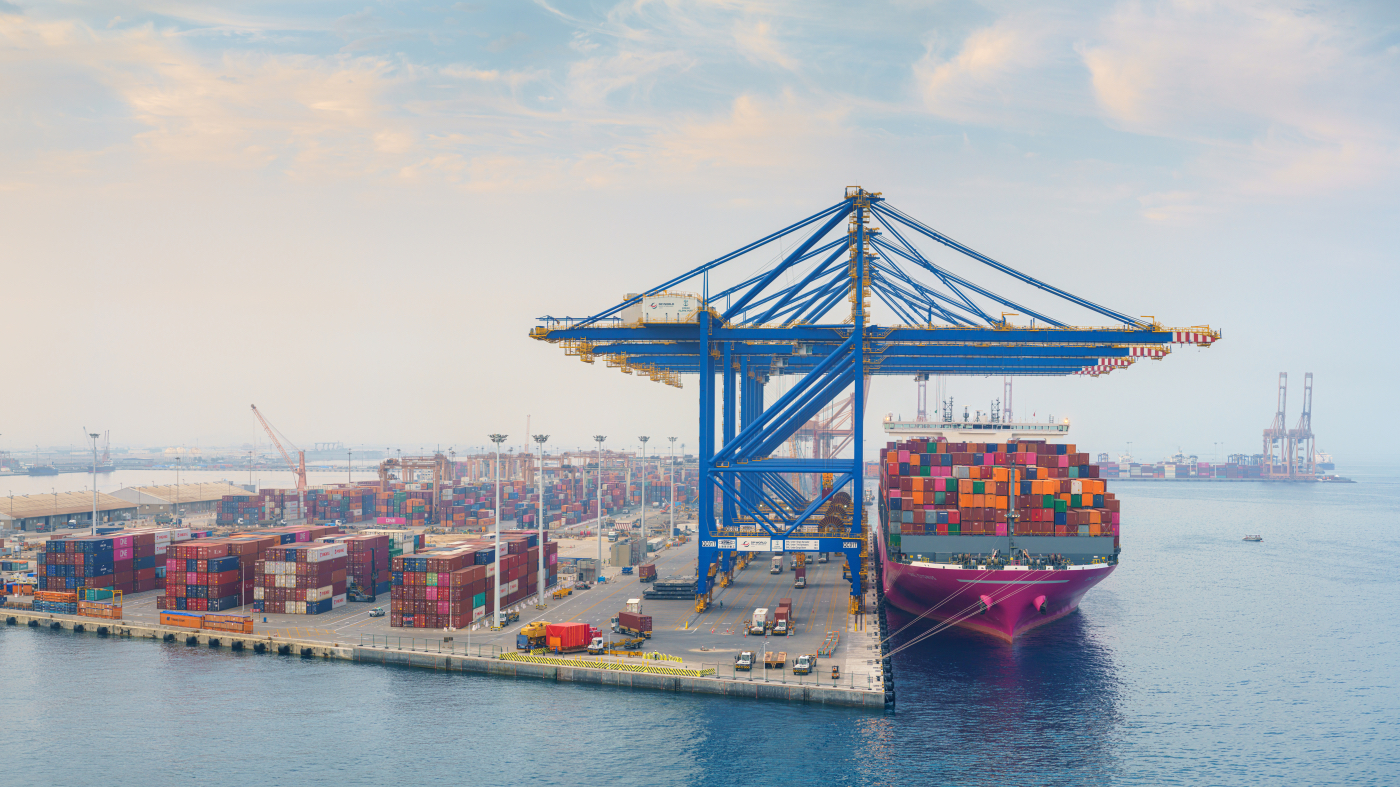
In March, the kingdom launched the Logistics Corridors Initiative to redirect cargo from Eastern Region and GCC ports to Jeddah Islamic Port and other Red Sea gateways. It also launched a rail freight corridor linking the eastern ports to Al-Haditha, strengthening access to Jordan and markets further north.
In the UAE, Dubai Customs introduced a temporary facilitation for cargo bound for the Jebel Ali and Dubai free zones through Khorfakkan and Fujairah. The UAE’s coordination with Oman has added another layer of flexibility. A temporary Green Corridor for diverted shipments via Omani ports has given cargo owners an additional overland route into Dubai.
These are more than tactical adjustments. They show Gulf logistics functioning as a connected system rather than a collection of isolated assets.
East coast ports in the UAE, land links through Oman and road-rail flexibility in Saudi Arabia are beginning to form a more credible resilience architecture for the region. The question now is how far this same logic can be extended across freight, ports, rail and logistics zones.
From workarounds to strategy
That is why this moment matters beyond the current disruption. The lesson is not simply that the Gulf can respond quickly. It is that the region already has the foundations for a broader logistics play if temporary workarounds are turned into durable corridors.
Saudi Arabia will sit at the heart of that next phase. Its geography already gives it a unique logistics role, linking the Gulf to the Red Sea and positioning the kingdom as a natural backbone for east-west flow.
The land bridge has been discussed for years, but recent momentum around design work has brought it back into focus as a strategic project that could tie the kingdom’s two coasts more closely together and strengthen redundancy across regional supply chains.
The wider Saudi logic does not end at the kingdom’s borders. In April, Saudi officials said a feasibility study for a proposed railway link to Turkiye via Jordan and Syria is expected to be completed by the end of 2026. Jordan, Syria and Turkiye have also signed a memorandum to strengthen transport integration, while Jordan and Saudi Arabia have discussed a strategic railway linking the Gulf to the Levant through Jordanian territory.
None of this amounts to an operating corridor today. Even so, it points to a more serious northbound vision than would have seemed unrealistic not long ago.
The same is true to the east. Iraq’s Development Road project, backed by a 2024 memorandum involving Iraq, Turkiye, Qatar and the UAE, is intended to create a land and rail corridor from Al-Faw to Turkiye and onwards to Europe. For the Gulf, this introduces the possibility of an additional route northwards.
The GCC railway network belongs in the same picture. The GCC’s railway authority continues to meet on network development, while cross-border projects are advancing in parallel.
In April, Hafeet Rail announced that the Oman-UAE railway connection project had reached 40% completion, with the line intended to support trade flow; connect ports, industrial zones and logistics hubs; and strengthen supply-chain resilience in both countries.
Transport links alone will not define the next phase. Industrial depth matters just as much. In the UAE, this direction was already visible in Operation 300bn, which aims to raise industry’s contribution to AED300bn ($81.7bn) by 2031, while an additional AED1bn National Industrial Resilience Fund is intended to support vital sectors, strengthen supply chains and accelerate industrial competitiveness.
The wider framing matters. What this episode has revealed is not a departure from the Gulf’s long-term economic direction, but an intensification of it. The same national plans that aim to diversify economies, attract investment, deepen industrial capacity and open new markets are also shaping how the region responds under pressure. Logistics resilience is becoming part of a broader effort to build more productive, better connected and increasingly self-reinforcing economies.
The Gulf’s next logistics phase will therefore be defined by more than bigger ports or faster clearance. Its real advantage will come from building a system that connects ports, roads, rail, inland hubs, logistics zones and strategic industries with greater discipline and purpose.
For Saudi Arabia in particular, the opportunity is larger than crisis response. With the right critical infrastructure – from the Red Sea to the Gulf, and from the kingdom southwards to Oman and the Arabian Sea, and northwards into the Levant and beyond – it can become the backbone of a more resilient regional supply chain.
If that happens, this period will be remembered for more than the strain it placed on regional trade. It will mark the point at which the Gulf began to turn short-term adaptation into long-term strategic advantage.
ABOUT THE AUTHORS
Andre Martins is head of transportation and advance industrials practice, India, Middle East and Africa at Oliver Wyman.
Alessandro Tricamo is partner, surface transportation at Oliver Wyman.
You might also like...

Riyadh looks to reset its regional defence outlook
11 September 2026

Construction begins on Dubai Creek Gardens project
11 September 2026

EGA completes majority stake acquisition in Italian firm
11 September 2026

Consultant wins Dubai Al-Maktoum airport metro link
11 September 2026


A MEED Subscription...
Subscribe or upgrade your current MEED.com package to support your strategic planning with the MENA region’s best source of business information. Proceed to our online shop below to find out more about the features in each package.
Take advantage of our introductory offers below for new subscribers and purchase your access today! If you are an existing client, please reach out to your account manager.