


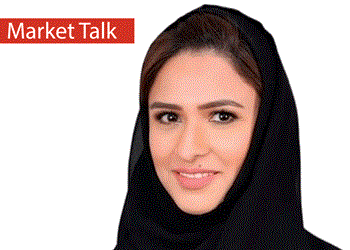
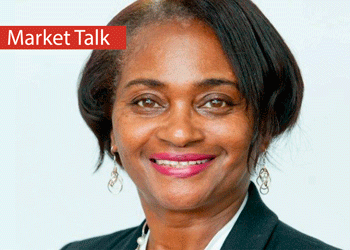
Sheikha Hanadi tells MEED that the region’s rapid growth provides an opportunity for women to take a leading role in business.
The rapidly changing skyline along the Doha corniche is testament to the economic strides Qatar has taken over the past five years. With its vast gas reserves, the Qatari economy is more vibrant than ever. It is experiencing double-digit growth, megaprojects are under way at Ras Laffan and New Doha International Airport, real estate projects are being built in Doha and Lusail, and new sectors such as finance, tourism and education are being developed.
With change comes challenges and opportunities. One woman making the most of the prevailing economic climate is Sheikha Hanadi Nasser bin Khaled al-Thani. A scion of one of Qatar’s leading families and trading groups, the Nasser bin Khaled & Sons Group, of which she is also deputy chief executive officer, she grew up with commerce in her blood and was clearly determined to make a name for herself.
After starting her career as a lecturing assistant at the economics department of Qatar University, she entered the world of business in 1998 when she founded the Qatar Ladies Investment Company. Now known as Amwal, it is one of the oldest women’s wealth funds in the region, and the first investment company to receive a licence from Qatar Central Bank to conduct investment banking, asset management and wealth management in the state.

She followed this up with the 2005 launch of Al-Waab City, a multibillion-dollar real estate project on Salwa road in Doha, covering an area of more than 1.2 million square metres. “In Qatar, we are fortunate enough to have gas reserves so we can choose the sectors in which we want to compete,” says Sheikha Hanadi, who is clearly not afraid of venturing beyond the safety zone of finance and wealth creation.
Her business achievements have already gained many plaudits, including the World Economic Forum’s Young Global Leader in 2005, and several ‘woman of the year’ and ‘CEO of the year’ accolades.
For Sheikha Hanadi, the current phase of economic growth is not only an opportunity for commerce and to build projects for the future, but is also a time to redress the faults of the past. On a more personal level, it is an opportunity for her to show that women can take the lead in business. “The first oil boom changed a lot in the Gulf,” she says. “We developed a sense of entitlement, and women stopped being productive. The latest wave of wealth is the region’s chance to correct its past mistakes, catch up and establish itself as part of the global network.”
Today, the Gulf has more than made up for the economic errors of the past. Doha, which entered the development race behind other regional centres, hopes to avoid some of the development pitfalls experienced by its neighbours. In many ways, this has allowed it to learn from others’ mistakes and take a more measured approach to development. “Qatar has been a late bloomer, and by observing other countries’ experiences it can pick and choose the aspects of development that it wants,” says Sheikha Hanadi.
But managing growth is not a simple task. Inflation is in double-digits, rents have rocketed, and shortages in building materials and human resources threaten to stifle growth. Yet work cannot take place quickly enough. The much-heralded Asian Games, which took place in Doha in 2006, pushed the capital’s infrastructure to the limits, and stressed just how much more development is required.
“Growth has many pros,” says Sheikha Hanadi. “But it also has difficulties. The main difficulty is the shift in the demand and supply curves. There is a gap in the housing market and raw materials, and that is driving inflation.”
A lack of monetary tools to control inflation is another contributing factor. The Qatari riyal remains pegged to the dollar, leaving the central bank hamstrung when it comes to setting interest rates to control growth.
“If you look at the dollar peg, this question has to be answered,” says Sheikha Hanadi. “It is a difficult one. There is no single answer, but we must at least leave options open.”
Inflation is not the only challenge. As the explosion in building activity continues, the economies of the Gulf have begun to exhaust their traditional sources of professional staff, together with skilled and unskilled workers. Labourers from south and east Asia are becoming more reluctant to work for currencies that are losing value, while those that are available are quickly snatched up by the other burgeoning Gulf economies.
Similarly, the local Qatari population is small and lacks much of the experience its economy needs, and for many there is little incentive to participate in the job market. Qatari nationals in the private sector are even rarer, with more than 90 per cent of the local working population employed by the government.
“There is a limited talent pool of Qatari nationals,” says Sheikha Hanadi. “The challenge is to develop them to be aggressive in business without the aspect of entitlement.”
Mutual benefits
Sheikha Hanadi says regional co-operation is the long-term solution to the region’s manpower problems. If people can move around the Gulf looking for work, centres of excellence that attract people working in different sectors will develop, rather than each city trying to develop all sectors by itself.
“It is only natural that the borders of the Gulf merge,” she says. “The first market is labour, and in the coming years we will see increasing levels of specialisation in each economy.”
It is a vision that may already be coming true as the GCC discusses the creation of a unified job market. Such a plan, if implemented, would not be a new phenomenon for the Gulf. In the days before oil, the people of Arabia were nomads travelling across the desert and along the coast looking for employment. Unlike today, women played a leading role in the economy.
“In the pearling age, men went to sea and women were left to run the businesses they left behind,” says Sheikha Hanadi, again emphasising her feeling that women do not go on to fulfil their full potential. “Women need to go back to being productive.”
Despite her successes as a business-woman, Sheikha Hanadi is quick to downplay the challenges that women in the Gulf face. “Being a woman is over-emphasised,” she says. “But I won’t tell you it is easy. It is hard to be a woman in business, whether it is in Denver, New York or Qatar. It is all about juggling things.”
In many ways, the Gulf offers more opportunities for women. It is a rapidly growing economy, and with growth comes opportunities that would otherwise not be there. “One advantage in the Gulf is that there are no glass ceilings, because people are a scarce resource,” says Sheikha Hanadi. “So if you ignore 50 per cent of people, it leaves a big gap.”
Despite the positive outlook for women in business, there is much work still to be done. The irony is that as Qatar’s economy grows, so the need for women to enter the workplace to provide additional income for their families reduces. Qatari families today are among the world’s richest, with gross domestic product per capita higher than practically any other country on earth.
Educational advantage
Women have demonstrated their ability to outperform men in education: 70 per cent of graduates from Qatari universities are female, and a growing number of women pursue masters and doctorate programmes. But the tables have not yet fully turned in the world of business.
“I want to see more women apply the knowledge they have,” says Sheikha Hanadi, acknowledging the gap between the number of women who complete their education and those who actually go into employment. “They should be productive. Degrees are nothing if you do not produce anything with them. A degree is not the main objective; it is the means to greater productivity.”
Despite her optimism for women in business, developing successful business ventures is not an easy task. “Entrepreneurship in the region is difficult,” says Sheikha Hanadi. “I am an entrepreneur and I work in a family business. That is the easy part. Creating something new is still very challenging.”
In future, it could be that women take the lead in entrepreneurship, taking risks that their male counterparts do not dare to take.
Career history
2007 Named Economic Personality of the Year by Qatar Chamber of Commerce and Business Council
2005 Named Young Global Leader by the World Economic Forum
2005 Founded Al-Waab City
1998 Founded Qatar Ladies Investment Company (Amwal). Published research papers on macroeconomic issues in the GCC
University of London Master’s degree in economics
Qatar University Bachelor’s degree in economics
You might also like...


A MEED Subscription...
Subscribe or upgrade your current MEED.com package to support your strategic planning with the MENA region’s best source of business information. Proceed to our online shop below to find out more about the features in each package.
Take advantage of our introductory offers below for new subscribers and purchase your access today! If you are an existing client, please reach out to your account manager.