


Contractors are gaining valuable experience from the regions early tunnelling schemes, and are realising that understanding local conditions is key to successful delivery
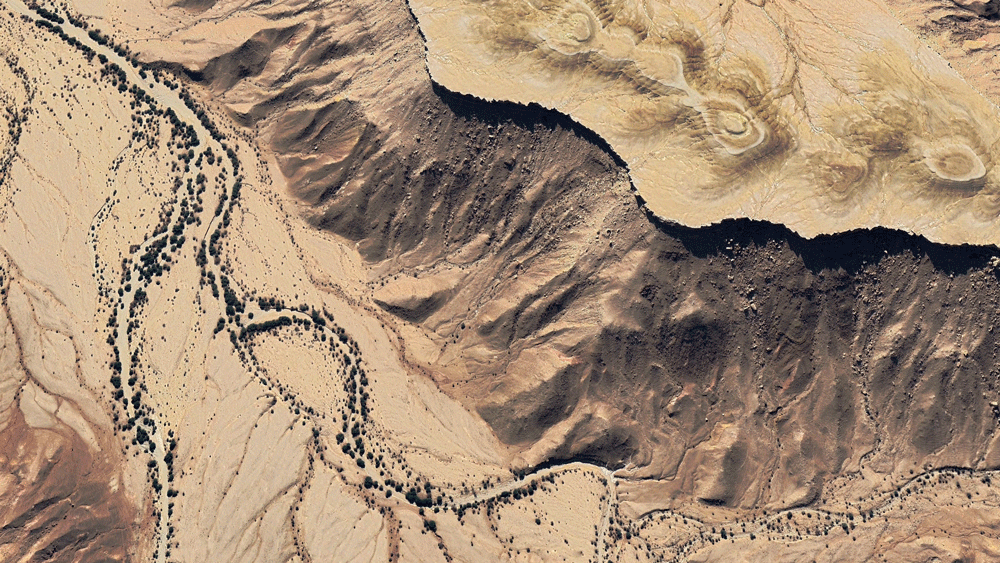
From drilling and blasting through rock in the Hajjar mountains to boring beneath the streets of Dubai and Abu Dhabi with tunnel boring machines (TBMs), the Gulf is developing a comprehensive portfolio of tunnelling experience.
It helps, of course, that tunnelling is an international business and that experience gained in overseas markets can be brought in to support new infrastructure in the region. But like in any construction project, understanding the local conditions is key to successful delivery.
Contractors tell MEED the high groundwater table and the presence of natural voids in the limestone in the region can create very challenging conditions.
Tunnel voids
Voids in tunnels are an absolute nightmare to treat, says a tunnelling manager for an international contractor based in the UAE. Dealing with this usually involves pre-treatment of the ground and grouting ahead of the tunnelling face to ensure that by the time the machine reaches the void, the cavity has been filled. But this can only be achieved if the contractors know the void is there, and that requires extensive ground investigation.
Although clients will carry out ground investigations in the early phases to enable their designers to create the tender documents and identify appropriate tunnelling methods, contract arrangements then require contractors to undertake their own analysis.
Under the prevalent design-and-build arrangement, the risk of unforeseen ground conditions lies with the contractor. So tunnellers will then undertake a second geotechnical investigation, which may need to be carried out in more detail than the original report.
However, contractors say this is the wrong way around, and that a thorough investigation done by the client will ensure all parties can be better prepared once the work begins. Once the construction contract is let it is all a rush and the client wants boring to begin, says a tunnelling director involved in several of the regions biggest schemes. They dont give contractors enough time to do the geotechnical investigation; [for them] it is supposed to be done in five minutes.
Getting the information requires boreholes being drilled along the line of the tunnel to accurately identify the ground conditions. In Riyadh, for example, about 50 borehole rigs are understood to have been used throughout the city to map the underground conditions ahead of the metro project.
Contractors say that regardless of who carries out the work, this remains an item the client will ultimately pay for. The clients pay whether their consultants or the contractor does the [ground investigation], says the tunnelling director. The cost of a borehole rig is the cost of a borehole rig. Do the report and accept it as the geological data of the job. Dont make the contractor go through it all again. The contractor could then start on day one with ground rules and trust it.
The key reason for project owners asking contractors to do their own ground investigation after letting the deal is because the client is seeking to be protected from risk; if the contractor runs into trouble, it cannot blame poor information from the client. But this also means the contractor will include the cost of the ground condition risk in the deal, adding to the price.
Steel anchors
Another ground condition particularly affecting microtunnelling in Dubai and Abu Dhabi involves steel ground anchors used to support the diaphragm walls employed to construct basement parking structures under high-rise buildings.
When you go to a site, you are looking for the nearest high-rise building, whether it has a basement and whether there is a risk of coming across ground anchors, says John Wheeler, general manager at Al-Naboodah Specialist Services, part of the UAEs Al-Naboodah Construction Group. Of course, microtunnelling machines are not designed to cut through these. There have been cases where machines have been stopped by [these anchors], he says. So every job you look at, you have to consider the risks, whether from ground anchors or existing services.
Wheeler says the key to any successful microtunnelling project is risk assessment and points out that even when the method is specified, careful attention must be paid to the surrounding conditions. Unfortunately, a lot of the consultants dont know the technology that well, he says. They put a line on a drawing and say install from A to B by microtunnelling, but it is far too close to an existing service. It may be too shallow for the ground conditions, so there is a very high risk of either heave, where you lift the surface, or you may cause settlement.
A rule of thumb states that the minimum depth should be twice the diameter of the pipe being installed. That alleviates the problem of heave, but when you look at the ground conditions you may need to go deeper to avoid settlement, says Wheeler.
Other advice that experienced contractors have for clients includes the suggestion that service diversions for existing utilities running along the path of major tunnelling projects are relocated as part of an advanced contract. This [service diversion] takes a phenomenal amount of time and we cant do anything until the cables and pipelines are moved, says the tunnelling director. It is part of the scope of works for the main contract, but if it had been done in advance, I could be much more productive.
Bureaucratic delays
One of the reasons why utility diversion contracts, often termed enabling works contracts, can be problematic is because of the large number of stakeholders involved and the time it can take to seek permissions. This is also true when it comes to attaining the go-ahead to construct the shafts that are needed to launch and access the TBMs.
Getting permissions for shafts is difficult in the UAE and even worse in Qatar, says the tunnelling manager, who has worked on tunnelling and microtunnelling projects throughout the world. The location of the shaft will determine which government bodies must be consulted, and even in projects that have the full support of the government, getting the paperwork completed can be very time-consuming.
A critical issue that is increasingly being reported by contractors on the regions tunnelling projects is the high groundwater table prevalent in the region. Although major tunnelling projects are mainly opting to use earth pressure balance machines that can work in saturated ground, shafts and station boxes must remain dry, and this is a challenge.
We try and make stations with diaphragm walls so that you get a dry concrete box, but it takes a lot of time. In Doha, the launch shafts for the TBMs are 300 metres long by 20-30 metres wide, so it is a very big box, says the tunnelling director, explaining that diaphragm walls use a slurry to keep out the water as the reinforced concrete walls are cast.
However, in Doha this would have meant using a huge number of hydromills to build them, which would not have been easy to procure. In the end, everyone took a chance to do it without and ended up with lots of wells around the boxes, which are now pumping water into the sea, says the director.
We have had problems discharging clean water from shafts, says the tunnelling manager. And the local storm drains are too small to take the flows. The municipality doesnt want groundwater going back into the ground because it is contaminated with metals and high salts, so that has been a problem.
Such issues are a feature of coastal cities with high water tables. Again, planning for this from the start can mitigate the issues later, with portable water treatment machines able to remove contamination and construction methods designed to prevent ingress.
Emulating success
When it comes to the management approach, contractors say schemes around the region vary. In Abu Dhabi, for example, the Strategic Tunnel Enhancement Programme sewer project went so well that Qatar adopted the exact same model with the same programme management company, the US CH2M Hill, for its Inner Doha Resewerage Implementation Strategy scheme, and separate contracts for the tunnel, pumping station and lateral connections.
On metro schemes, Riyadhs outsourcing model, where consortiums are responsible for entire lines, has led to a thin layer of management on the client side to oversee this. But on the Doha Metro, the project has been separated into a much greater number of packages, with project managers appointed by the client for each line, as well as a central project management office and a central technical office.
The structure and the number of consultants is much smaller in Riyadh than in Doha, says the tunnelling director. It is interesting to see the difference; it is a much less tense environment in Riyadh and a tense environment is counterproductive. I would advise clients not to be hoodwinked by the jargon of project management offices and project management consultancies as they just end up defending their own position.
Invest in a good consultant, somebody with a lot of common sense, he says, noting that contractors need to be able to discuss technical issues with a client side counterpart or supervisor.
As these projects progress, more lessons emerge, but perhaps the biggest of these is that preparation is everything. The better the preparatory work, the more risk you remove from the project itself, says the tunnelling director. Whether a client, a consultant or a contractor, low risk is better for everyone.
You might also like...

Saudi Arabia's Misk tenders residential package
17 April 2026




A MEED Subscription...
Subscribe or upgrade your current MEED.com package to support your strategic planning with the MENA region’s best source of business information. Proceed to our online shop below to find out more about the features in each package.
Take advantage of our introductory offers below for new subscribers and purchase your access today! If you are an existing client, please reach out to your account manager.