


Cost reduction will be driven by digitisation and the energy transition

Maire Tecnimont is forecasting that, coping with market demands, the operating cost of industrial plants will reduce by up to 30 per cent within 10 years due to increasing digitisation and efficiencies driven by the ongoing energy transition.
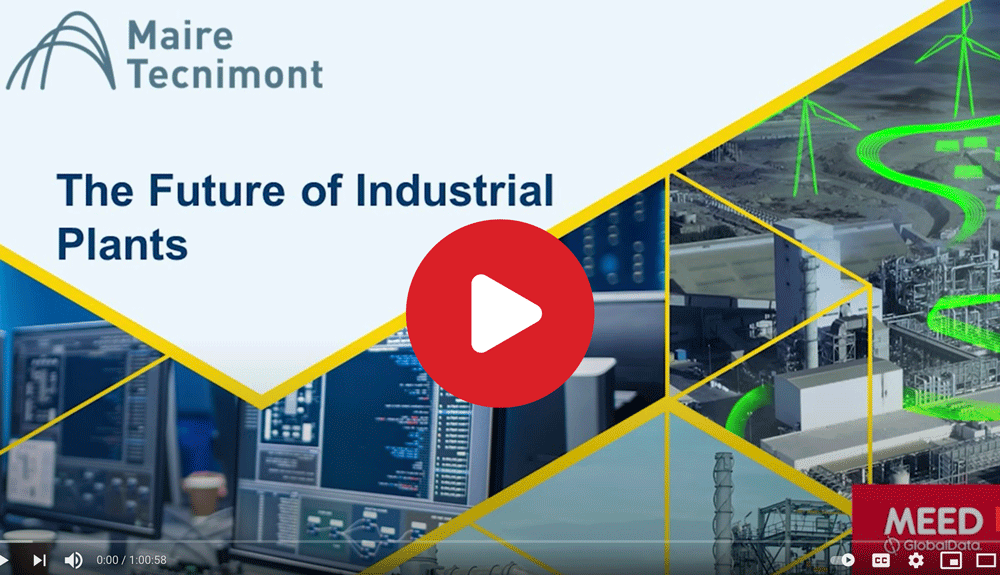
Speaking at a MEED webinar on 15 September, Max Panaro, Maire Tecnimont vice-president for information and communications technology (ICT) and system quality, said the company is targeting digital solutions and services to proactively contribute to achieving this challenging market need.
The Italy-based company is also forecasting that investing in digital technology will contribute to improving gross margins for plant owners by 3-8 per cent.
Panaro said the industrial plants being built in the next 10 years would be “natively digital”, meaning they will have been constructed with applications for technology such as 5G, complex sensors and artificial intelligence in mind from the moment they were conceived.
He also said that these “hyper-connected plants” will be designed with an increased emphasis on reduced emissions and energy efficiency due to the ongoing energy transition.
According to Panaro, digitisation and an emphasis on green technologies are mega-trends that will significantly transform how industrial plants are designed, built and operated.
“All the technological players are committed to a strong reduction in energy utilisation, and we all know that energy utilisation is a cost,” he said. “This is a trend that has to be understood and embraced from the early design phase.”

Design trends
Panaro said that natively digital industrial plants would use artificial intelligence to optimise processes and reduce maintenance costs through predictive maintenance.
“This is something that we have already been applying,” he said. “We have applied this technology in Oman, and we have seen that it can reduce the risk of stopping production, the loss of assets and the cost of unplanned maintenance.”
Maire Tecnimont said that the shift towards natively digital plants would change the relationship between the plant owner, the operator and the engineering, procurement and construction (EPC) contractor.
Panaro said that the shifts in design trends would require EPC contractors to be involved at an earlier stage to collaborate on early design work.
He also said that EPC contractors should remain involved in the project after it becomes operational to assist in optimisation.
“Connecting the dots is what the EPC contractor has always done in the past,” he said. “Now, the EPC contractor has the duty and the privilege of connecting both the physical and digital dots.”
Tech investment
Before the Covid-19 pandemic, the Ireland-based multinational professional services company Accenture surveyed 255 upstream oil and gas companies.
It found that 72 per cent planned to invest more in digital technology, both in the short and long term.
Oil and gas executives said that cybersecurity, cloud and big data analytics were the digital tools that were having the most impact on current business operations.
They also said that they expected artificial intelligence and machine learning to drive more value in the future.
Maire Tecnimont has said that the oil and petrochemicals sector has lagged behind the digitisation seen in retail, banking, entertainment and manufacturing. It gave three main reasons for slow adoption.
One is that legacy platforms in the sector often generate fragmented sets of data in pieces that are hard to assemble into a single coherent overview.
Another is that the distributed nature of the business, which often operates in remote locations, means that it is hard to standardise technology across different sites in several countries.
The third key reason for slow adoption, according to Maire Tecnimont, is a conservative mentality within the sector, where a tendency to rely on “what has always worked” is creating inertia.
The slow adoption of digital transition technologies in the sector has resulted in higher costs and inefficiencies, with productivity falling out of step with increasing project complexity.
According to Maire Tecnimont, companies that go beyond a piecemeal approach to digitisation and reinvent the entire process from start to finish are likely to become market leaders over the long term.

You might also like...

Oman steps up hydrogen plans
08 May 2026


A MEED Subscription...
Subscribe or upgrade your current MEED.com package to support your strategic planning with the MENA region’s best source of business information. Proceed to our online shop below to find out more about the features in each package.
Take advantage of our introductory offers below for new subscribers and purchase your access today! If you are an existing client, please reach out to your account manager.