

Integrated delivery will be key as projects in the kingdom become more complex
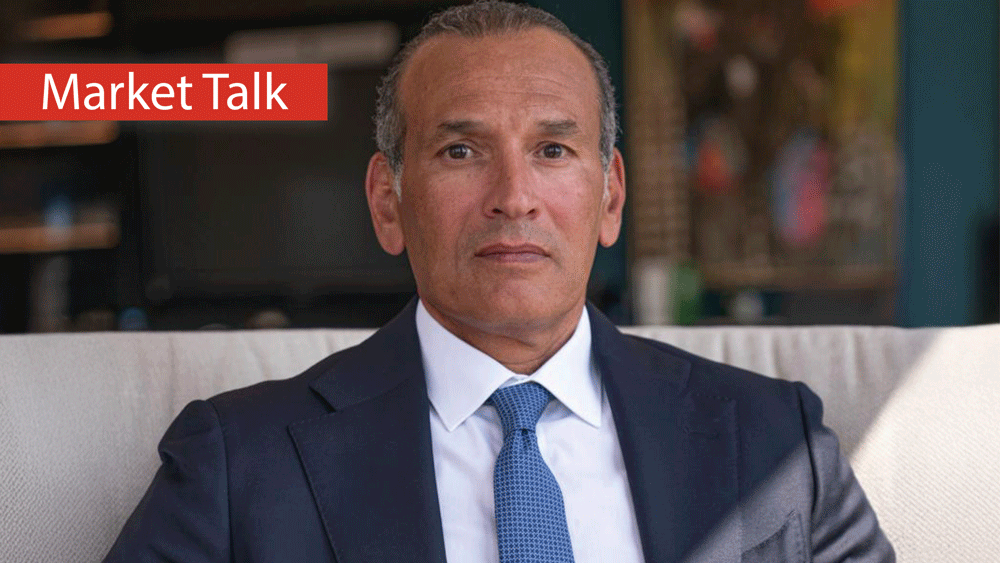
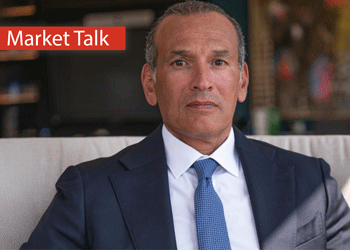
In conversation with Mohamed Mahlab, founder and CEO of Rowad Modern Engineering (Rowad)
 As Saudi Arabia moves deeper into the delivery phase of Vision 2030, how do you see the expectations being placed on contractors and delivery partners changing?
I believe the market is entering a more mature phase, where the focus is shifting towards delivery certainty, execution discipline and measurable outcomes.

Clients increasingly need partners with technical depth, financial capacity, leadership and organisational maturity to manage complexity and deliver with consistency and control.
In Saudi Arabia, the scale and pace of development make this especially important. Contractors must mobilise effectively, manage complex interfaces, anticipate risk and maintain resilient supply chains.
At Rowad, fast-track delivery is one of our established strengths, underpinned by strong leadership, rigorous planning and disciplined execution.
Ultimately, the contractors that will lead the next phase of Vision 2030 will be those that combine technical capability, financial resilience and execution certainty.
Why do you believe traditional, often fragmented approaches to project delivery need to evolve, and what does an integrated delivery model offer clients that conventional approaches may not?
Today’s projects are too complex for fragmented delivery models. When engineering, procurement and construction (EPC) are managed separately, it creates more interfaces, slower decisions and greater execution risk.
At Rowad, we already operate as an EPC contractor, which means we are structured to integrate engineering, procurement and construction under one delivery strategy.
Integrated delivery extends that principle across the wider project team, aligning owners, consultants, contractors and specialists around shared priorities from the outset.
For clients, the value is clear: faster decision-making, earlier risk-visibility, stronger coordination and greater delivery certainty.
Ultimately, it is about moving from fragmented responsibility to integrated accountability.
What needs to change in the relationship between project owners, contractors, specialists and consultants to create greater collaboration, accountability and delivery certainty?
The priority is to build genuine project partnerships around shared objectives, with earlier engagement, clear accountability and faster decision-making across owners, consultants, contractors and specialists.
At Rowad, we bring extensive regional experience while actively seeking partnerships with Saudi contractors, specialists and consultants.
We strongly believe that international capability is most effective when combined with strong local partnerships. Saudi contractors, specialists and consultants bring invaluable market knowledge and local expertise, while international partners can contribute additional technical depth, delivery experience and specialist capability.
When those strengths are brought together effectively, the outcome goes beyond knowledge exchange. It creates greater project certainty, stronger local capability and a more resilient delivery ecosystem for the kingdom.
Saudi Arabia is delivering multiple complex projects simultaneously. How can integrated delivery help address challenges around capacity, capability, risk and the coordination of increasingly complex supply chains?
Saudi Arabia’s project pipeline requires more than individual contractor capability; it requires strong coordination across capacity, specialist expertise, risk and increasingly complex supply chains.
Integrated delivery partners help by bringing the right capabilities together early, identifying gaps before they affect execution, and aligning EPC and specialist packages around one delivery strategy.
The result is better use of capacity, earlier risk visibility, stronger supply-chain coordination and greater certainty in project delivery.
Integrated delivery is not only about improving project execution; it is also about building stronger connections with the markets where we operate. While Rowad is an Arab and Egyptian company with deep regional experience, we recognise that every country has its own culture, business practices and ways of working. Understanding and respecting these differences is essential to creating successful long-term partnerships.
Through an integrated delivery approach, we can bridge this connection by combining our international experience with local knowledge, enabling us to better understand client expectations, communicate more effectively, and respond to market needs with greater agility.
This approach also creates a valuable platform for developing local talent. By empowering local professionals, strengthening knowledge transfer and increasing engagement with local communities, we aim to contribute to building a sustainable and capable construction ecosystem in the kingdom.
Looking towards 2030 and beyond, one of our key objectives is to continuously reduce reliance on expatriate resources and develop a strong local workforce capable of leading our operations in the kingdom. Our ambition is to nurture experts who can drive innovation, deliver complex projects and contribute to taking the industry to new levels of excellence.
How can contractors maintain delivery speed while ensuring quality and safety on increasingly ambitious Saudi projects?
Speed should never come at the expense of discipline or standards. True fast-track capability is built on rigorous preparation, decisive leadership and strong execution control.
That means early engineering decisions, parallel project activities, robust procurement planning, experienced project leadership and close coordination across technical, commercial, procurement and site teams. The objective is to remove bottlenecks before they affect the project and maintain momentum throughout execution.
At Rowad, we have delivered bridge projects in approximately two months and university projects in around nine months by structuring delivery differently through early planning, coordinated workstreams and timely decision-making, without compromising engineering standards or safety.
Among Rowad’s key milestones in Saudi Arabia is the successful completion of the Culture Ministry headquarters in Diriyah within an accelerated 10-month timeline. The project required a complex EPC scope, high-end specifications, close coordination with multiple stakeholders and strict adherence to quality standards. In addition to its delivery achievement, the project obtained LEED Gold certification, reflecting compliance with international sustainability standards and reinforcing Rowad’s capability to deliver projects that combine performance, quality and environmental responsibility.
Our approach is supported by established quality assurance processes and policies, ISO 9001 certification through EuroCert and TUV Austria in Saudi Arabia.
Health and safety is equally embedded in execution through site-specific plans, occupational health clinics, environmental and traffic management plans, emergency response procedures and periodic audits.
Looking towards 2030 and beyond, what do you believe a successful Saudi construction and delivery ecosystem should look like, and what role can integrated delivery play in building it?
I believe the successful Saudi construction ecosystem of the future will be highly collaborative, digitally enabled and increasingly driven by local capability.
It should bring together Saudi contractors, international companies, consultants, specialists, financial institutions and technology providers within a more integrated delivery environment. Integrated delivery can help make this possible by encouraging earlier collaboration, more effective risk allocation and decisions focused on overall project success rather than individual contractual boundaries.
The financial ecosystem must also evolve alongside the construction sector. Fast-track and megaprojects require significant financial capacity, and while strong governance and risk assessment remain essential, there is also value in considering a contractor’s broader international track record and proven financial capability.
Saudi Arabia already provides a strong foundation through its governance, regulatory environment and digital transformation, and we have benefited from operating within that framework.
Looking beyond 2030, the companies that will succeed will be those with a long-term commitment to the kingdom.
For Rowad, that means bringing our technical and international delivery experience, building strong local partnerships and continuing to evolve with the Saudi market.
Published in partnership with

Don’t miss MEED’s SMP 2026, where Rowad joins as a Partner.
👉 Secure your place as an attendee or request the sponsorship deck by clicking here, or email us at meedevents@meed.com
You might also like...
Middle East contract awards: August 2026
23 September 2026

Egypt plans $3bn PPP projects
23 September 2026
Sabic signs technology licensing agreement with Technip Energies
23 September 2026
Oman sets November roads bid deadline
23 September 2026

A MEED Subscription...
Subscribe or upgrade your current MEED.com package to support your strategic planning with the MENA region’s best source of business information. Proceed to our online shop below to find out more about the features in each package.
Take advantage of our introductory offers below for new subscribers and purchase your access today! If you are an existing client, please reach out to your account manager.