


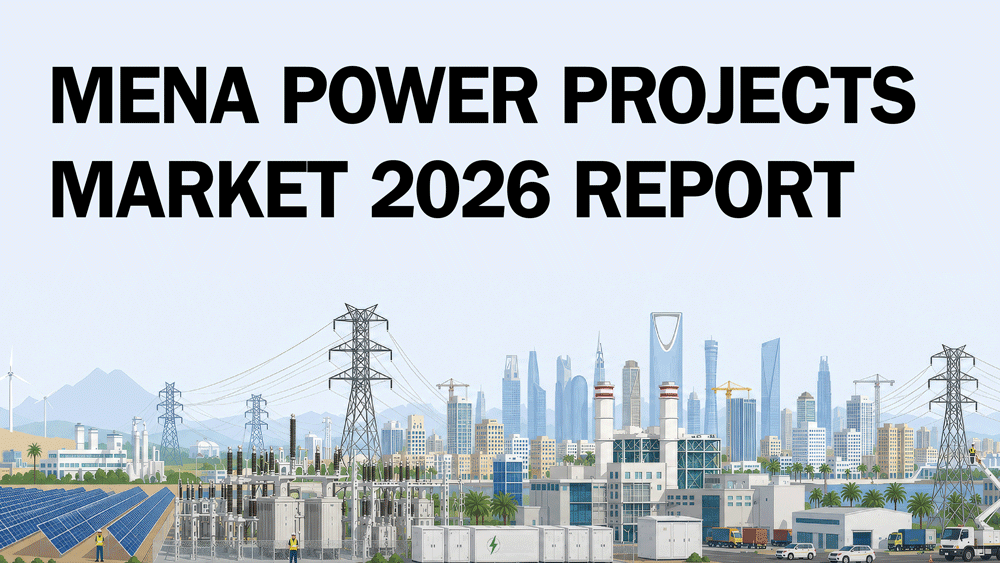
Population growth, urbanisation, gigaprojects and industrial demand are driving record investment in generation, transmission and smart grids
 The Middle East and North Africa (Mena) power sector stands at a historic crossroads in 2026. Navigating a landscape of complex regional geopolitical tensions and shifting global dynamics, the region’s energy ecosystem is demonstrating remarkable resilience.
Far from slowing down, Mena nations are accelerating their energy transitions, proving that secure, sustainable infrastructure is the ultimate foundation for long-term economic stability.
Driven by visionary national strategies, the region is successfully transforming these macroeconomic headwinds into unprecedented commercial opportunities. Mena continues to break global records in low-cost utility-scale solar and wind deployment, while pioneering cross-border grid interconnections that fortify regional energy security.
Contract awards
Power project contracts worth $315.7bn have been awarded in the Mena region (across 14 countries) between 2016 and April 2026, with an annual average of $28.7bn.
Saudi Arabia holds the largest share in awarded value with just more than $135.2bn, followed by the UAE with $49.7bn.
Total contract values increased from approximately $12.8bn in 2016 to a peak of over $80bn in 2024, before moderating to around $66.9bn in 2025 and a projected $10.4bn in 2026. After an initial rise in 2017, awards declined in 2018-19, followed by a steady recovery from 2020 onwards, accelerating significantly in 2023 and reaching a historic high in 2024.
Sector-wise, generation projects consistently accounted for the majority share of investments ($215.2bn), while transmission projects with $100.5bn contributed a smaller but stable portion, with noticeable growth during peak investment years.
Power infrastructure now sits at the centre of economic transformation across the region
Installed capacity in the region continued to grow in 2026, driven by increasing power demand from the population and industrial growth. In absolute terms, Saudi Arabia was the leader in the Mena region, with an installed capacity of nearly 121.4GW in 2024, followed by Egypt, with nearly 63.5GW, and the UAE, with 45.5GW.
Although Saudi Arabia led in terms of total installed capacity, Morocco witnessed the largest increase in installed capacity between 2023 and 2024. With a 7.4% growth in electricity installed capacity, Morocco is driven by the National Energy Strategy that mandates 52% of total installed power capacity come from clean energy by 2030.
You might also like...
Abu Dhabi expects 45% emissions cut as electricity demand rises
21 September 2026
OMV to fast-track development of Libyan oil discovery
21 September 2026
Commissioning starts for Libyan oil metering system
21 September 2026

Humain and MIS sign 250MW data centre deal
21 September 2026
A MEED Subscription...
Subscribe or upgrade your current MEED.com package to support your strategic planning with the MENA region’s best source of business information. Proceed to our online shop below to find out more about the features in each package.
Take advantage of our introductory offers below for new subscribers and purchase your access today! If you are an existing client, please reach out to your account manager.