
Regions reputation as a magnet for foreign investment is strong
Despite the politically charged relationship between Erbil and Baghdad, the Kurdistan regions capacity to attract foreign investors has been undiminished. This is testament to a business-friendly investment regime and companies willingness to bet on the untapped growth potential of a hydrocarbons-rich province that also serves as a safe and stable staging post for entry into the rest of Iraq.
The Kurdistan regions official stock of foreign direct investment (FDI) stands at $5.77bn, accounting for 15 per cent of total investment projects in the region. Unofficial estimates put the value of FDI in the Kurdistan region significantly higher, above $30bn.
The flow of inward investment shows little sign of slowing down. UAE real estate developer Emaar Properties is one of the more recent heavyweights to vote with its feet, announcing in October 2013 the start of pre-sales registration for homes in Claren, the first residential project in Downtown Erbil, its integrated development in the city centre intended to serve as a world-class lifestyle and business destination. Downtown Erbil, spread over an area of 541,000 square metres and valued at $3bn, sits alongside a tourism city that the Dubai developer is promoting in Suleimaniyah province.
Oil block
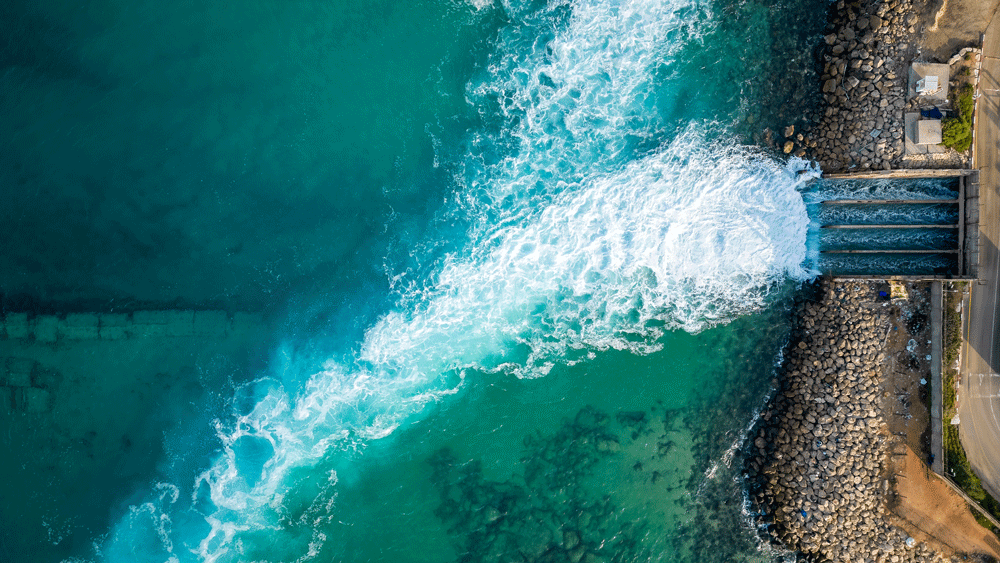
Major Gulf investors are also well positioned to develop the energy resources in Iraqs north. Abu Dhabi National Energy Company (Taqa) plans to spend about $300m this year developing the Atrush oil and gas block in the Kurdistan region. Taqa, majority-owned by the government of Abu Dhabi, won approval from the Kurdistan Regional Government (KRG) to develop the block in late 2013.
Some of the best opportunities are to be found in industries that can feed off the regions hydrocarbons reserves
Taqas involvement in the Kurdistan region dates back to a meeting between KRG President Massoud Barzani and Hamad al-Hurr al-Suwaidi, chairman of the Taqa board, in 2012. Taqa that year bought a 53.2 per cent operating interest in the Atrush oil block for $600m from the US General Exploration Partners.
The Atrush block will see more than $300m in 2014 in investment for wells, facilities, pipelines and associated infrastructure in the first phase, says a company spokesman. This investment will enable us to deliver the first commercial oil volumes from Atrush. There is still considerable appraisal activity occurring that will define future developments.
Like other foreign investors in the Kurdistan region, Taqa has broader ambitions. It sees its Kurdish presence as connected to its wider Iraq market presence.
Iraq is the first Mena [Middle East and North Africa] country that Taqa has entered under its integrated country strategy, says the spokesman. As such, Taqa is exploring opportunities across both of the companys core business areas upstream oil and gas, and power and water.
While Taqas initial opportunity in the Kurdistan region was in oil and gas, it is exploring power and water opportunities across Iraq, and the spokesman says the company expects to become a 50 per cent shareholder in the 1,000MW Suleimaniyah gas-fired power plant by the end of 2014.
Taqas field development plan for the Atrush block is a multiphase development. Phase 1 will bring its production capacity to 30,000 barrels a day (b/d). By the end of 2014, Taqa expects to have placed the orders for the first production modules to be installed at the Atrush block. They will be fully onstream by early 2015.
Phase 2, which will ramp up in 2015-16, will deliver another 30,000 b/d of capacity, bringing the total to 60,000 b/d.
Throughout field development, we are going to be investigating new technologies, says the spokesman. We are going to maintain flexibility in our development plans so we can increase production capacity, address reservoir challenges and deal with the material volumes of associated gas that will also be produced. We expect to be producing oil and gas from Atrush for anywhere from 25-40 years.
Big spenders
Major players such as Taqa and Emaar are the most high-profile foreign investors, but there are numerous others that have established a presence in the region.
There are more than 2,700 foreign companies operating in the KRGs territory. Kurdistan Board of Investment (BoI) figures reveal that the UAE is the most substantial source of funds, with invested capital worth more than $2.5bn, accounting for 6.5 per cent of total investment. This is well ahead of Turkey, the next largest, whose $1.1bn of investment accounts for nearly 3 per cent of total licensed investment projects in the Kurdistan region.
We should see double the size of developments because the infrastructure needs in the Kurdistan region are boundless
Shwan Zulal, Carduchi Consulting
Iranian companies are also trying to break into the market, but they are finding it difficult as international sanctions make it challenging to develop projects that involve Iranian funds. Less than a tenth of 1 per cent of KRG investment projects are backed by Iranians, a tiny amount considering the size of the Islamic Republic and its vast cultural and commercial links to Iraq.
Priority sectorsOverall, foreign investors have tended to make a beeline for the capital, Erbil, where $4.3bn-worth of foreign investment is licensed, out of the total $5.8bn quoted by the BoI.
Up to now, the bulk of foreign investment has centred on real estate. Fifteen of the foreign investment projects licensed with the BoI are in housing, and six in tourism. However, the KRG authorities are eager to diversify the inflow of FDI into other sectors including industry, agriculture and financial services.
Some of the best opportunities are to be found in industries that can feed off the regions hydrocarbons reserves. These are projects where you can use the existing cheap supply of oil and gas in Kurdistan to develop industries, rather than just build offices and buildings, which is the easy thing to do, says Shwan Zulal, head of London-based consultancy Carduchi Consulting.
The dominance of real estate investment (housing accounts for by far the highest value of investment with $13.4bn of licensed projects up to March 2014) is one trend the Kurdish authorities are keen to reverse, although it is proving a challenge.
Investors willingness to pour capital into real estate projects reflects the relative ease with which they can get money back as soon as a development is finished, selling on the property and getting their money back with interest. This has not encouraged long-term investment, with the exception of a few major projects such as Qaiwan Groups Bazian refinery.
According to Shivan Ferzil, Kurdistan representative of the Iraq-Britain Business Council, tourism is proving a particularly active sector for foreign investment, with Erbil chosen as the 2014 Arab Capital of Tourism.
Prominent foreign-backed tourism projects include the Divan Hotel in the capital with Turkish sponsors and Emaars Downtown Erbil development. There is clearly scope for further FDI in tourism projects. Overall, the BoI notes just six foreign-backed tourism ventures, compared with 105 by local investors.
| Foreign investment projects | ||
|---|---|---|
| Number | Value ($m) | |
| Dohuk | 9 | 554 |
| Erbil | 38 | 5,188 |
| Suleimaniyah | 2 | 23 |
| Source: Kurdistan Board of Investment | ||
Banking is another area with substantial room for foreign investment to grow. Weve seen a lot of banks, especially Lebanese ones, coming into the region, such as Byblos Bank, Bank of Beirut & the Arab Countries, and, most recently, Fransabank, says Ferzil.
Fransabanks Erbil branch is one of two in the country, alongside a presence in the federal capital, Baghdad. The lenders chairman Adnan Kassar noted at the opening ceremony in early April that Erbil is considered to be an investment destination, a solid commercial and economic base, and a gateway to the promising Iraq market.
That message has been absorbed by Western banks too. In March of this year, the UKs Standard Chartered opened its first Erbil branch a move that reflects its need to be near its international clients, which are now active across the Iraq market. In addition to servicing our existing clients, we aim to support large infrastructure projects that are planned in the country, said Gavin Wishart, Standard Chartereds Iraq CEO. We believe our move will bring depth to the Iraqi financial market and will complement our product capabilities and expand our footprint in line with our group strategy.
A modern banking sector is desperately needed in the Kurdistan region in order to facilitate financial transactions such as the paying of salaries by bank transfer rather than cash.
But more changes will be needed if the region is to capture its full investment potential. The authorities generous policy of granting land tax-free has not necessarily helped to bring projects to fruition, says Zulal. Theres been a practice whereby people use land as land banks and have not brought projects forwards, he says. And while the BoI has done a good job of encouraging real estate investment, they havent managed to attract many industrial investors yet.
Investors are able to double or triple their money simply by sitting on the land, without spending for the long term. This, however, is part of the attraction of the KRGs investment law, which offers substantial public subsidies for investment projects that have been licensed by the BoI, such as provision of land plots for subsidised lease, provision of public infrastructure to the edge of the project, and exemption from corporate taxes for 10 years and customs duties for five years.
The lack of a modern banking system has contributed to the preference for many to sit on land banks; land is used as collateral, but recently local Kurdish investors have found it difficult to raise liquidity for new projects. With limited access to cash, many are now looking to foreign companies to help unlock investment, says Zulal.
This is where limitations are straining the investment chain and a lot of local investors are looking to foreign partners to come in and provide relief, says Zulal.
Investors undeterred
One positive is that foreign investors show no signs of taking fright from the standoff between Erbil and Baghdad. There may be some niggling doubts as to whether now is a good time to invest in the Kurdistan region, before the outcome of the 30 April national elections is known, but its impact on actual investment has been marginal.
The money is flowing and we should see double the size of developments because the infrastructure needs in the Kurdistan region are boundless, says Zulal. And because of the potential for oil production, and the amount of money that can be generated from that, there is still a lot of scope for growth.
You might also like...
Iraq discusses starting operations at $3.78bn refinery project
08 October 2026
Drilling resumes at Iraq’s Akkas field
08 October 2026
Neom extends bid deadline for Oxagon wastewater plant
08 October 2026
NWC tenders package 16 of sewage treatment programme
07 October 2026
A MEED Subscription...
Subscribe or upgrade your current MEED.com package to support your strategic planning with the MENA region’s best source of business information. Proceed to our online shop below to find out more about the features in each package.
Take advantage of our introductory offers below for new subscribers and purchase your access today! If you are an existing client, please reach out to your account manager.