


Cash still dominates Morocco’s transactions, reflecting high unbanked levels. GlobalData expects gradual gains for cards and ecommerce as inclusion initiatives, contactless acceptance and digital banking expand
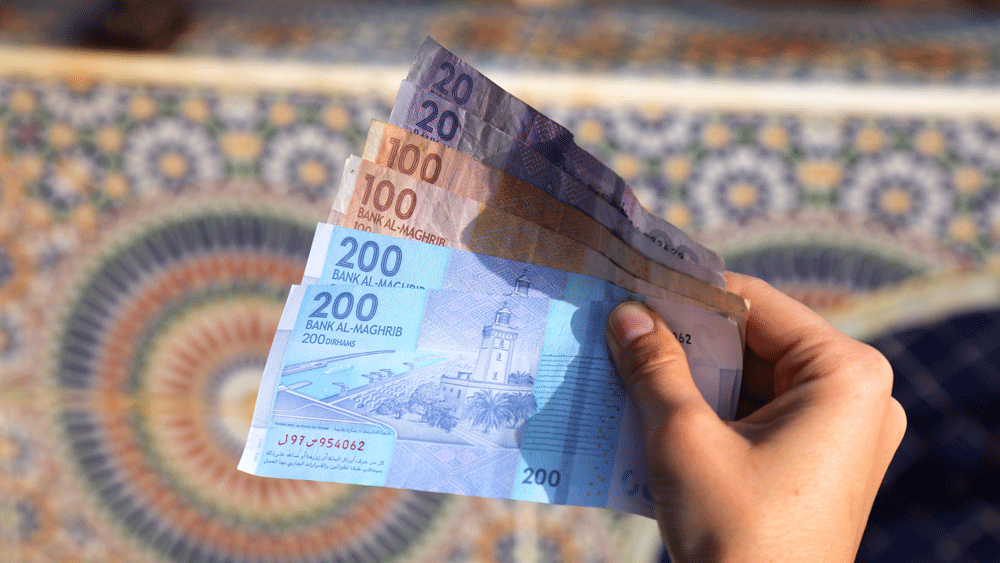
Cash will remain the backbone of Morocco’s payments market through the rest of the decade, even as policymakers and banks push for wider adoption of electronic alternatives. GlobalData’s latest Morocco Cards and Payments: Opportunities and Risks to 2030 report estimates that cash will account for about 83.7% of total payment volume in 2026, underlining how deeply embedded cash usage remains across daily commerce.
A central driver is limited access to formal banking. GlobalData estimates that 53.4% of Morocco’s adult population will be unbanked in 2026, which constrains the addressable market for cards and account-based payments. This helps explain why electronic payments growth, while steady, is starting from a relatively low base and is likely to be uneven by income segment and geography.
Financial literacy
The government and the regulator are trying to close this gap through financial inclusion efforts and education. Programmes such as Scale2Save are aimed at improving financial literacy and encouraging people to use formal financial services, which in turn supports digital payment take-up. Meanwhile, the payments industry is working to reduce practical barriers for merchants. In July 2025, Barid Cash, a payment institution and subsidiary of Al-Barid Bank, launched a smartphone-based acceptance solution for SMEs that enables merchants to take contactless card payments without a point-of-sale terminal or card reader. Such approaches are important in a market where small retailers are numerous and where the cost and complexity of traditional acceptance infrastructure can slow adoption.

Card usage is developing along two distinct tracks. Debit cards are the dominant card type and are closely linked to financial inclusion initiatives led by Bank Al-Maghrib, the central bank. Measures such as requiring commercial banks to offer basic bank accounts are intended to bring more consumers into the formal system, and with that typically comes debit card issuance and use. Digital-only banking platforms are also beginning to complement conventional branch networks. In February 2026, Saham Bank introduced nabD, a fully digital banking service designed for mobile use, allowing customers to open accounts remotely and complete routine banking tasks without visiting a branch, which could help extend reach to underserved communities.
Credit cards, by contrast, are growing more slowly. GlobalData notes that adoption remains limited, with banks prioritising lower-risk segments such as higher-income individuals. Product design is also being used to widen appeal, including sharia-compliant credit cards offered as part of bundled packages. The focus on affluent customers is evident in product launches such as Banque Populaire’s May 2025 partnership with Mastercard to introduce a Platinum credit card for premium clients. Corporate cards are another area of incremental expansion, illustrated by Al-Barid Bank’s November 2025 launch of the Visa Business credit card. Over time, these moves should support gradual growth in credit card usage, although mass-market penetration is likely to remain constrained while cash is dominant and credit risk management remains conservative.
Digital natives
E-commerce is one of the strongest structural drivers for digital payments. GlobalData points to rising smartphone penetration and improved connectivity, alongside changing consumer behaviour. National Telecommunications Regulatory Agency data shows the share of individuals aged five and older who ordered goods online increased from 15.1% in 2019 to 24.9% in 2024. Logistics improvements are reinforcing this trend. In July 2025, logistics technology firm Cathedis and Damane Cash, the financial services arm of Bank of Africa, partnered to roll out more than 1,800 parcel relay points nationwide, helping reduce delivery friction and supporting higher online order volumes.
Overall, Morocco’s payments transition looks set to be evolutionary rather than rapid. As GlobalData’s Morocco Cards and Payments: Opportunities and Risks to 2030 report suggests, the long-term opportunity lies in converting cash-heavy day-to-day transactions into account-based payments, a shift that will depend as much on inclusion and merchant acceptance as on new products and platforms.
You might also like...

Aramco selects contractors for five offshore tenders
23 October 2026

Contractor wins $599m Ras Al-Khaimah hotel construction deal
23 October 2026

Adnoc Onshore seeks bids for Bab gas cap well tie-in project
23 October 2026

Focus turns to the Northern Emirates
23 October 2026





A MEED Subscription...
Subscribe or upgrade your current MEED.com package to support your strategic planning with the MENA region’s best source of business information. Proceed to our online shop below to find out more about the features in each package.
Take advantage of our introductory offers below for new subscribers and purchase your access today! If you are an existing client, please reach out to your account manager.