


Local developer concedes credit crunch is forcing a review of projects.
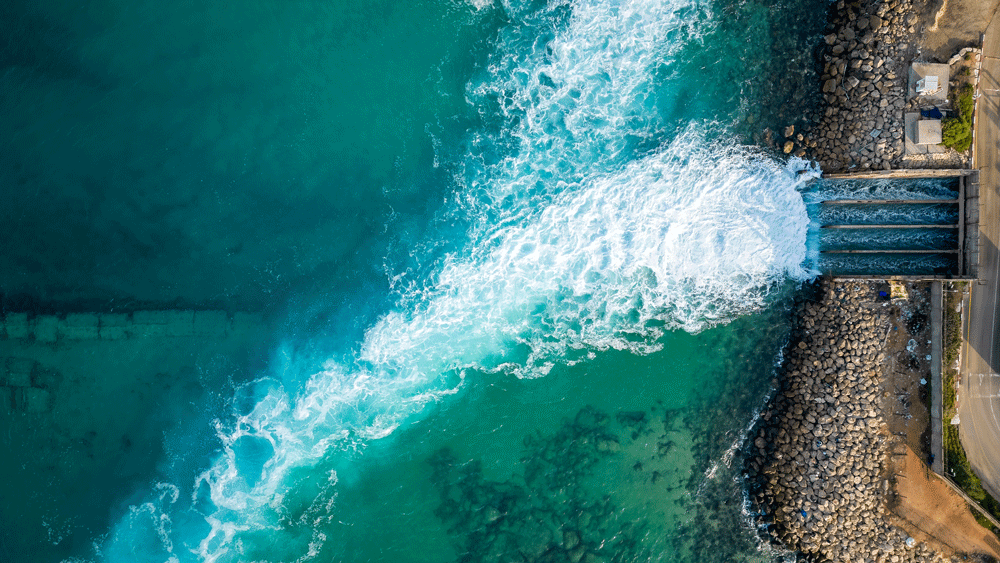
Local developer Nakheel is scaling back work on another of its landmark man-made island projects in Dubai and reviewing activity at several of its other schemes, just weeks after MEED revealed it was halting dredging work at Palm Deira.
Dredging contractors working on the Dubai Waterfront project have been instructed to reduce the amount of work they do on the project as a result of the adverse economic climate.
A Nakheel spokesman says the company is planning to scale back several more of its schemes across the emirate over the next few months.
“This will not affect our long-term business objectives and is a responsible approach in line with current global economic conditions,” he says.
Dubai Waterfront is the world’s largest waterfront development and, when completed, will be twice the size of Hong Kong island. The offshore component is made up of seven man-made islands.
Reclamation work on the development began in July 2006 when Belgium’s Jan de Nul was awarded the $1-1.5bn dredging package. The contract involves the placement of more than 300 million cubic metres of sand and 12 million cubic metres of rock to protect the islands.
The project is the second of Nakheel’s projects to be scaled back because of the worsening economic climate in Dubai.
In late October, it instructed contractors working on the Palm Deira to stop work on offshore elements of the project and focus on areas closer to the shore that can be sold more quickly.
“We are directing work to complete reclamation in areas closest to the shore, so that once these areas are complete we can undertake progressive land sales and development,” said a Nakheel spokesman at the time. “This is in keeping with Nakheel’s business model.”
The Netherlands’ Van Oord was awarded the estimated $2.9bn reclamation contract for Palm Deira in 2005. At the time, it was expected to take about half of the world’s dredging fleet to complete the works (MEED 27:10:08).
Nakheel has more than $110bn worth of projects under development, with Palm Deira and Dubai Waterfront two of the largest. It recently launched the $38bn Nakheel Harbour & Tower project, which includes a 1.4 kilometre-high tower. Once completed, it will be the tallest building in the world.
Its other schemes in Dubai include Palm Jumeirah, The World, The Universe, Jumeirah Village and International City. They provide a variety of real estate products including villas, apartments, hotels, shopping malls and other entertainment facilities.
Once these projects are completed, it could drive down real estate prices in the emirate even further, due to supply outstripping demand.
On 12 November, HSBC Global Research issued a report stating that real estate prices on the secondary market in Dubai fell by
4 per cent in August.
Despite the dramatic downturn in the fortunes of Dubai’s real estate market in recent weeks, Nakheel says it remains committed to the long-term future of the sector.
“We are witnessing a global negative economic movement, and while we believe that the economic fundamentals of Dubai have not changed, we also believe that we have a responsibility to help this market maintain healthy momentum,” says the spokesman. “This involves reassessing our immediate business objectives to accommodate the current economic climate.”
Market momentum is a growing concern for the emirate. As more projects are slowed down and developers lay off further staff, there is a growing danger that the Dubai economy could contract in 2009.
You might also like...
Azerbaijan seeks interest for wastewater PPP
29 July 2026
Kuwait construction holds up despite regional strife
29 July 2026

A MEED Subscription...
Subscribe or upgrade your current MEED.com package to support your strategic planning with the MENA region’s best source of business information. Proceed to our online shop below to find out more about the features in each package.
Take advantage of our introductory offers below for new subscribers and purchase your access today! If you are an existing client, please reach out to your account manager.