


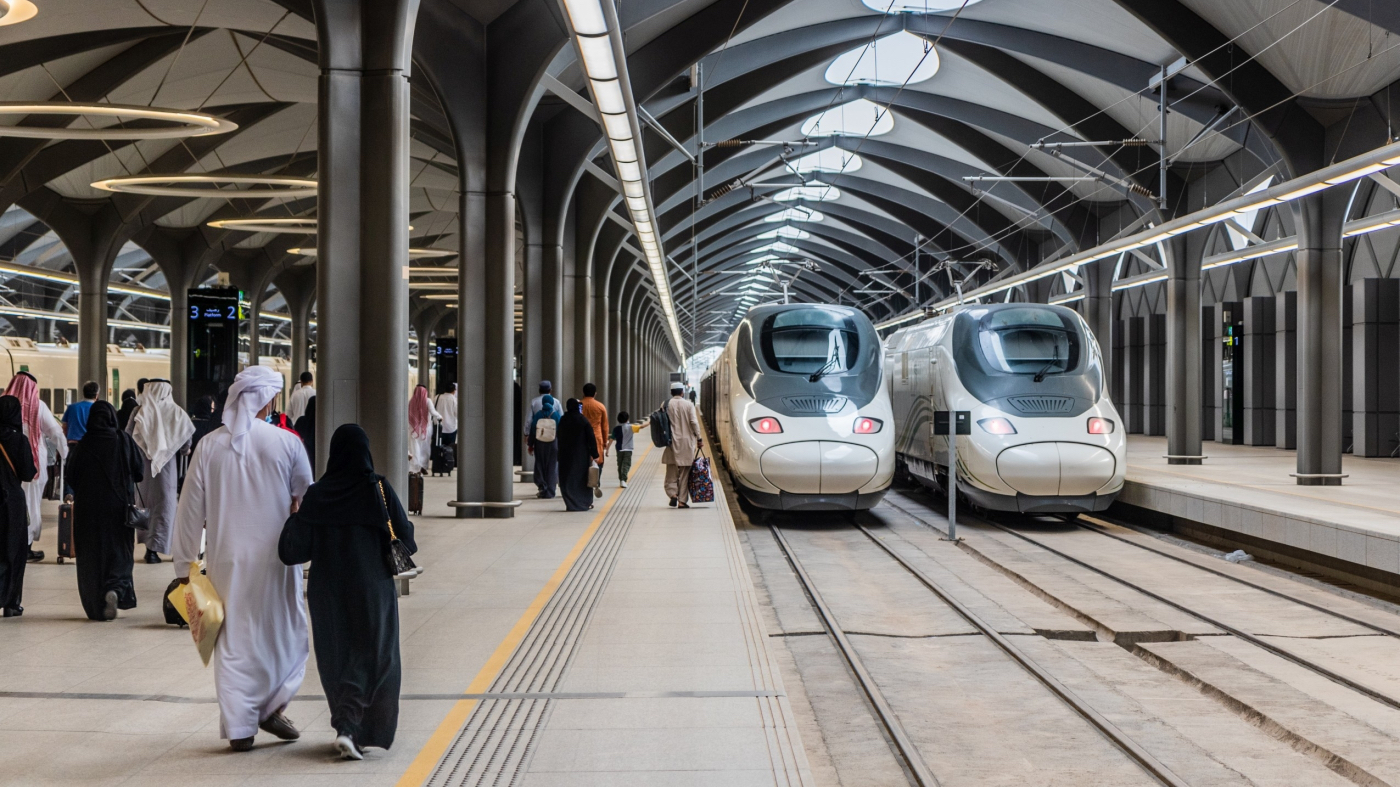
Saudi Arabia’s national rail operator will purchase 20 new high-speed trains from Spain’s Talgo to serve its Haramain high-speed railway
Saudi Arabian Railways (SAR) has signed an agreement with Spanish firm Talgo to purchase 20 new high-speed trains for its Haramain high-speed railway.
In a statement, Talgo said that the deal adds €1.33bn ($1.57bn) to its order backlog.
The new fleet will increase the network’s passenger capacity to more than 30 million travellers annually.
The agreement was announced on 8 February by the kingdom’s Minister of Transport and Logistics Services, Saleh Al-Jasser, who is also chairman of SAR, and Spain’s Minister of Transport and Sustainable Mobility, Oscar Puente.
The new trains are scheduled to be delivered in 2028, with full delivery expected by 2031.
Brief history
The $13bn Haramain high-speed railway linking Mecca and Medina entered partial commercial operation in October 2018.
The scheme is the Gulf region’s first high-speed rail service, with trains capable of reaching speeds of up to 300 kilometres per hour (kph). It spans 450 kilometres.
Construction of the railway began in 2009. The project comprised two phases, the first of which was awarded in two packages: one for civil works and the other for station construction.
The Al-Rajhi Alliance consortium won the $2.9bn civil works contract in 2009. The consortium included the local Mada Group, Saud Consult, Masco and Al-Arrab Contracting Company; France’s Alstom Transport; the UK’s Eurostar and Arup; and China Railway Engineering Corporation.
In 2011, the second package, covering the construction of four stations in Mecca, Medina, Jeddah and King Abdullah Economic City (KAEC), was awarded to two consortiums led by Saudi Binladin Group and Saudi Oger.
Saudi Binladin Group, in joint venture with Turkey’s Yapi Merkezi, won the $1.29bn contract to build passenger stations at Mecca and Medina, while a team comprising Saudi Oger and El-Seif Engineering won the $1.27bn contract to build the stations at Jeddah and KAEC. However, in 2017, the client terminated the contract with Saudi Oger and they were replaced by Yapi Merkezi.
A joint venture of the UK’s Fosters + Partners and Buro Happold was awarded a SR142m contract to design the stations.
Phase 2, which covers a 450km route, comprises the construction of the railway tracks, installation of signalling and telecoms systems, electrification, construction of the operational control centre, the procurement of 35 trains, and the operation and maintenance of the railway for 12 years.
Spanish/local consortium Al-Shoula Group won the $8.2bn contract for phase 2 of the project in 2011.
Spanish companies that were part of the Al-Shoula consortium include:
- Adif / Renfe: 12-year operation and maintenance
- OHL / Copasa / Imathia: track construction and maintenance
- Inabensa / Cobra: electrification and electro-mechanical equipment
- Talgo: rolling stock
- Dimetronic (recently acquired by Siemens): signalling
- Indra: ancillary and control systems, including intrusion detection and ticketing
The scheme has five stations in total. In addition to the terminals in Mecca, Medina, Jeddah and KAEC, a fifth station was built at King Abdulaziz International airport.
.gif)
You might also like...
UAE bank asset quality hinges on property market
03 April 2026
Safety and security matters
03 April 2026
Saudi forecast remains one of growth
03 April 2026

A MEED Subscription...
Subscribe or upgrade your current MEED.com package to support your strategic planning with the MENA region’s best source of business information. Proceed to our online shop below to find out more about the features in each package.
Take advantage of our introductory offers below for new subscribers and purchase your access today! If you are an existing client, please reach out to your account manager.