

As the global energy industry adjusts to a surge in unconventional energy sources unlocked by new technology, the worlds biggest oil company, Saudi Aramco, is resetting its focus
Throughout 2013, Saudi Arabias national oil company Saudi Aramco has been producing about 10 million barrels a day (b/d) of oil. Such high levels of output from the worlds biggest oil producer has not been welcomed by all its partners in oil producers group Opec, who would like to see oil supplies constrained to maintain higher prices on the energy markets. But it highlights how seriously Riyadh takes its responsibilities as the worlds swing producer of oil, able to adjust output to protect interests of both energy producers and consumers.
Unlike most national oil companies (NOCs), Aramco has extensive domestic and international commitments, which means whatever decisions Riyadh takes regarding its oil output, there will always be somebody challenging the decision, either inside or outside the kingdom.
Oil oversupply threat
Saudi Aramco is proving that an NOC can balance its obligations says oil consultant and former Aramco vice-president, Sadad al-Husseini. No other NOC operates in the same way [as Aramco].
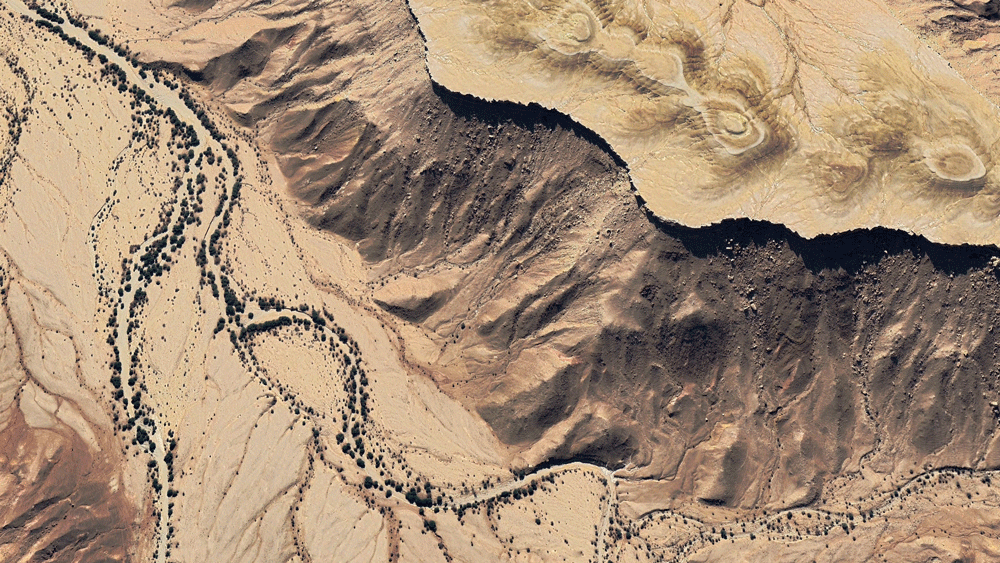
The company was founded as California Arabian Standard Oil Company in 1933, as a subsidiary of US firm Standard Oil of California, (now the US Chevron). Texas Company (now the US Texaco) bought a 50 per cent stake in that subsidiary and eight years later, in 1944, its name was changed to Saudi Aramco. Since its launch, the firm operated as a commercial enterprise until it was fully nationalised in 1980.
Unlike most NOCs in the region, Aramco does not offer production-sharing agreements for any of its upstream oil and gas operations. However, times are changing and it will be forced to change with them.
As new sources of unconventional oil and gas becoming available, Aramcos biggest customer, the US , is forecast to become self-sufficient in its energy needs by 2020.
| Exports by region, 2012 | |||
|---|---|---|---|
| Region | Crude oil | Refined products | NGLs |
| US | 16.5 | 0.2 | 0 |
| Mediterranean | 7.4 | 1.8 | 5.6 |
| Asia | 53.2 | 50.2 | 26.5 |
| Europe | 5 | 9.5 | 0.9 |
| Other | 17.8 | 67.1 | |
| Source: Saudi Aramco | |||
The withdrawal from the market of the worlds biggest energy consumer would, at a stroke, lead to a glut in global energy supplies and prices, currently being sustained at record levels, could drop significantly.
The consequences of such a scenario are being examined closely in Riyadh. The Oil Ministry, Aramco and other key decision-makers are reviewing the oil firms strategic priorities and operations, and planning huge rounds of investments aimed at safeguarding the kingdoms position as a major global energy player.
One result is a series of major domestic and foreign investment initiatives across the whole hydrocarbons value chain and a renewed focus on its core capabilities.
But despite the looming threat of oversupply in the future, Aramco continues to pump very-high levels of oil output and, as a result, business in 2013 is booming.
Despite having an estimated oil production capacity of about 12.5 million b/d, the oil company is usually happy to produce anything above 8 million b/d. Since mid-2012, Aramco has plugged the gap in global energy supplies caused by sanctions against Iranian crude oil exports. As a result, it has been producing more than 9.5 million b/d throughout 2012 and 2013.
While this has pleased US consumers, it has caused problems within Opec, as Tehran has accused Riyadh of profiteering from fellow members. This has led to strained relations within the group with both Riyadh and Tehran nominating opposing candidates for the secretary-general role.
Opec challenges
Deadlock over the appointment has reached the stage where the incumbent secretary-general, Libyas Abdalla el-Badri, has extended his tenure due to the lack of a replacement. Where this leaves Opec in the future is the cause of much debate with some oil industry commentators saying the group is a diminishing force.
| Saudi Aramco International tie-ups | |||
|---|---|---|---|
| Name | Major shareholders | Capacity | Country |
| Motiva | Aramco/Shell | 1,105 | US |
| S-Oil | Aramco/Hanjin Energy | 650 | South Korea |
| Showa Shell | Aramco/Shell | 400 | Japan |
| Fujian | Aramco/Sinopec/ExxonMobil | 240 | China |
| Source: Saudi Aramco | |||
Saudi Arabia, however, remains Opecs most powerful member and can usually count on support from its three fellow GCC member-states as well as Iraq. Riyadh knows that without its 12.5 million b/d of of oil production capacity Opecs influence would be significantly weakened.
Another challenge to Opecs influence comes from the rise in new sources of hydrocarbons. The US, Canada and Venezuela are all starting to exploit unconventional oil and gas and many traditional producers are starting to worry about the pressure this could apply to global markets.
With ongoing problems to supply in countries such as Libya, there is no real chance of the global oil market becoming oversupplied, says Robin Mills, head of consulting for the Dubai-based Manaar. However, look forward towards the end of the decade and Iraq should be producing significantly more oil, as well as other countries bringing on unconventional sources. This could put extreme pressure on the oil price.
Aramco is not expected to change any of its operating policies around its conventional oil and gas assets, but there are indications that it may be considering partnerships on the development of any unconventional oil and gas deposits, especially where specialist expertise Aramco does not have is required.
The firm currently has one upstream joint venture with the UK/Dutch Shell Group for a gas field development in the Empty Quarter, but Shell is understood to be seeking to extricate itself from the partnership.
Oil field services agreements
Despite a lack of IOC involvement in current oil and gas production, international companies still play a vital role helping Aramco to maintain its enormous hydrocarbon capacities. Many of the worlds biggest oil field services companies, including the US Halliburton, Baker Hughes and Schlumberger, have long-term service agreements in place to support Aramcos major onshore oil field developments.
All of the deals are focused on maintaining production at the kingdoms major assets such as Ghawar, the worlds largest oil field, and ensuring the fields can sustain production levels into the future. The same companies are also working with Aramco to search for unconventional energy reserves, such as shale gas deposits in previously untapped areas in the north of the kingdom.
An anticipated ramping up of Aramcos offshore activities in particular offers exciting potential opportunities to international engineering companies.
Many contractors are excited about Aramcos offshore oil and gas fields, especially in the Red Sea, says an executive from an international engineering consultancy. It is looking like Aramco is preparing for a new wave of offshore oil and gas field developments.
Currently, Aramco has a long-term services agreement in place with Australias WorleyParsons to provide engineering support for the maintenance and repair of Aramcos offshore oil and gas field assets in the Gulf. Aramco, however, is tendering a similar engineering services contract to support the potential rapid expansion of its Red Sea developments, which is likely to run concurrently with the WorleyParsons deal.
In contrast to its upstream operations, Aramco takes a different approach on its downstream refining and chemicals projects. In this sector, the firms approach is more like other NOCs in the region and it works closely with IOCs as well as operating its own domestic refineries. Aramco has a global refining capacity of 4.5 million b/d, of which it retains an equity share of 2.4 million b/d.
Domestically, it operates four wholly owned refineries across the kingdom, with another world-scale complex under construction at Jizan. Jizan will have a capacity of 400,000 b/d when it starts operations in 2016-17.
The remainder of its refining operations are joint ventures with some of the worlds largest IOCs and are located either domestically or in strategic markets such as China and the US.
An ongoing challenge for Aramco is balancing the often conflicting demands of its commercial interests, which encourages it to sell its output internationally, and its obligations to support the kingdoms domestic policy objectives.
Gasoline consumption is growing at more than 5 per cent a year in the kingdom, fuelled by the worlds second-lowest price a litre, $0.12. This means that a large proportion of the 1.2 million b/d of domestic refining capacity due to come on stream in the next four years will have to be set aside for domestic use.
This challenge is reflected in Aramcos recent foray into the petrochemicals sector, with schemes being designed to lengthen the value chain and aimed squarely at job creation.
The most ambitious is the $20bn Sadara Chemical Company project, which is under construction at Jubail in the Eastern Province. The complex will be the largest ever single-phase petrochemicals plant and will have a capacity of 8 million tonnes a year of speciality chemicals when completed. The plant is a joint venture of Aramco and the US Dow Chemical.
Business initiative
Aramco believes Sadara will be the anchor tenant for an adjacent conversion park that will attract small to medium-sized enterprises (SMEs) to the area and drive job creation.
To help SMEs, the oil company has also set up an initiative that offers assistance to any budding entrepreneurs in Saudi Arabia. The Waed Programme is focused on turning ideas into established businesses within the kingdom. This includes funding and advice on setting up a small business.
Historically, exporting crude oil has been the primary driver of all Aramcos operations, but as the worlds oil industry changes, the companys strategic priorities are evolving. Aramco is now repositioning to place its domestic downstream operations on an equal footing with exporting crude oil.
The news reported by MEED in late August that Aramco is planning a $70bn expansion of its petrochemicals capacity is part of this change in focus. It is also a reaction to the changing global picture and the prospect of potential oversupply in the global energy oil markets.
Saudi Aramco leads the world in the scale of its operations and also in the way it balances its commercial and domestic obligations. The energy sector is adjusting to the prospect of a new era, defined by a surge in unconventional energy sources unlocked by new technology and potential oversupplies of raw energy. It is likely that where Saudi Aramco leads in this new landscape, many more of the regions NOCs will follow, creating new opportunities for the region IOCs, oil services contractors and engineering and technology suppliers.
Key fact
Aramco has a global refining capacity of 4.5 million b/d, of which it retains an equity share of 2.4 million b/d
b/d=Barrels a day. Source: MEED
You might also like...
UAE bank asset quality hinges on property market
03 April 2026
Safety and security matters
03 April 2026
Saudi forecast remains one of growth
03 April 2026
A MEED Subscription...
Subscribe or upgrade your current MEED.com package to support your strategic planning with the MENA region’s best source of business information. Proceed to our online shop below to find out more about the features in each package.
Take advantage of our introductory offers below for new subscribers and purchase your access today! If you are an existing client, please reach out to your account manager.