

The National Water Company is leading an initiative, aimed at encouraging private sector involvement, to overhaul the kingdom’s wastewater industry and help meet rising demand.
Rapid economic expansion and population growth of 3 per cent a year have in recent years translated into a 6 per cent annual increase in demand for water in Saudi Arabia.
The kingdom falls in the ‘absolute water scarcity’ category, with annual per capita fresh water availability below 500 cubic metres. By 2025, it will not be able to meet its water needs. The kingdom’s plans to reuse wastewater are a step towards solving this major obstacle to the country’s development.
Because of its shortage, Saudi Arabia’s water production and transportation costs are the world’s highest, and the kingdom is home to 24.5 per cent of global desalination capacity.
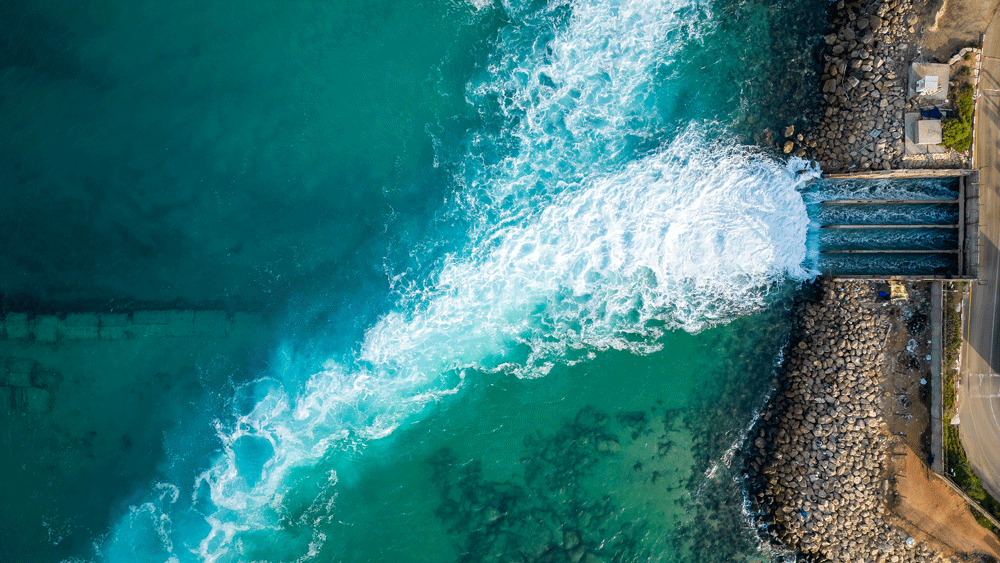
On average, a Saudi citizen consumes 286 litres of water for domestic use each day. This is far higher than most European countries - the UK average is 150 litres a day - but short of the 431 litres a day and 666 litres a day consumed in Canada and the US respectively.
However, the vast majority of drinking water produced in the kingdom is not consumed by domestic users. More than 75 per cent of the output of desalination plants and aquifers is used for irrigation.
There is tremendous potential for the reuse of wastewater, which could significantly reduce the pressure on the country’s resources. For now though, treated effluent reuse accounts for only 6 per cent of drinking water supply in the kingdom.
Saudi Arabia’s sewage collection infrastructure covers 45 per cent of its population, which puts the country about half way between Algeria, with 85 per cent coverage, and Iraq, with only 2 per cent. To achieve 100 per cent coverage, the kingdom will spend $37bn on sewage collection, treatment and water distribution infrastructure over the next 20 years. An additional $17bn in operating expenses will be incurred over the same period.
It is hoped that a large proportion of this investment will come from the private sector.
To that effect, the National Water Company (NWC) is heading a comprehensive privatisation programme that will hand responsibility for wastewater collection, wastewater treatment and the distribution of treated sewage effluent to private investors.
Under the first part of the programme, NWC has awarded two management contracts for water services and wastewater collection. France’s Veolia has the contract for Riyadh, while GDF Suez, also French, and the local Acwa Power International has the contract
for Jeddah.
NWC is now finalising the selection of consultants and preparing to issue a tender for a similar six-to-seven-year public-private partnership (PPP) covering all of Greater Dammam, Medina, Mecca and Taif.
This will be followed by management contracts covering a further nine locations, which will be awarded over the next five years.
These include Buraida and Onaizah; Khamis Mushayat and Abha; Tabuk; Jubail; Al-Hofuf and Al-Mubarraj; and Yanbu. Together, the cities covered by the privatisation programme account for 60 per cent of the Saudi population and for 76 per cent of the total drinking water supply in the kingdom. The remaining 500 cities and towns, which are home to 35 per cent of the country’s population, will not be included in the privatisation process.
The second part of the privatisation, which focuses on wastewater treatment infrastructure, has yet to be launched. It will involve the sell-off of existing wastewater treatment plants and the construction of new facilities under 25-year concessions across the kingdom’s six largest cities.
Brownfield and greenfield wastewater treatment plant assets will be sold to private investors. The investors will set up a project company in which NWC will take a 40 per cent stake. The greenfield projects will be developed on a build-own-operate basis and will be financed by the project company.
NWC is awaiting confirmation of credit support from the Finance Ministry before it issues a request for prequalification for the first of its wastewater treatment plant privatisations in Riyadh. The company will offer two sets of plants, located at Al-Kharj and Al-Hayer, to the private sector in two separate tenders. The successful investor will operate and maintain existing plants and build new capacity at the site.
Once the tendering process for Riyadh has been completed, NWC will launch the privatisation of wastewater treatment plants in Jeddah, the second-largest city in the kingdom. This will be followed by Medina, Mecca and Greater Dammam.
The Riyadh deals will cover 1.1 million cubic metres a day (cm/d) of new and existing capacity. The Jeddah sell-off will be about the same size, while the total capacity of the plants sold to private investors in Mecca, Medina and Greater Dammam will be 1.2 million cm/d.
NWC has also launched a plan for privatisation of the reuse and sale of treated sewage effluent. The company is now evaluating bids for the consultancy contracts for the PPP project, which will cover Mecca, Medina, Riyadh and Jeddah.
Approximately 1 million cm/d of treated water will be available in Riyadh, and a market for 800,000 cm/d has already been identified in the city.
The treated effluent can be used in agriculture and landscaping, district cooling, various industries and to recharge aquifers.
At a price of $0.53 a cubic metre, NWC estimates this market will result in potential turn-over of $4bn, with profits to be shared between itself and investors, over a period of 25 years. If the treated effluent is sold at the higher price of $0.67 a cubic metre, turnover could reach $5bn.
Together, the three separate privatisation schemes that are under way will result in the complete overhaul of the wastewater sector. For the kingdom, treated sewage effluent represents a significant resource that has been largely untapped.
Capital expenditure requirements for full water distribution and sewage collection
| 2005-09 | 2009-14 | 2014-19 | |
| Capital expenditure | $13bn | $9bn | $8bn |
| Water distribution | 31% | 34% | 45% |
| Sewage collection | 63% | 61% | 50% |
| Sewage treatment | 6% | 5% | 5% |
You might also like...
A MEED Subscription...
Subscribe or upgrade your current MEED.com package to support your strategic planning with the MENA region’s best source of business information. Proceed to our online shop below to find out more about the features in each package.
Take advantage of our introductory offers below for new subscribers and purchase your access today! If you are an existing client, please reach out to your account manager.