


The recently announced series of economic reforms looks to set the tone for the future direction of the kingdoms current leadership
The new Saudi leadership under King Salman bin Abdulaziz al-Saud ended 2015 by announcing a series of unprecedented economic reforms as its hand was forced by the continuing slump in global oil prices.
The budget statement ended an annus horribilis for the kingdom, after a decade of relative economic and political stability under former head of state King Abdullah.
Exposed reliance
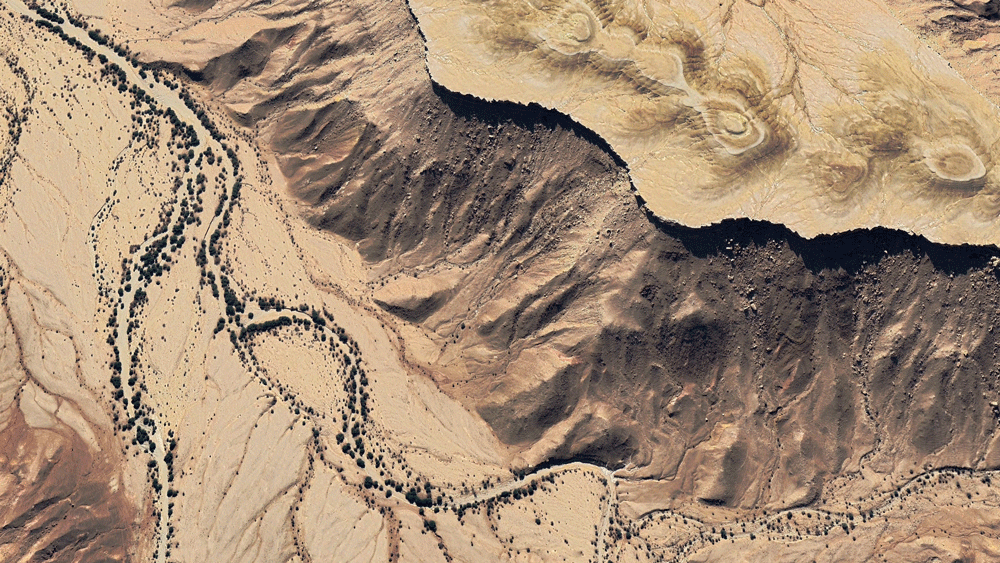
The crude market collapse has exposed the extent of Saudi Arabias reliance on oil revenues, despite the emphasis placed on diversification by the previous leadership.
This has left Saudi Arabias policymakers with the challenge of boosting non-oil revenues to make up for the budget shortfall. But the challenge is also an opportunity to push through long-needed reforms to a country where a level of complacency crept in during the 2010-14 period of soaring crude prices.
The 2016 budget set out a 14 per cent reduction in spending to SR840bn ($224bn) that would generate a forecast budget deficit of SR326bn over the year.
| Sector | 2016 budget allocation (SRbn) |
|---|---|
Education and training | 191.659 |
Health and Social Development | 104.864 |
Municipality Services | 21.246 |
Military and Security Services | 213.367 |
Infrastructure and Transportation | 23.903 |
Economic resources | 78.121 |
Public administration | 23.84 |
Budget Support Provision | 183 |
| Total | 840 |
| Source: Saudi Arabia Finance Ministry | |
| Government revenues | 2015 (SRbn) | 2014 (SRbn) | Percentage change |
|---|---|---|---|
Petroleum products tax | 16.08 | 15.04 | 6.91 |
Customs duties | 25 | 23.52 | 6.29 |
General service fees | 1.8 | 1.611 | 11.73 |
Government share in the telecommunications sector | 4.4 | 4.962 | -11.33 |
Passport & residency documents fees | 15.7 | 14.531 | 8.04 |
Other income taxes | 14 | 13.925 | 0.54 |
Rents and sales | 1.8 | 1.146 | 57.07 |
Investments* | 37 | 21.858 | 81 |
Other revenues | 25.5 | 9.23 | 149 |
Zakat** | 14.5 | 14.3 | 1.4 |
Fees of port services | 4 | 3.762 | 6.33 |
Visa fees | 2.7 | 2.394 | 12.78 |
Mining fees | 0.52 | 0.517 | 0.58 |
Total | 163.5 | 126.796 | |
| *= Investments: Saudi Arabian Monetary Authority (Sama) SR22bn, Public Investments Fund SR15bn; **= Deposited in Samas account and expensed directly to the beneficiaries of social insurance in addition to what has been allocated in the budget as their benefits. Source: Saudi Arabia Finance Ministry | |||
More interestingly, the document called for a series of privatisations, subsidy cuts and taxation, signalling an about-turn for the economic policy of previous leaderships.
The collapse in oil prices has in many ways made it even more urgent to think big and, in some ways, think the unthinkable, says Kristian Ulrichsen, fellow for the Middle East at the Baker Institute, Rice University in the US.
It is easier to ram things through when people can see that there is no alternative to the status quo. To that extent, the oil price may have helped in creating the conditions where public acceptance of the measures is greater than it could have been two years ago, adds Ulrichsen.
Budget and taxation
Saudi citizens have long enjoyed some of the worlds lowest gasoline and electricity prices. These subsidies are seen as part of the social contract in which the government controls the countrys oil and gas resources.
The price of high-grade gasoline under the new budget will be increased to $0.24 a litre from $0.16 a hike of 50 per cent while low-grade gasoline is rising by 67 per cent to $0.20 a litre. Price increases for electricity, water and sewage, diesel and kerosene are set to follow.
To beef up alternative revenue lines, Riyadh is reviewing the taxation system including the current level of fees and the necessary arrangements for the application of value-added tax (VAT) approved by the Supreme Council of the GCC.
Saudi Arabia recorded a budget deficit of $98bn in 2015, largely due to the fall in crude revenues. This was exacerbated by the one-off bonuses issued by King Salman to public sector employees following his appointment early in the year.
About half of the planned 14.5-per-cent cut in spending can be achieved by not repeating last years public sector bonuses, says Jason Tuvey, Middle East economist at London-based Capital Economics.
That then leaves a cut of about 7 per cent to meet their spending target it looks like capital spending is going to bear the brunt of that, Tuvey adds.
Chief architect
This reduction in capital spending is likely to affect the Saudi projects market with an expected decrease in the value of new schemes planned over the coming years.
According to Tuvey, the Saudi budget normally allocates capital spending under the headline infrastructure and transport and this provision has been cut by 60 per cent in the 2016 plan.

Deputy Crown Prince Mohammad bin Salman is seen as the architect of much of the change sweeping the kingdom over the past year, both in terms of domestic reforms and foreign policy.
Thirty-year-old Prince Mohammad, who is second in line to the throne, gave a rare interview to the Economist earlier in January, setting out a programme of economic reforms in the type of business language rarely used by the older generation of Gulf leaders.
Prince Mohammeds Transformation Plan 2020, set for publication towards the end of January, will highlight the kingdoms strategy to cut public-sector spending and create jobs for a workforce that is set to double in the next 15 years.
The most notable revelation from the interview was the governments plan to float a share in its state oil producer and largest company Saudi Aramco.
Personally, Im enthusiastic about this step, he told the Economist. I believe it is in the interest of the Saudi market, and it is in the interest of Aramco, and it is for the interest of more transparency, and to counter corruption, if any, that may be circling around Aramco.
Private sector involvement
No further details were provided on which parts of Aramco could float, or when this was likely to happen.
I expect we will see a constant stream of revenues from privatisations over a five-year horizon rather than all coming at once, says Tuvey.
Privatisations will also boost efficiency and raise productivity. This is something that has been sorely lacking in [Saudi Arabia] for several decades. It fits into [Prince Mohammads] plan to get the private sector more involved in the economy and create jobs, he adds.
The deputy crown prince has also had a significant influence on the kingdoms foreign policy and, as defence minister, has led Saudi Arabia and its Arab coalition allies in a major offensive against Houthi forces in Yemen.
The Yemen Civil War shows no signs of resolution with much of the countrys population centres in the north and east still occupied by the Houthis Supreme Revolutionary Committee.
Asserting leadership
Many political commentators see the Saudi-led offensive in Yemen as the kingdom asserting its leadership in a battle that its ally the US has shown little interest in pursuing.
Riyadh claims that the Houthis have enjoyed significant military support from Iran, painting the conflict as a wider proxy war between Iran and its Shia allies and Saudi Arabia as the de-facto leader of the Sunni Arab world.
The tension between Saudi Arabia and Iran boiled over at the start of 2016 after Riyadh executed prominent Saudi Shia cleric Nimr al-Nimr as part of a wider execution of 47 people accused of terrorism and sedition.
In reaction, Iranian protesters stormed and ransacked the Saudi embassy in Tehran an action condemned by the Iranian government. Riyadh then announced it would cut all diplomatic ties with Iran and was followed by several countries including Qatar, the UAE, Bahrain and Kuwait removing their ambassadors from Tehran.
I think they predicted the Iranian response to the extent that they thought Iran would overreact and it would perhaps create tension between Iran and the US at the moment the US was preparing to release some sanctions in Iran, says Ulrichsen.
As it turned out, the diplomatic spat had no effect on the process, with the UN finally signing off on the removal of nuclear-related sanctions on Iran on 16 January.
Going it alone
[With the current US administration] the Saudis feel bewildered at why their longest-running political ally in is now, in their view, pivoting to Iran in the way they are, says Ulrichsen.
The Yemen war in March was a very clear message to Iran and the US that it will do it alone if it has to, without the US. Saudi Arabia now thinks it cant trust that the US has its back. They have to put their own interests first, Ulrichsen adds.
The regional power struggle with Iran and the impact of the oil price crash are the two factors that will continue to define the early years of the King Salmans rule.
With Prince Mohammed as an important power behind the scenes of the Saudi leadership, the kingdom is likely to continue down a path of economic and political transformation as it reacts to difficult external influences.
You might also like...
UAE bank asset quality hinges on property market
03 April 2026
Safety and security matters
03 April 2026
Saudi forecast remains one of growth
03 April 2026
A MEED Subscription...
Subscribe or upgrade your current MEED.com package to support your strategic planning with the MENA region’s best source of business information. Proceed to our online shop below to find out more about the features in each package.
Take advantage of our introductory offers below for new subscribers and purchase your access today! If you are an existing client, please reach out to your account manager.