


While elevated and suspended rail systems can be efficient, they may not be the best way to connect neighbourhoods, says Omar Delawar, CEO of DHB Holding
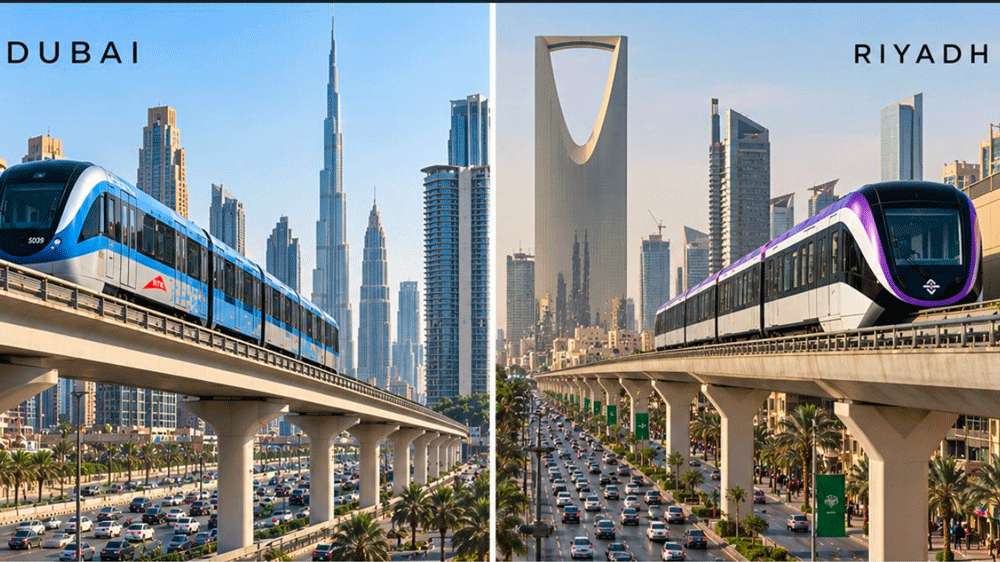
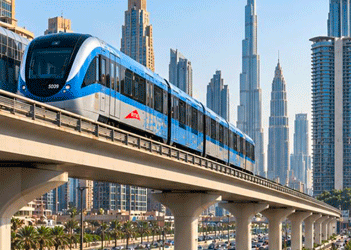
Every time a new picture of a future city comes out, it shows tall towers, autonomous vehicles, landscaped boulevards and a metro line elevated above the street. The system may be a conventional elevated railway or a monorail, or a train suspended below the track. However, before accepting this image as blueprint for future cities, we should ask what effect this infrastructure has on the city below.
While elevated and suspended rail systems can efficiently transport people, that is not the main point. The true question is whether they are the best way to connect neighbourhoods, enable daily life without the need for a car, and enhance the public realm, or do they just add another layer of concrete above streets that are already overcrowded with roads, bridges and flyovers?
A future city should not be evaluated based on how much of its infrastructure is in the air; instead, it should be assessed according to the quality of life it provides on the ground.

Suspended and elevated railways are nothing new. New York opened its first elevated railway in 1868, and Chicago then introduced its "L" train in 1892. The Wuppertal Suspension Railway in Germany, which opened in 1901 and is still in operation today, is an example of a train that hangs beneath its track. These systems were not intended as statements in the field of architecture – they were practical answers to tough urban conditions.
At present, many cities are again considering the idea of having elevated rail lines, since underground metro systems are costly, take a long time to complete and are technically challenging. Tunnels require extensive ground investigation, utility diversions, special ventilation, complex emergency systems and challenging station construction.
In dense city centres and areas that are historically significant, these expenses might be considered acceptable. However, it is not necessary for every route to be situated underground. Elevated rail can generally be constructed more quickly and at a lower cost, and can run along highways, in industrial areas, next to rivers and in new urban developments, since it escapes traffic and thus offers reliable journey times.
Design priorities
The problem begins when 'cheaper to build' is considered more than what is better for the city.
An elevated metro is not just a transportation project – it becomes an integral part of a city's identity for many generations. It introduces columns, shadows, noise, access for maintenance, visual obstruction and a constant presence above the public area. If situated in the wrong location, it can create darker streets, making the city less welcoming and potentially less safe. It may divide neighbourhoods, weaken active shopfronts and discourage people from walking underneath it.
That is what I have in mind when I talk about “concrete pollution”. It is not just a matter of the carbon footprint of concrete, even though that is important. It also refers to the visual and social impact of having too much infrastructure such as flyovers, road barriers, columns, walls and the neglected areas underneath bridges.
Several cities have committed this error in the 21st century. They prioritised vehicles and forgot that streets are not merely corridors for traffic, but are also places where people can walk, meet, shop, sit and experience the city.
A metro might lessen the need for private cars, but if it is situated above an eight-lane highway and is surrounded by parking areas with difficult pedestrian crossings, it could end up being yet another separate transport system in a city that is already dependent on cars. The key consideration should always be what the space will feel like at street level.
Over or under
The debate about public transport is usually presented as a choice between two extremes: underground or elevated railways. However, there is another option that merits attention: rail at ground level. In certain corridors, constructing and maintaining a metro system at ground level has advantages over building tunnels or elevated lines. It is cheaper, requires less concrete and steel, is usually easier to access and can become part of a greener and more active urban corridor.
A common concern is that ground-level metro, tram or reginal rail divides the city and affects traffic movement, but in my view this is usually the result of poor planning and poor design.
A rail line becomes a barrier if it is fenced in the same way as a highway, making pedestrians walk long distances in order to cross it. This does not have to happen, however. It is possible to provide frequent safe crossings. Bridges or underpasses can be situated at major junctions, where they are actually required. Stations can be designed to open out directly onto public squares, shaded streets, parks and cycling routes.
In newly developed areas, there will be opportunities to plan a ground-level rail corridor before development takes place. The railway can be situated within a landscaped park, in a linear green belt – similar to how Alexandria's tram network used to be – or along an active boulevard, enabling it to be used safely and frequently at the same time as allowing walkable mixed-use development to take place on either side, in the style of Boulevard des Marechaux in Paris.
This can be far more effective than placing large, elevated structures above the roads simply because that makes it easier to coordinate with traffic and cheaper or faster to build.
Considered solutions
Of course, ground-level rail is not a suitable option in all cases. High-capacity central corridors, major interchanges, heavily congested routes and areas with sensitive historic features might need a tunnel or an elevated line. All types of systems – elevated, suspended, underground and ground-level – have their place.
The choice should be based on the specific corridor, considering its cost, the number of people that are expected to use it, the climate conditions, the population and traffic density of the area, the character of the streets and the effect the transport network will have on public life. Bridges and tunnels should be used only when they remove obstacles, not simply as the default solution in cases of poor planning.
Ground-level rail should be adopted in all instances where it can cut costs at the same time as improving the city. Elevated systems should only be employed where they are genuinely necessary and must then be carefully designed with regard for the lives that exist below them.
The city of the future will not be the one that has the most infrastructure above it. It will be a city in which children, elderly residents, office workers and tourists can move safely and comfortably at ground level, and access the public transport network without having to use a car.

You might also like...
Emaar Misr awards $268m Red Sea Marassi project deals
15 September 2026
Riyadh Expo signs private real estate development deal
15 September 2026
Riyadh Cement signs 25-year power purchase agreement
15 September 2026
Neom plans Oxagon freight rail connection with SAR network
15 September 2026
A MEED Subscription...
Subscribe or upgrade your current MEED.com package to support your strategic planning with the MENA region’s best source of business information. Proceed to our online shop below to find out more about the features in each package.
Take advantage of our introductory offers below for new subscribers and purchase your access today! If you are an existing client, please reach out to your account manager.