


Signing to reopen strait on paper, but constraints make for slow-clearing of trade backlog
The US-Iran agreement, declared complete on 14 June, reopens the Strait of Hormuz, lifts the US naval blockade and ends a war that has closed the Gulf’s export artery since 28 February. The strait reopens at Friday’s signing on paper, but the recovery will take months.
US President Donald Trump announced the deal on Truth Social, authorising the "toll-free opening" of the strait and the immediate removal of the blockade, with formal signing set for Geneva on 19 June – with vice-president JD Vance to sign for Washington and parliamentary speaker Mohammad Baqer Ghalibaf for Tehran in the highest-level US-Iran meeting since 1979.

Iran’s deputy foreign minister Kazem Gharibabadi confirmed the text was finalised but said Tehran would not implement it until signing, with the strait staying closed in the interim.
Signing versus substance
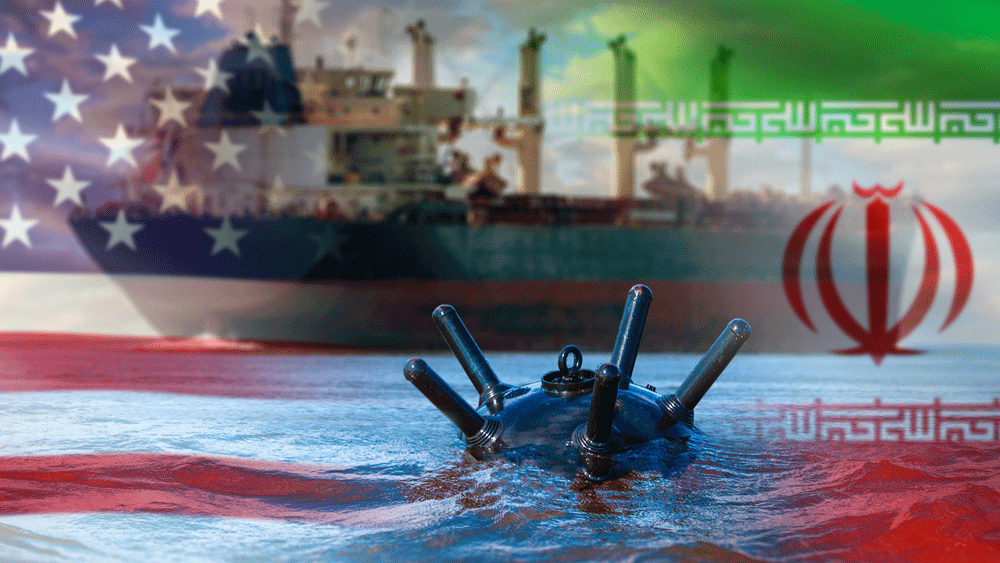
The signing on 19 June is merely the starting line that will set in motion a partial reopening to traffic alongside a clearance operation to remove the mines laid by Tehran across key sections of the strait.
The memorandum gives Iranian forces 30 days from signing to clear the strait of mines. At the same time, the Pentagon’s estimates appear to suggest that a full minesweeping could take up to six months, even with three dedicated vessels in the region.
Such gaps – here a 30-day treaty obligation against a six-month operational reality – have become the running feature of the bilateral negotiations, which have been framed by mutual distrust and plagued by an absence of granular detail.
The deal is welcome for the region despite its uncertainty. Behind the mines sits a tanker backlog built over more than 100 days, and Gulf producers that throttled back production and need time and assurances to restore flow.
Before the war, roughly 100 ships transited daily; Kpler now projects around 40 a day could sail within the first month, but with an estimated 300 loaded vessels stranded on either side of the strait, and 250 more sitting empty and idle in the Gulf, it is a pressure release valve, not an immediate restoration of flow.
A total restoration of oil and trade flows is unlikely to come into view before the year’s end.
Insurance represents the second brake, with war-risk premiums standing at 1-4% of vessel value per transit, or about $8m for a $200m tanker – against less than 0.1% before the war.
Shipping associations are no less cautious, with the Baltic and International Maritime Council calling for verified mine-free routes before volume traffic resumes.
Insurance underwriters are likewise unlikely to relent on prices until clearance is confirmed.
Conditional relief
Markets have already traded the sentiment, however. Brent settled at $87.33 on 13 June – an eight-week low – and have fallen further as the deal has firmed. As of early morning trading on 16 June, the first full day of trading after the Islamic New Year, Brent was down at $78.
Yet the relief remains highly conditional: a 60-day nuclear negotiation now follows the signing, and a breakdown in either this, passage through the strait or peace in Lebanon could return the strait to crisis.
The US-touted toll-free terminology is also narrower than billed, with the Iranians instead affirming a 60-day grace period for fees but not eliminating the possibility of “fees” for navigation, environmental and insurance services after that point.
The distinction is legal, not rhetorical, with international maritime law barring tolls on passage through natural straits but permitting the imposition of service fees on vessels passing through territorial waters.
It is through this terminology that Iran is now consistently framing its plans to charge fees from passing vessels through the office of its Persian Gulf Strait Authority – established 5 May and since sanctioned by the US Treasury.
For the Gulf, a 60-day waiver that resolves into an Iranian (and possibly joint Omani) fee regime is a pause in Iran’s tollgate economy, not its end – and would represent a strategic concession for the US, the Gulf and the globe.
Levant entanglement
Lebanon is another conditional space that the deal cannot fully escape, with a flare-up on that front being the final potential trigger that could collapse the 60-day agreement.
Iran has explicitly tied a ceasefire in Lebanon to the resolution of transit in the strait, but Israel does not agree with this, and the linkage may have inadvertently handed Tel Aviv the exact tool it needs to disrupt the US–Iran ceasefire – through the simple of continuing a conflict that it already wants to continue.
Within a day of the deal, Israeli Defence Minister Israel Katz said the IDF would stay in southern Lebanon “without any time limit”, with US officials corroborating that Israeli withdrawal was never a condition of a deal.
On the ground, the ceasefire is already looking frail, with post-deal fire straying in both directions and already endangering the regional calm and Hormuz reopening the Gulf is already pricing.
For Gulf producers and shippers, the distinction and in some cases friction between what the deal declares and what it actually delivers remains a cause for uncertainty.
A declaration is easy, but the delivery requires nuclear negotiation, mine-clearance verification, insurance repricing and a 60-day political test before barrels can again move at volume.
Trump, who has been frustrated for months with the slow progress on Iran from a US perspective, is also more than likely to be distracted by other concerns on a timeline shorter than 60 days – risking the political will to peace coming up short.
In the Gulf, whether Saudi Arabia and the UAE send cabinet-level representatives to Geneva on Friday will signal whether the region’s political leaders are willing to wield the political capital necessary to keep the US on track and pursue the ceasefire to fruition.
You might also like...

Chinese contractor wins Damac Riverside apartments deal
16 October 2026

Morocco begins prequalification for 350MW solar projects
16 October 2026

Algeria tenders 310km Tamanrasset railway
16 October 2026
Joint venture wins $246m RCRC bridges contract
16 October 2026

A MEED Subscription...
Subscribe or upgrade your current MEED.com package to support your strategic planning with the MENA region’s best source of business information. Proceed to our online shop below to find out more about the features in each package.
Take advantage of our introductory offers below for new subscribers and purchase your access today! If you are an existing client, please reach out to your account manager.