


The Gulf’s petrochemicals industry is heavily skewed towards the production of commodity chemicals but the drive to develop new industries is boosting lower-profile chemicals such as caustic soda
Over the past decade, the region has transformed itself into a major exporter of products such as polyethylene. Compared with its production of plastics and commodity chemicals, the Gulf region’s other chemicals are often overshadowed. The chlor-alkali chain of products is illustrative of how the market is skewed.
Chlorine and caustic soda production are key indicators of global economic growth
Paul Hodges, International Echem
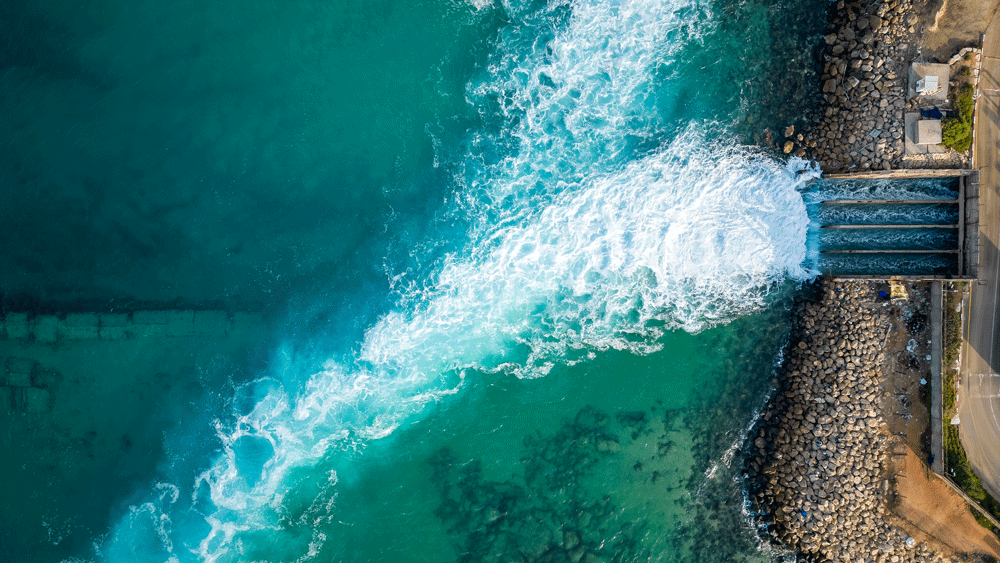
Sodium hydroxide – also known as caustic soda, and chlorine – are two co-products made from the electrolysis of salt. Three techniques are available, using mercury, membrane or diaphragm technologies. Each of the processes produces 1.1 tonnes of caustic soda for each tonne of chlorine.
In Europe and the US, caustic soda has traditionally been used by the pulp and paper industries and also in the production of metals such as aluminium.
The majority of chlorine is used for the output of polyvinyl chloride (PVC), a rigid plastic with numerous applications in the construction sector. It can also be used for the purification of water.
Caustic soda
“Chlorine and caustic soda production are key indicators of global economic growth,” says Paul Hodges, chairman of UK consultants, International Echem.
“They have been produced in large volumes for more than a century, and have a wide range of uses from pharmaceutical and aluminium production to detergents and disinfection.”
On 1 May, Saudi Arabia’s Sahara & Maaden Petrochemicals Company (Samapco) announced it had started production from its new chlor-alkali plant at Jubail Industrial City in the east of the kingdom.
In 2010, the GCC was producing only 450,000 t/y of caustic soda, but new capacity additions lifted this to 880,000 t/y in 2012. The start-up of the Sampaco plant took the region’s capacity to more than 1 million t/y for the first time. The US consultant Nexant forecasts this figure could rise to more than 1.5 million t/y by 2015.
Total global production, by comparison, stands at about 60 million t/y and could grow to almost 80 million t/y by the end of 2016.
Samapco is a joint venture of Riyadh-based Sahara Petrochemicals and state-owned Saudi Arabian Mining Company (Maaden). The plant will use technology licensed from German engineering firm Uhde. Plans for the plant were first announced in March 2011. It will produce 250,000 t/y of caustic soda, along with 300,000 t/y of ethylene di-chloride (EDC), a key intermediate chemical used in the production of PVC.
Maaden’s ambitions as an aluminum producer will be critical to the region’s chlor-alkali market. The first aluminum was produced at Ras al-Khair on the east coast of Saudi Arabia on 12 December 2012, marking the beginning of a new industry for the kingdom.
The smelter is owned by a joint venture of Maaden and the US’ Alcoa and will produce up to 740,000 t/y of primary aluminium. It uses bauxite sourced from mines in the north of Saudi Arabia, which is refined into alumina at the 1.8-million t/y Ras al-Khair refinery before being smelted into aluminium.
Aluminium driver
Maaden’s smelter is one of several aluminium schemes in the region. Since the start-up of Aluminium Bahrain (Alba) in the 1970s, there are now seven producers in the Gulf, with a total capacity of 4.66 million t/y.
“With the growth of aluminium production in the region, there will be greater demand for caustic soda,” says Hodges.
“But the focus remains on local markets. There is a big difference between local markets and exports. The chlor-alkali products have different drivers to commodity chemicals such as polyethylene.
“The Middle East has never been a great player in the chlor-alkali markets. Its focus has always been on commodity chemicals such as polyethylene. This is changing, but there are few plans for export-orientated plants.”
One of these is a project to build an EDC and caustic soda plant in Salalah. This is being constructed by the local Saltic. Previously known as Oswal Oman Caustic, the firm will invest between $400m-500m in the venture.
The plant is designed to produce 1,000 tonnes a day (t/d) of caustic soda, along with 1,231 t/d of EDC, which is used for manufacturing vinyl chloride monomer, the key raw material in the production of PVC.
Oman plans
Saltic has already selected UK-based Ineos to provide the technology for the EDC plant, while Japan’s Chlorine Engineers Corporation was hired for the caustic soda facility. Canada’s SNC-Lavalin and South Korea’s STX were involved in detailed engineering work on the project.
Saltic also has an agreement in place with Dhofar Power Company for 150MW of power supply for the life of the plant.
In September, Saltic selected South Korea’s Hanwha Engineering & Construction for the plant’s engineering, procurement and construction (EPC), which is expected to be completed by the end of 2014. The first commercial production is scheduled for early 2015.
SNC-Lavalin and STX conducted the detailed engineering of the facilities, as well as ethylene unloading facilities at Salalah port, since Saltic will have to import its ethylene feedstock to produce EDC.
The chemicals project is reliant on Salalah port’s current expansion of the cargo terminal, which will provide enough export capacity to handle Saltic’s output. Construction has mobilised on the expansion, which is expected to be completed by the first quarter of 2014. Some industry sources question the viability of such a project, since the Middle East has traditionally focused on meeting domestic demand.
The company says it has contracts in place for the supply of salt feedstock with Australian and Indian suppliers, as well as offtake agreements for its caustic soda and EDC.
“This is where reasonable people will disagree, but you have to question the economics of the Oman project,” says one industry source. “The company says it has offtake agreements, but what are they dependent on? If China slows, will they be able to sell? Is it a take or pay agreement? If it is, do they have the money to pay if they cannot sell?”
With the growth of aluminium production in the region, there will be greater demand for caustic soda
Paul Hodges, International Echem
Demand for caustic soda is also just one half of the equation that Gulf petrochemicals producers must take into account when considering plans for new chlor-alkali plants. The other side is chlorine, demand for which is closely tied with the construction sector.
Caustic soda, owing to its liquid form, is easy to transport and export, while gaseous chlorine is usually used immediately in the production of EDC, which can then be shipped.
“This is where it gets difficult. When you build a plant, you have to think about the contradictory dynamics of the two products. It is hard to sell both and get the best prices for both at the same time. It becomes an optimum sizing issue,” says the source.
The GCC has only one PVC facility: Arabian Petrochemical Company (PetroKemya) in Jubail, which produces 436,000 t/y, and there are no plans for future capacity additions.
Qatar Vinyl Company produces EDC and vinyl chloride monomer (VCM), the two key intermediaries used in PVC production, but has no integrated PVC production itself.
As such, the region has become a net PVC importer, absorbing approximately 300,000 t/y. Around 85 per cent of this is used in the production of pipes. Other rigid applications, such as door and window frames account for only 2 per cent of demand.
The Dubai-based Gulf Petrochemicals and Chemicals Association (GPCA) estimates PVC demand rose by 5 per cent to 707,000 t/y in 2012, compared with 2007.
Saudi Arabia is both the biggest consumer and saw the highest growth in demand, rising from about 370,000 t/y in 2007 to more than 450,000 t/y. The UAE in 2012 consumed only 150,000 tonnes in 2012.
The industry body forecasts demand will grow by 8.7 per cent a year for the next five years, driven by pipe and cable applications as major infrastructure and construction projects in the region are realised.
PVC competition
Despite the strong market share enjoyed by PVC producers in applications such as pipes and cables, the product’s continued use, particularly for transporting potable water, is now being questioned due to competition from other polymers.
Since 2008, Saudi Arabia has removed PVC from its preferred materials list for its potable water pipeline network, to be replaced mainly by high density polyethylene. New polypropylene capacity, which is due onstream in the next few years may also erode PVC’s market share in sewage applications.
“The small plants in the region make sense. You need chlorine for drinking water. But with the growth of aluminium production in the region, there will be greater demand for caustic soda,” says Hodges.
While PVC demand in the region may face a difficult future, caustic soda is an essential feedstock needed for the bauxite refining process, and this is likely to drive capacity increases.
Key fact
Caustic soda production in the GCC could rise to more than 1.5 million tonnes a year by 2015
Source: Nexant
You might also like...
A MEED Subscription...
Subscribe or upgrade your current MEED.com package to support your strategic planning with the MENA region’s best source of business information. Proceed to our online shop below to find out more about the features in each package.
Take advantage of our introductory offers below for new subscribers and purchase your access today! If you are an existing client, please reach out to your account manager.