


While the emirate’s sewerage network is struggling under the strain of increasing demand, better long-term planning is enabling other states to provide the necessary additional capacity.
When power generation or desal-ination capacity is in short supply, the impact on consumers is clear and often immediate in the form of supply cuts, which are not uncommon across the Gulf. But it is not just the region’s electricity and water providers that are struggling to cope with the challenges posed by rapid population growth. Wastewater treatment capacity is also lagging significantly behind demand, and although the consequences of this particular supply shortfall may be less visible, they are just as significant.
The UAE, with double-digit population growth each year, is finding it difficult to keep up with wastewater treatment needs, and it has not gone unnoticed. In Dubai, residents have started to complain about the smell of sewage in the air.
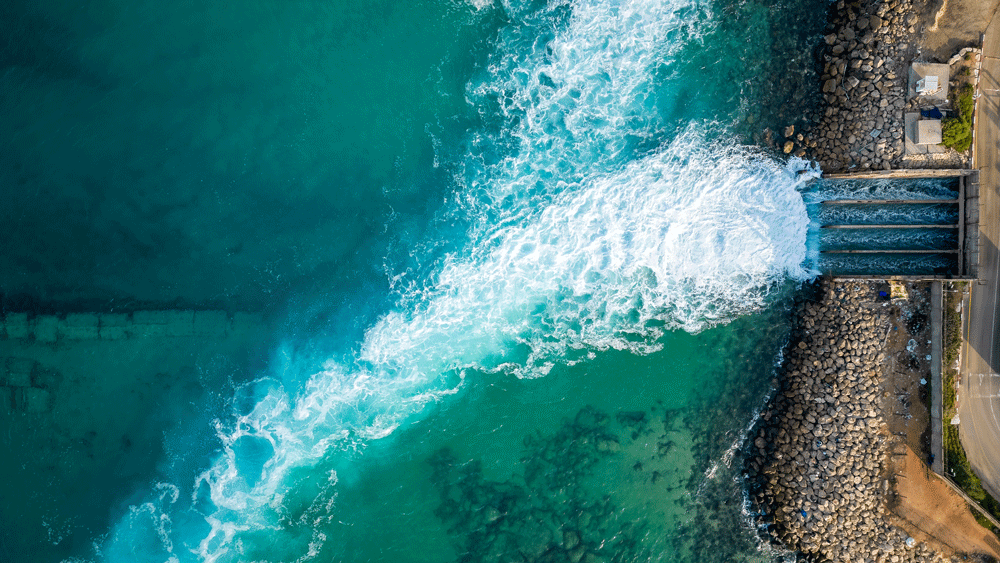
The city’s rapid expansion has pushed its one wastewater treatment plant beyond its limits. Dubai Municipality has admitted that the plant at Al-Aweer is now churning out treated effluent that is hazardous and fails to meet international standards.
Exceeding capacity
Originally designed to treat 57 million gallons a day (g/d) of sewage, the plant now runs at 70 per cent above design capacity and processes 101 million g/d.
The biological oxygen demand (BOD) indicator, which measures the rate at which micro-organisms decompose waste, is at 154 tonnes a day (t/d). This is almost double the design level of 75.4 t/d.
The treated effluent is used for irrigation and landscaping or discharged into Dubai Creek. However, because the plant is operating beyond its design capacity, the BOD is not able to remove the bacteria. Effluent that is not treated to a sufficiently high standard may still contain harmful pathogens including ecoli and salmonella. However, these are believed not to pose any immediate health risks to Dubai residents because direct contact with the effluent is limited.
Dubai Municipality says 3,000 trucks deposit 22 million g/d of sewage at the Al-Aweer plant. But some sewage never makes it to the plant. In December 2007, it was revealed that tankers were illegally dumping raw sewage into the city’s stormwater network, which discharges into Dubai Creek.
“The real risks [to residents] are to do with tankers illegally discharging because queues at Al-Aweer are so long,” says an industry source. “The tankers discharge septic material down storm drains because the technique is to pay drivers by the run. They are paid to take the sewage away rather than to deliver it to the treatment plant.”
The municipality is aware of the problem and is implementing several projects to alleviate it. In the short term, a 14 million-g/d aerated lagoon to receive sewage is planned at Jebel Ali, as are two 5.5 million-g/d membrane bioreactor plants. In the long term, only additional wastewater treatment capacity can help. A 66 million-g/d plant will come on line in Jebel Ali in 2010. The Al-Aweer plant will also be expanded.
It is arguably Dubai Municipality’s lack of forward planning that has resulted in the current situation. The municipality was expecting the inflow of sewage to grow at a rate of 15 per cent a year. Instead, it now faces a 25 per cent annual growth rate.
Growing demand
Other emirates are also having to deal with burgeoning demand, but so far seem to be managing the situation better. Abu Dhabi’s wastewater treatment plants are also operating above their design capacity.
The Mafraq plant, which processes 92.5 million g/d of sewage, was designed to handle only 79 million g/d. A second plant at Al-Zakher in Al-Ain was designed to treat 12 million g/d of sewage, but now processes 26.4 million g/d.
Abu Dhabi Sewerage Services Company (ADSSC) has not yet experienced the same quality problems as Dubai, but is aware that it may be only a matter of time.
“Our effluent meets the standards,” says Alan Thomson, managing director of ADSSC. “But we are waiting on a failure coming through because we realise we cannot maintain the quality forever as load increases.”
ADSSC has developed its demand forecasts in conjunction with the government’s Plan Abu Dhabi 2030, covering urban development in the emirate. Based on long-term projections, ADSSC plans to invest a total of AED11bn ($3bn) on developing wastewater infrastructure.
Its AED4bn strategic investment programme includes the building of a AED2bn deep-tunnel gravity sewer leading from the northern part of Abu Dhabi island to the mainland. The parallel tactical investment programme focuses on asset enhancement and includes the addition of new capacity as well as the improvement of existing facilities.
An 11 million-g/d expansion of the Mafraq plant will be completed in nine months. Four new plants with a total capacity of 161 million g/d will also be built at Al-Wathba in Abu Dhabi and Al-Saad in Al-Ain.
Meanwhile, ADSSC has come up with a contingency plan. It will divert some sewage from Mafraq to a new treatment plant being built at the Mussafah industrial site. The 40 million-g/d plant is due to come on line by the end of 2008.
Unlike Dubai, Abu Dhabi has successfully co-ordinated its activities with private sector developers. “The approach has been more centralised and government-led in Abu Dhabi,” says the industry source. “It is a free-for-all in Dubai.”
In some cases, developers are building their own treatment plants on site, but others still rely on Dubai Municipality. “Some developers have their own concession agreements; others are wallowing and not getting anywhere,” says the source. “This is the case on one of Dubai’s most well-known real estate projects. Its developers want to discharge into the municipality’s network, but it does not have the capacity.”
Planned increases
ADSSC’s approach has left it better prepared to cope with new demand. “We have worked closely with developers so we know exactly what their plans are, when they are likely to happen, and we can discuss how to handle the loads,” says Thomson.
Smaller emirates that are starting from a low base have adopted a similar method. Ajman, which is only now building its sewage network, must work closely with developers to meet demand. So far, 6,000 properties in the city have been connected to a 10.8 million-g/d treatment plant. A total of 75,000 people will be connected to the system by the end of 2008. “Apart from the properties in the city centre, we have been approached by new developers who have purchased massive pieces of land in the desert,” says Olivier Crasson, general manager of Ajman Sewerage (Private) Company.
“We are certain that the population outside the city, where there is nothing today, will be exactly the same as inside. The growth is absolutely fantastic. There is a tsunami of developers asking for more services coming.”
While it may face the same challenges as the more populous emirates, Ajman’s position is unique. Ajman Sewerage was set up as a public-private partnership between Belgium’s Besix, France’s Veolia Water, the US’s Black & Veatch and the government of Ajman. The company has the exclusive concession to build and operate Ajman’s sewage system until 2033.
“It is the first experience like it in the Middle East,” says Crasson. “The service is not subsidised. We have to levy fees with the full cost being supported by customers.”
This is unusual in a region where consumers are not used to paying real prices for power and water. “It is a challenge,” says Crasson. “We will not get people paying from the first day. You first have to prove that you can deliver and then people will not be discussing it any more.”
It is clear that as all of the emirates face the task of meeting growing demand for wastewater services, long-term planning in conjunction with urban planners and developers will be vital. And while Abu Dhabi and Ajman appear to have mastered this approach, it is something Dubai still needs to work on.
Key Facts
10-15 per cent a year - Population growth
9 per cent a year - Water demand growth rate
1.06 billion g/d - Desalination capacity
57 million g/d - Dubai wastewater capacity
Source: MEED
You might also like...
Local contractor to build Abu Dhabi emergency lagoon
19 June 2026
Kuwait tenders downstream maintenance contract
19 June 2026
A MEED Subscription...
Subscribe or upgrade your current MEED.com package to support your strategic planning with the MENA region’s best source of business information. Proceed to our online shop below to find out more about the features in each package.
Take advantage of our introductory offers below for new subscribers and purchase your access today! If you are an existing client, please reach out to your account manager.