


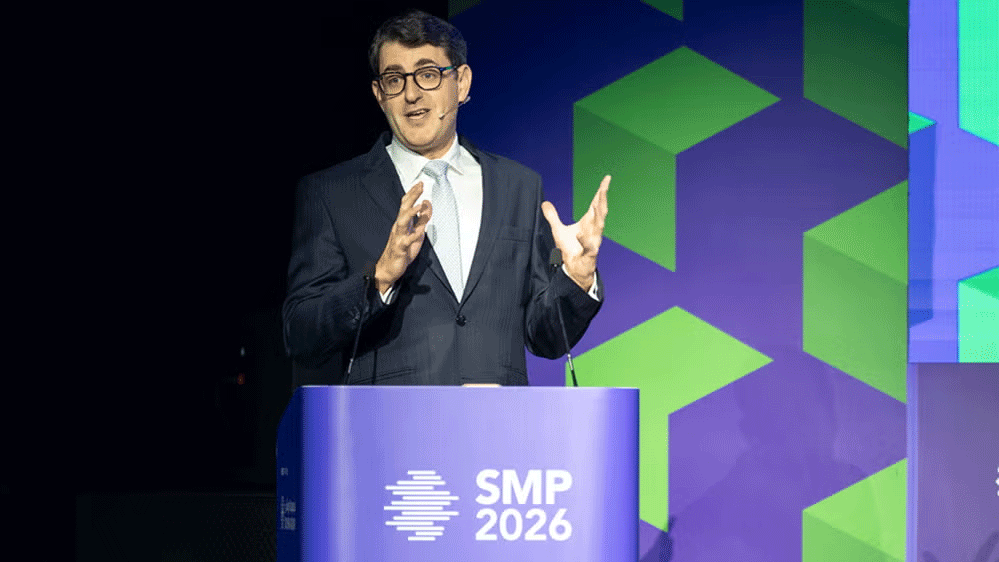
Josep Forroll, chief development strategy officer at Diriyah Company, outlines the principles guiding development at one of Saudi Arabia’s most important cultural sites
Most developments treat heritage as something to work around. When you began shaping the Diriyah masterplan, what were the non-negotiables that everything else had to respond to, and where did you allow flexibility?
Josep Forroll: As the developer of the 300-year-old birthplace of Saudi Arabia and the ancestral home of the Al-Saud family, we recognised that we had been entrusted with one of the kingdom’s most significant cultural assets. That responsibility shaped every planning and development decision we made.
Diriyah Company is creating an environment that enhances Diriyah’s historic, national and international relevance, transforming it into one of the region’s foremost destinations for cultural knowledge-sharing activities and international events. We are committed to creating rich experiences that narrate the stories of the city’s history and ensuring its cultural landmarks are complemented by leading hospitality brands, fine dining experiences and world-class retail offerings. Since December 2022, we have welcomed more than 5.3 million visits as Saudi nationals, expatriates and a growing number of international guests visit its palaces, alleyways and restored buildings, many of which now house museums celebrating the kingdom’s culture.
With Diriyah’s historic heart protected, we were able to shape a wider masterplan anchored by the Unesco World Heritage Site of At-Turaif. Every aspect of the development reflects the principles of traditional Najdi architecture, creating a destination that is authentic to its natural setting.
Beyond those defining principles, we have allowed flexibility in how we realise that vision. A masterplan of this scale must be resilient enough to adapt over time, responding to changing needs and future opportunities while remaining anchored in the values that define it. That approach ensures Diriyah can continue to evolve without compromising its identity.

Diriyah is often described as heritage-led, but in planning terms that can mean very different things. How did that principle translate into actual land use and design across the 14-square-kilometre development?
JF: Diriyah’s centuries of heritage and history are the fundamental driving force behind our world-class master planning process. We realised that the Najdi architectural heritage gave us the opportunity to create something truly distinctive at a scale never attempted before.
Heritage did not simply influence the appearance of individual buildings – it shaped the way the entire destination is planned. It informed the relationship between districts, the public realm, the pedestrian experience and the integration of residential, commercial, hospitality, retail and cultural assets into one connected city.
That philosophy is reflected consistently across the development, from residential communities and retail districts to our 34 hotels, the Diriyah Opera House, Diriyah Arena and museums.
Diriyah Company is also working with some of the world’s best architectural firms, who have seized on our approach as a unique opportunity to create places built for today that pay homage to the past.
From a master planning perspective, where do you expect the strongest long-term value to be created in Diriyah? What are the underlying drivers behind that?
JF: The greatest long-term value in Diriyah will not come from any single asset or district; it will come from the strength of the masterplan as an integrated development.
From the outset, we have planned a complete city where people can live, work, visit and invest. Residential, commercial, hospitality, retail, cultural and entertainment assets have been designed to complement one another, creating a connected destination that drives long-term resilience and sustainable growth.
The value created also extends well beyond real estate. As one of the kingdom’s gigaprojects, Diriyah is expected to contribute $18.6bn to Saudi Arabia’s GDP. More than 70,000 people are already working across the development, and once complete, Diriyah is expected to create around 180,000 jobs – demonstrating the lasting economic impact the masterplan is designed to deliver.
Diriyah is planned to be pedestrian-focused: a deliberate counter-position in a region where the car has dominated urban planning for decades. What were the hardest planning challenges in making a fully walkable city, particularly in this climate?
JF: What many see as a challenge, we see as an opportunity to rethink how a city should function. Diriyah Company’s commitment to building a walkable, human-centric city reflects a fundamentally different approach to urban development, one we believe can serve as a model for cities around the world.
The greatest challenge was not the climate; it was making the long-term investment in the infrastructure needed to prioritise people over cars. We developed a 5.7-kilometre subterranean network of tunnels carrying dual carriageways and utilities up to 30 metres below ground.
This is complemented by our commitment to creating connected communities where people can walk to work, school and other destinations. Extensive pedestrian pathways, cycleways and fully pedestrianised, open-air destinations such as Diriyah Square encourage people to experience the city on foot, creating a vibrant, human-centric urban environment.
Subterranean parking is a major cost and engineering commitment. What was the planning rationale behind that choice, and how do you see it paying back in terms of urban quality and long-term value?
JF: From the outset, our objective was clear – if you want to create a truly walkable, human-centric city, vehicles and parking cannot define the urban environment. That meant making the long-term investment to move parking below ground.
Under Diriyah Square alone, we are delivering a three-level car park with approximately 10,500 spaces and around 60,000 parking spaces across the wider development. Together with the Riyadh Metro, this will support Diriyah’s 100,000 future residents, the professionals who work here and the millions of visitors we expect each year.
The long-term value lies in the quality of the place we are creating. By moving vehicles below ground, we can dedicate the surface to people, creating vibrant public spaces, walkable streets and a more enjoyable urban environment.
For a contractor, specialist subcontractor or supply chain partner who has not yet engaged with Diriyah but is evaluating whether to, what is the most important thing they need to understand about how Diriyah Company operates and what it requires of its partners?
JF: Diriyah Company has very clear and transparent systems in place to enable smooth engagement across the full spectrum of contractors and partners. If they are yet to work with us, this gives them the confidence to become a partner and work on what is a truly unique project in global urban development terms.
A key example is our Be Ready programme, a structured onboarding and readiness framework that equips contractors, designers and fit-out partners with a clear understanding of our delivery standards and ways of working before they mobilise. It also supports the development of local capabilities in line with Saudi Arabia’s local content ambitions.
Market response has been strong and shows it was ready for structured engagement of this kind. We understand that contractors and designers want to know what is expected of them before they mobilise, not after they arrive on site. That approach has helped Diriyah Company attract a strong pipeline of partners across a broad range of disciplines.
Diriyah is not just a development; it is effectively setting a new design benchmark in the region. Which aspects of the plan do you think will influence other cities going forward?
JF: Our ambition has never been to simply build another large-scale urban development. It has been to demonstrate that there is another way to create cities; one that places people, heritage and quality of life at the centre of the masterplan.
I believe the one thing that will have the greatest influence is our commitment to human-centric planning. From prioritising walkability and creating vibrant public spaces to integrating culture, hospitality, retail, residential and commercial uses into one connected destination, every decision has been guided by how people will experience the city.
In many ways, Diriyah draws inspiration from traditional urban living, where communities are connected, walkable and centred around people. Diriyah Company has reinterpreted those principles for a modern city, combining authentic Najdi architecture with sustainable design and integrated mixed-use planning.
You might also like...
Honeywell wins Bahrain aromatics technology deal
13 October 2026
Contractors line up for Neom wastewater plant
13 October 2026
Contractors submit Riyadh road scheme bids
13 October 2026
Contractor groups prequalify for Dubai Metro Gold Line
13 October 2026
A MEED Subscription...
Subscribe or upgrade your current MEED.com package to support your strategic planning with the MENA region’s best source of business information. Proceed to our online shop below to find out more about the features in each package.
Take advantage of our introductory offers below for new subscribers and purchase your access today! If you are an existing client, please reach out to your account manager.