


The Egyptian finance minister is planning a series of public-private partnership schemes to attract international investment and stimulate economic growth.
The global economic downturn has been a source of grievance for finance ministers around the world for the past year. But for Egypt’s Finance Minister Youssef Boutros-Ghali, the frustration must have been particularly acute.
The crisis has done more than shave a few percentage points off the country’s economic growth statistics. It has stalled a reform programme that has been at the centre of government policy for the past five years - one that, until a year ago, was enjoying considerable success and fuelling sustained economic growth.
“Obviously, all sectors are exposed to the outside world,” Boutros-Ghali tells MEED. “There has been a drop in exports, tourism revenue, remittances and income from traffic on the Suez Canal, all of which have affected local economic activity and domestic demand.”
Boutros-Ghali was appointed finance minister in the newly formed cabinet of Prime Minister Ahmed Nazif in July 2004. The creation of Nazif’s administration was a watershed for Egypt, marking the start of a new focus on modernising the economy and making it more attractive to foreign investors.
To do so, Nazif brought together a cluster of liberal-minded economic reformers with an international outlook, including Mahmoud Mohieldin as minister of investment and former banker Rachid Mohamed Rachid as foreign trade and industry minister.
Government experience
Unlike Mohieldin and Rachid, whose backgrounds are in the private sector, Boutros-Ghali has had a long career in government. From 1986 to 1993, he was economic adviser to the prime minister and the governor of the Central Bank of Egypt, before joining the cabinet in 1993, where he held a range of ministerial positions in the fields of international co-operation, economic affairs and foreign trade.
But he also has a wealth of international experience. He speaks five languages and has studied in the US, where in 1981 he gained a PhD in economics from the Massachusetts Institute of Technology. For six years after that, he was a senior economist for the International Monetary Fund (IMF) and chief negotiator to the body on Egypt’s economic development programme in the late 1980s and early 1990s.
In October 2008, he became the first developing country representative to be appointed chairman of the IMF’s International Monetary & Financial Committee, which advises the organisation’s board of governors on global monetary and financial issues.
Great things were expected from Nazif’s new reformist cabinet, and much has been achieved. The government launched an aggressive privatisation programme that raised £E15bn in 2005-06 alone. It has also restructured the banking sector, and has targeted foreign direct investment (FDI) in industry to help tackle unemployment.
Boutros-Ghali also set ambitious macro-economic targets for the country, including a reduction of its unwieldy budget deficit by 1 percentage point a year to 3 per cent of gross domestic product (GDP) by 2010-11, and sustainable economic growth of 7-9 per cent a year.
In the early years, the minister enjoyed considerable success. By the end of the 2007-08 financial year, the deficit had fallen to 6.9 per cent, from 11 per cent in 2000, and GDP growth had reached 7 per cent, up from 4.5 per cent in 2004-05.
Boutros-Ghali told MEED in March 2007 that continued growth “will be realised through more reform, more privatisation, more liberalisation and further deregulation of the economy. We want to establish an environment where there is the least possible hindrance to profitable investment”.
But then Cairo hit hard times. The overheated international contracting market and fast-rising oil prices led to soaring global commodities prices, which in Egypt resulted in rampant inflation. Between February 2007 and February 2008, the price of unsubsidised bread in the country increased by 26.5 per cent. In response, planned cuts to wages and subsidies were reversed and Boutros-Ghali put on hold the 2008-09 reduction in the fiscal deficit, instead aiming to keep it stable at 6.9 per cent.
The challenge of dealing with such a high cost of living was swiftly followed by that of coping with the global downturn. Unfortunately, Boutros-Ghali’s success in liberalising the economy and opening up to international investment means the economy has been hit all the harder by the downturn, unlike more isolated North African economies such as Algeria.
In early 2008, the minister targeted economic growth of 7.2 per cent for 2008-09, but he has had to revise his targets. “Economic growth remains positive,” he says. “We expect a growth rate of 4.5 per cent, or 5 per cent if we are lucky.”
The minister’s expectations appear optimistic. Local investment banks EFG-Hermes and Beltone Financial predict growth of 3.3 per cent and 3.2 per cent respectively for 2009, and a fall to 1-2 per cent in 2009-10.
In line with most economies in the Middle East and North Africa (Mena) region, Boutros-Ghali has responded with an expansionary budget in the hope of creating employment and ensuring sustainable growth in the future.
“We have increased public spending by 1.5 per cent of GDP, or £E15bn,” he says. “All of it will be spent on infrastructure. It is all employment generating. The construction part will be labour intensive. We have extended our public housing programme by 50 per cent, which creates significant demand.”
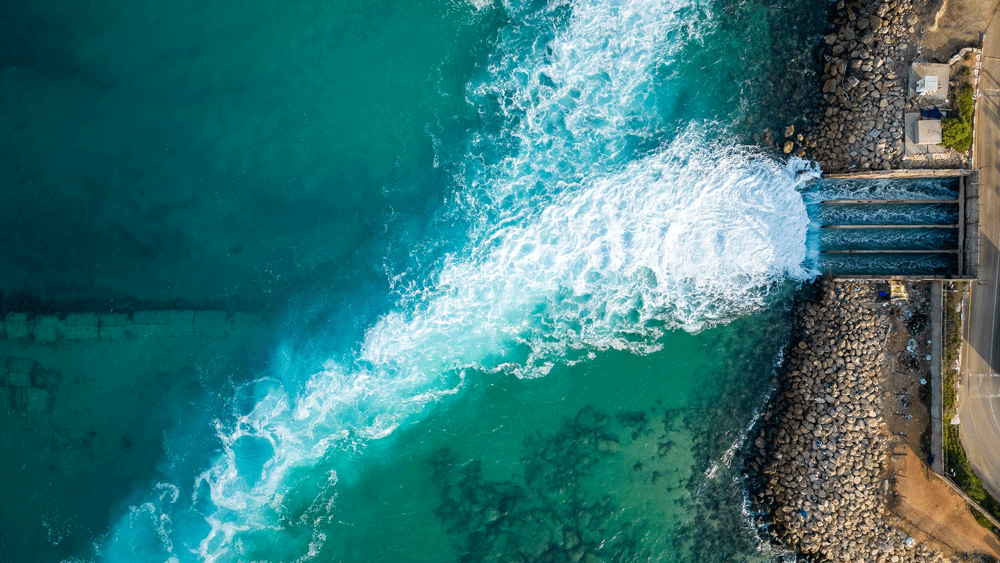
The minister also plans to attract £E15bn in investment in public-private partnerships [PPP]. “A number of projects are going ahead,” he says. “We are about to award contracts to build 350 schools, and contracts to build three wastewater treatment stations, two sewage stations and four hospitals are also being tendered. All are to be tendered to the private sector with their own funding, for us to rent out when they are complete. So we will be spending £E15bn on infrastructure, which does not register on the budget.”
International investment
The government’s ability to attract inter-national interest in the programme has been under scrutiny in recent months, but it now appears to be going ahead, albeit with some delays. The minister is confident that foreign companies will find the scheme an attractive opportunity, and that ultimately its total value could quadruple.
“Once we get the PPP scheme rolling, we will have programmes worth £E60bn,” he says. “I think there will be an appetite [for them]. All of those companies who do not have work in the Gulf have money to spend, but they don’t have the customers. I am an ideal customer. I will give guaranteed payments for 25 years, all take or pay. For treated water, I will pay for the cubic metres whether I take them or not, so it is guaranteed income.”
But while the PPP scheme will have little effect on the government’s fiscal position in 2009-10, its own increase in expenditure will not be matched by increasing revenue. “We are still working on [our predictions for] revenue,” says Boutros-Ghali. “But it will be dropping. We have had lower sales tax receipts because people are buying less, income tax receipts are down because people are not earning as much, and receipts from Suez Canal traffic are down.”
As a result, Boutros-Ghali will be forced to compromise further on his objectives to reduce the fiscal deficit. When the decision was announced to delay the targeted 1 per cent reduction for 2008-09, the government insisted that the 1 per cent target was an average throughout a period of time, rather than an annual stipulation.
“We have kept to schedule even in the face of massive price increases and the resultant massive increase in subsidies,” says the minister. “We have not changed our targets one iota in the past five years. We have postponed [them] by a year.”
But over the coming financial year, the deficit is likely to fall for the first time since Boutros-Ghali became finance minister. “This year we expect it to be about 6.5-6.8 per cent, which is somewhere around where we have targeted,” he says. “Next year, it will be bigger, but we are hoping that the average of this year and next year will be about 7.5-8 per cent, which is not far away from our targets.”
Boutros-Ghali insists that increased expenditure will facilitate the repayment of debt in the future. “All [the spending policies] are labour generating and will increase the productivity of the Egyptian economy to allow us to deal with the added debt burden,” he says. “We have established that our current growth ceiling is in the order of 7.5 per cent, but after this investment spending - on roads, ports, the rail network - we expect to raise this to 8.5-9 per cent in the next two to three years.”
The spending programme will be financed by the local banking system, which for now has ample liquidity. “There are no problems with the banking sector,” says Boutros-Ghali.
“Only 25-30 countries in the world were hit [by the global banking crisis]. There are another 160 countries that are fine. They are less exposed and do not have such a breadth of financial instruments.”
But how long can government spending be maintained in the face of falling revenue? “I hope longer than the crisis lasts,” says Boutros-Ghali. “We will see how long this is. We hope that by the first half of 2010 something will start loosening up and that our income will start improving.”
Tackling the budget challenge has also meant that Boutros-Ghali has had to compromise on his policy of reducing subsidies. These were mainly food and energy subsidies that are being phased out to allow more competitiveness in the markets.
Instead, the government is increasing export subsidies for the next two years, he says, and subsidising “certain categories of sales tax” for a year to boost spending.
“If people buy machinery, we give them a subsidy equal to the sales tax cost,” says Boutros-Ghali. “It only applies for a year, from 1 January to 31 December 2009.”
According to the minister, the policy will cost the government about £E200-400m. Cairo is also delaying the introduction of planned taxes for the country’s free zones, exempting refineries from the taxes that were expected to be introduced this year.
In contrast, proposals to increase the availability of gas feedstock for selected industries have been delayed for a year. “Industry is suffering, so [the measures have been] rolled back,” says Boutros-Ghali.
“The cost will be insignificant - about £E30m. It [the government] is just delaying the [proposed] increase by one year.”
But despite the impact of the global economic turmoil on Egypt’s ability to pursue its economic reform programme, Boutros-Ghali remains sanguine. “It will not change our attitude to reform,” he says. “This is life. No one could have anticipated what happened, and even if they had, there is nothing they could have done about it.”
You might also like...
Caution governs Jordanian bank lending
12 June 2026
Trump touts Iran settlement after fresh hostilities
12 June 2026
A MEED Subscription...
Subscribe or upgrade your current MEED.com package to support your strategic planning with the MENA region’s best source of business information. Proceed to our online shop below to find out more about the features in each package.
Take advantage of our introductory offers below for new subscribers and purchase your access today! If you are an existing client, please reach out to your account manager.