


With thousands of new graduates entering the labour market each year, Manama urgently needs to create new jobs to avoid a brain drain to neighbouring states
Key fact
About 55-60 per cent of Bahrain’s population is thought to be Shia
Source: MEED
Salah used to work for Bahrain’s national carrier Gulf Air until May 2011, when he was arrested and detained for three months.

Unwilling to give his full name, he remains out of work despite promises by the government that all workers sacked in relation to last year’s pro-democracy protests should be reinstated. He is now considering leaving the country to get a job at one of the GCC’s other carriers, which are continuing to recruit new staff to support their relentless expansion.
In order to ensure that Shia restiveness is addressed, Bahrain will have to focus on creating thousands of new jobs
Salah’s story is not uncommon. Across Bahrain’s Shia community, many have been affected by a wave of sackings in both private sector and public sector firms. When King Hamad bin Isa al-Khalifa commissioned the Bahrain Independent Commission of Inquiry (BICI) to investigate last year’s events, one of the things it was told to look into was the layoffs.
Bahrain’s economic challenge
Although efforts are under way to ensure that people are able to return to their jobs, Bahrain faces a serious economic challenge over the coming years and this has only been exacerbated by the sackings of the past year.
With its small economy, dwindling oil reserves and high budget deficit, job creation is a strategic imperative for the island’s future. Its constrained financial position means Manama will have to rely more heavily on the private sector to drive growth. In order to ensure that Shia restiveness is addressed, the government will have to not only restore the jobs of all the workers sacked last year, but also turn its attention back to creating thousands of new jobs.
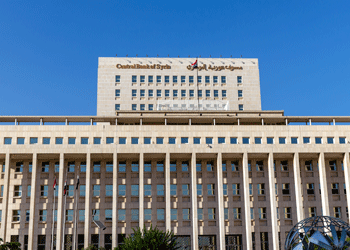
Since the dismissals of workers involved in Bahrain’s protest movement started in March 2011, it has ballooned to include government bodies such as the Central Bank of Bahrain, the ministries of health, education and the interior and private firms including Aluminium Bahrain, Bahrain Telecom and Gulf Air. Other business leaders in the private sector also say they were put under pressure from the government to sack workers involved in the protests or associated strikes.
In total, the BICI received 1,624 complaints about unfair dismissals, primarily from the Shia community. However, the number of people estimated to have been affected by the sackings is thought to be much higher. The General Federation of Bahrain Trade Unions (GFBTU) says about 14,535 people have been affected by the layoffs and that as of 5 March 2012, there were 1,776 workers in the public and private sectors who had either been dismissed or suspended and who remain out of work. For a country with a population of just 570,000 nationals, of which about 55-60 per cent are thought to be Shias, that is a large proportion.
More significantly, for a country where the Shia population already feels marginalised and often live in poor conditions, the sackings threaten to push many families into poverty. If that occurs, it risks further radicalisation.
The government says that all public sector workers have now been restored to their jobs. However, those affected by the situation say many people have been forced to accept demotions, reduced salaries or have been forced to sign agreements not to be involved in any future political protests.
Other cases, such as Salah’s, remain unresolved. The Bahrain Centre for Human Rights, a local activist group, says 300 people have not yet been reinstated. Managing the process of reviewing the layoffs is a commission consisting of the GFBTU, the Bahrain Chamber of Commerce & Industry and the International Labour Organisation. The Labour Ministry has also started intervening to ensure dismissed staff are re-employed on their old contracts.
Although welcoming the measures to restore people to their jobs, Al-Wefaq, the main opposition group, criticises the government for failing to hold anyone accountable.
Job discrimination in Bahrain
Employment has long been a thorny subject in Bahrain. Shias complain of discrimination in government jobs, particularly in the armed forces. They also claim that the ruling regime has been importing Sunnis from other countries and giving them citizenship and jobs to redress the balance of the country. Protests in Shia villages have long been a common feature of life in Bahrain, even before uprisings in other Arab countries inspired last year’s protests.
As a result, the Economic Development Board (EDB), a reform vehicle created by Crown Prince Salman bin Isa al-Khalifa to wrestle political power from Prime Minister Khalifa bin Salman al-Khalifa, put job creation at the heart of its Vision 2030 strategic masterplan, published in 2008. Unlike similar documents elsewhere in the region that generally focused on urban planning, Manama set out tangible goals for raising the standard of living for Bahrainis. At the centre of this was an aim to double the income of every household. It also aimed to unleash the private sector to drive job creation.
The EDB estimated that about 4,000 nationals with at least a degree were entering the job market every year, while the private sector was creating only 1,100 jobs a year for Bahrainis and about 2,700 jobs for non-nationals.
To achieve its goals, the EDB established two significant reforms of the labour market. Quotas on employing Bahrainis were dropped and the Labour Market Regulatory Authority (LMRA) was established in 2006 to be in charge of granting work visas for expatriates, while collecting a levy from firms for each foreign worker they employed.
The second initiative was the creation of Tamkeen, an organisation that used the money earned by the LMRA to provide training to nationals. The two reforms were intended to allow the private sector the freedom to employ people of any nationality it wanted without restrictions, while also trying to make the local workforce more competitive for better-paid jobs.
Training scaled back
“The original idea for Tamkeen was brilliant, but I’m not sure if it has the same political backing it did a few years ago,” says the head of one local bank.
Since 1 April 2011, the government has halted the collection of fees by the LMRA. The move was intended as a boost to local businesses after confidence was shattered by the protests. At a cabinet meeting on 25 March, the prime minister extended this period even further, pushing it back from expiring at the end of March to the end of June.
Tamkeen has also had its ambitions scaled back by the government’s decision to lower the LMRA fee it receives from 80 per cent to 50 per cent. The prime minister also ordered a review of the initiative and delayed plans to increase the levy on expatriate workers from BD30 ($80) to BD50, without indicating when or if the increase would occur.
Tamkeen still has plans to continue supporting firms in 2012 and it has generally found it easier to raise money than to spend it. But the close links between it and the crown prince, who has now been politically sidelined by the prime minister, mean its future is uncertain.
Whatever happens to the initiative, the government will have to solve the unemployment problem if it wants to restore stability to the island. Human rights violations and democratic representation in government have been the driving force behind the protests for much of the past year, but even before the Arab uprisings ousted leaders in other parts of the region, Bahrain’s Shia community had been taking to the streets to demonstrate.
“Quality of life is still the major issue underneath all the other problems we currently face,” says one opposition member.
Efforts to improve the household income of Bahraini families will not be helped by the news that yet another local bank has hit financial difficulties. Arcapita filed for Chapter 11 bankruptcy protection in late March and is the latest Bahrain-based bank to be humbled by the financial crisis. Before it, Arab Banking Corporation, Gulf International Bank and Gulf Finance House have all faced significant financial difficulties.
“There have been some serious problems in some of the biggest banks here, and those banks used to make a lot of Bahrainis very prosperous,” says the head of one local bank.
Economic diversification
Manama has for a long time recognised the need to diversify its economy. Lack of opportunities has often caused skilled Bahrainis to leave the country to get work in other parts of the region. It is thought that the exodus has increased in the wake of the unrest. But the country cannot afford a brain drain if it is to improve the lot of its people.
| Employment complaints received by BICI | ||
|---|---|---|
| Public Sector Employees | Dismissed | Suspended |
| Central Bank of Bahrain | 6 | 0 |
| Civil Service Bureau | 4 | 0 |
| Council of Representatives | 19 | 21 |
| Education Ministry | 153 | 111 |
| Health Ministry | 60 | 154 |
| Interior Ministry | 88 | 6 |
| Municipal Affairs & Urban Planning Ministry | 48 | 43 |
| Other | 87 | 20 |
| TOTAL | 465 | 355 |
| Private Sector Employees | Dismissed | Suspended |
| Aluminium Bahrain | 228 | 0 |
| APM | 43 | 0 |
| Arab Shipbuilding and Repair Yard Company | 8 | 3 |
| Banagas | 48 | 0 |
| Bahrain Telecom | 111 | 0 |
| Gulf Aluminium Rolling Mill Company | 13 | 0 |
| Gulf Air | 91 | 0 |
| Other | 246 | 13 |
| TOTAL | 788 | 16 |
| BICI=Bahrain Independent Commission of Inquiry. Source: BICI report | ||
More worryingly, human rights groups claim that people continue to be suspended for up to 10 days without pay. In February, the courts sentenced a teacher to three months in prison for refusing to work during a 2011 strike. Although the verdict was suspended, the BICI report said the strike was legal.
There are no easy solutions to Bahrain’s employment problem, but the longer protests continue, the more reluctant foreign firms will be to invest in the country. Well-educated nationals will be more tempted to leave the country if they can. Unlike in most Gulf states, the government cannot rely on oil revenues to buy itself out of the problem through generous handouts and the creation of public sector jobs.
Manama needs more than just political stability to deliver a prosperous future for all its citizens. And as of now, it does not even have that.
You might also like...

The price of permanent risk
25 June 2026
Oman awards concession agreement for offshore block
25 June 2026
Contractor wins €770m Italy-Tunisia power link deal
25 June 2026
Abu Dhabi awards Bab Gas Cap concession agreements
25 June 2026
A MEED Subscription...
Subscribe or upgrade your current MEED.com package to support your strategic planning with the MENA region’s best source of business information. Proceed to our online shop below to find out more about the features in each package.
Take advantage of our introductory offers below for new subscribers and purchase your access today! If you are an existing client, please reach out to your account manager.