


Saudi Arabia’s focus is shifting from ambition to delivery, activation and lasting value
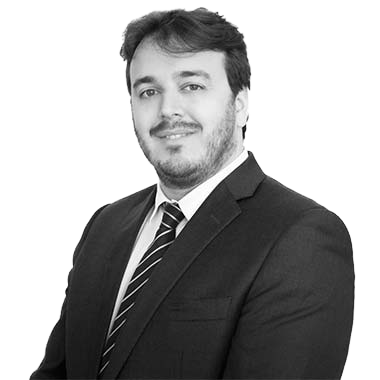
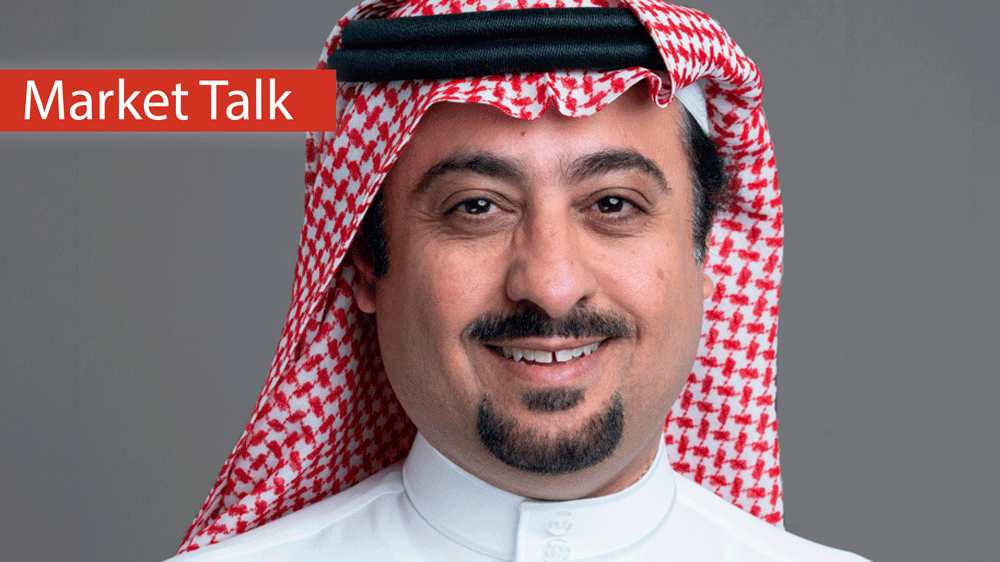
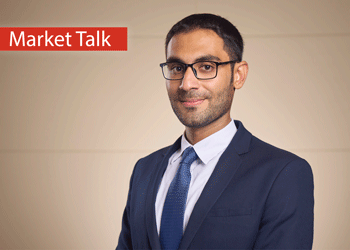
In conversation with Abdulelah Alsheikh, Country Director at Jacobs
 Saudi Arabia has undergone an extraordinary period of development under Vision 2030. As we look to the next phase, how do you see the kingdom’s priorities evolving from announcing and developing major projects to delivery, activation and long-term value creation?
The first phase of Vision 2030 was about ambition – new institutions, new capital investment, a pipeline of projects at a scale that could reshape the kingdom’s economy and cities. What we’re seeing now is the more demanding phase that follows: delivery.

The question is increasingly not simply what we build, but what each investment ultimately enables. Does it create a functioning destination? Does it attract residents, businesses, visitors and investment while strengthening the competitiveness of its city or region? Does it generate economic and social value over decades rather than simply deliver a physical asset?
That changes the emphasis from project development to delivery, activation and performance. It requires much stronger integration between infrastructure, real estate, mobility, economic development, public services and operations, and a sharper understanding of sequencing – a city is not activated simply because its buildings are complete.
Saudi Arabia has already demonstrated it can conceive and mobilise projects of extraordinary scale. The next measure of success is how effectively those investments translate into productive places, stronger regional economies and sustainable long-term value.
That’s exactly where Jacobs sits – at the intersection of strategy, programme delivery, infrastructure and long-term asset performance, connecting a project’s original ambition with the practical realities of delivering and operating it.
With your background spanning government, investment, urban development and the private sector, what do you believe are the most important factors in turning ambitious masterplans into successful, economically sustainable cities and communities?
One lesson I’ve learned across those different roles: a masterplan is a tool, not the end goal.
We sometimes place too much emphasis on the physical plan itself. Successful cities are ultimately shaped by economics, institutions, infrastructure, people and markets. The spatial plan has to bring those elements together.
The starting point should be a clear proposition for the place: what will attract residents, businesses and investment; what economic activity will sustain it; and what gives it a lasting competitive advantage? Equally important is communicating a clear vision — stakeholders need to understand not only what is being built, but why it matters and how it will create long-term value. Only then should we determine the development programme, infrastructure requirements and sequencing needed to support that proposition.
Phasing is particularly important. Large developments need to function at every stage of their growth. Infrastructure cannot be considered independently from absorption, population growth and commercial demand, nor can every component be delivered simultaneously simply because it appears in the ultimate masterplan.
There is also an important distinction between creating real estate and creating a city. A successful community needs the right mix of jobs, services, mobility and amenities and a strong sense of place. Those elements have to mature together.
Saudi Arabia has an opportunity to develop a distinctive model for city development. We should learn from international experience, but our cities must respond to local demographics, culture, climate and economic aspirations. The most successful developments will combine global expertise with a deep understanding of the local context.
Saudi Arabia’s giga and megaprojects involve an unprecedented number of developers, consultants, contractors, government entities and investors. How can stronger governance and collaboration across this ecosystem help improve delivery certainty and project outcomes?
At this scale, complexity itself becomes one of the principal delivery risks.
You may have an excellent masterplan, experienced consultants and contractors and strong individual government entities, but if decisions, responsibilities and reporting lines are fragmented, the programme will still struggle.
Good governance isn’t another layer of oversight. Too many layers can often have the opposite effect. What matters is clarity: who owns the outcome, who has authority to make decisions, how interfaces are managed, how quickly issues get escalated and resolved, and whether everyone is aligned around the same priorities.
We also need to move beyond a siloed approach to delivery. Megaprojects are systems: a decision in one area can – let’s say land use – can ripple into infrastructure, financing and commercial performance elsewhere. Success depends on optimising outcomes across the whole programme, not individual workstreams. That requires integrated programme management, reliable data, disciplined change control and transparent decision-making. Increasingly, digital platforms can provide a common view of programme performance, but technology alone will not solve governance problems. The institutional arrangements and decision rights have to be clear first.
This is an area where Jacobs’ global programme delivery experience is particularly relevant: the objective is not simply managing individual contracts; it’s managing the interfaces between them and keeping strategic objectives aligned with what’s actually being delivered on the ground.
As projects increasingly move from construction to activation and operation, how should developers think differently about commercial viability, infrastructure, community needs, and long-term asset performance from the earliest stages of development?
Operations should influence development decisions from the beginning rather than becoming a discussion towards the end of construction.
Every major design decision has a long-term consequence: capital cost, operating cost, maintenance, energy and water consumption, mobility patterns, asset utilisation and ultimately commercial performance.
Developers therefore need to think increasingly in terms of long-term value, not simply development cost.
The same applies commercially. It’s relatively straightforward to define a programme in terms of square metres of residential, hospitality, retail or office space. The harder questions are whether there is sufficient demand, how quickly it can be absorbed, what infrastructure is required to support it and whether it can run sustainably once built.
This is why activation has to be considered much earlier – long before physical completion, which is a milestone, not the end goal. Success is ultimately determined by whether a development attracts residents, businesses and investment and delivers the economic and social outcomes it was designed to create.
Data will become increasingly important as projects mature. Once developments are operational, real information on mobility, utilities, occupancy, visitor behaviour and asset performance should feed back into subsequent phases. This creates a much more adaptive development model, where decisions are informed by how the place is actually performing rather than solely by assumptions made years earlier.
The strongest projects will be those where planning, design, infrastructure, commercial strategy and operations are treated as one continuous process.
Developing local capability is central to Vision 2030. What progress are you seeing in the Saudi project delivery ecosystem, and where do you believe further investment in talent, leadership, technology and knowledge transfer is still required?
Over the past decade, the capability and confidence of Saudi professionals have grown substantially across government, development, investment, engineering and programme delivery.
Perhaps more importantly, Saudi professionals today are being exposed to projects of a scale and complexity that very few markets globally can offer. That experience is creating a generation of people who will apply those capabilities across the kingdom’s institutions and private sector for decades to come.
The next stage, however, needs to go beyond localisation as a numerical target. The objective should increasingly be capability localisation: developing people with the skills, judgement and leadership capabilities to take ownership of major programmes and strengthen Saudi organisations over the long term.
International companies have an important responsibility here. Effective knowledge transfer goes beyond training courses or graduate programmes. It happens through responsibility: Saudi professionals working alongside experienced international specialists, leading workstreams, managing clients and progressively assuming senior programme and technical leadership positions.
At Jacobs, developing Saudi talent is fundamental to building a sustainable business in the kingdom. Artificial intelligence, digital delivery and advanced data capabilities will accelerate that process, but leadership, judgement and institutional knowledge remain equally important. Success should be measured by the talent, expertise and leadership that remains within the kingdom long after a project is complete.
You will be joining senior industry leaders at MEED’s Saudi Mega Projects 2026 in September. What do you see as the most important conversation the industry needs to be having now about successfully delivering Saudi Arabia’s next generation of projects?
The industry needs to broaden the definition of delivery.
Understandably, recent years’ discussion has centred on project pipelines, delivery and the extraordinary scale of investment taking place in Saudi Arabia. Those remain important, but they are no longer the only measures of success.
The more important question now is: what does successful delivery ultimately mean?
A project delivered on time and on budget is clearly a success from a project-management perspective. But from a national perspective, we must ask further questions. Has it attracted investment? Are people using it? Is it strengthening the competitiveness of its city or region? And will it continue to perform financially, socially and environmentally over the long term?
That is the conversation I believe the industry needs to have. It also means being willing to continuously reassess programmes as circumstances change. Prioritisation, sequencing and optimisation should not be interpreted as retreating from ambition. They reflect a disciplined approach to achieving long-term outcomes.
Saudi Arabia has already demonstrated an exceptional capacity to think at scale. The opportunity now is to combine that ambition with increasingly sophisticated delivery, governance and operational models.
If we achieve that, the legacy of this period will not simply be a collection of major projects. It will be stronger Saudi cities, more competitive regional economies, deeper national capability and a development ecosystem capable of sustaining the kingdom’s transformation well beyond 2030.
Published in partnership with

Don’t miss Saudi Mega Projects 2026, where Jacobs joins as a Consulting Partner.
👉 Secure your place as an attendee or request the sponsorship deck by clicking here, or email us at meedevents@meed.com
You might also like...

Focus turns to the Northern Emirates
23 October 2026

Hormuz closure wipes out growth in 2026
23 October 2026
Regional tensions strengthen the case for GCC rail
23 October 2026

UK’s Yamna to build $1.3bn AI data centre in Salalah
23 October 2026


A MEED Subscription...
Subscribe or upgrade your current MEED.com package to support your strategic planning with the MENA region’s best source of business information. Proceed to our online shop below to find out more about the features in each package.
Take advantage of our introductory offers below for new subscribers and purchase your access today! If you are an existing client, please reach out to your account manager.