

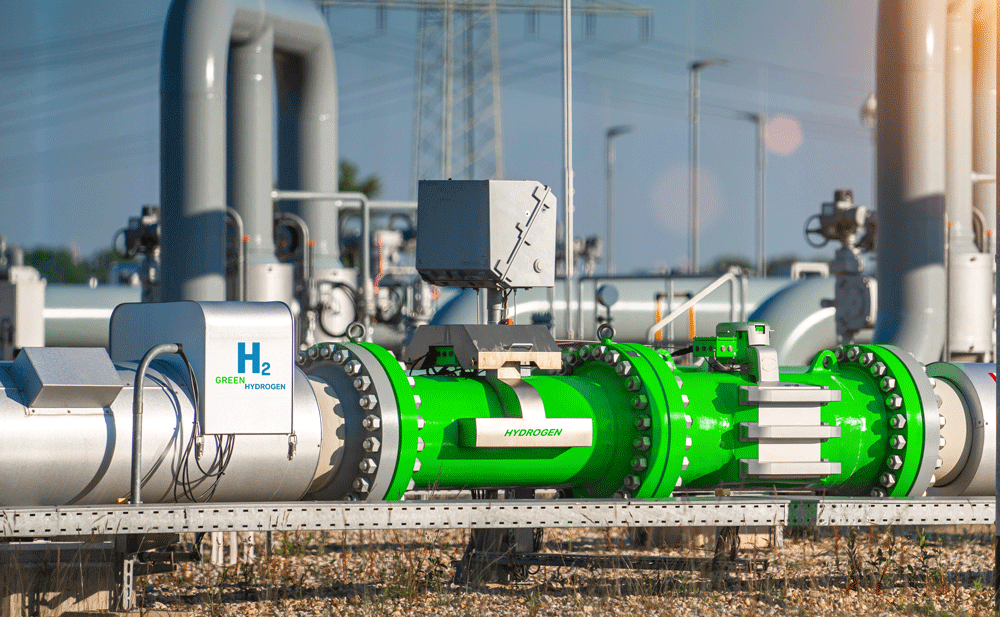
Oman’s 2030 green hydrogen production target will require up to $50bn of investment
One of the consortiums that won Oman’s green hydrogen land block auctions is expected to reach an offtake agreement sometime this year.
“We are expecting to announce an offtake agreement hopefully sometime this year,” said Rumaitha Al-Busaidi, business development manager at Hydrogen Oman (Hydrom), the main orchestrator of Oman’s green hydrogen programme.
Hydrom has signed land concession agreements with teams led by Denmark’s Copenhagen Infrastructure Partners, South Korea’s Posco and France’s Engie, Japan’s Marubeni, France’s EDF, and a team comprising London-based Actis and Australia’s Fortescue in the first two rounds of its land auctions.
Oman has also signed what it refers to as legacy projects with other teams led by Belgium’s Deme, BP and Shell.
A long-term offtake agreement for the products produced by these facilities is the main requirement for reaching a financial investment decision (FID), which the majority of the consortiums aim to achieve by 2027, except for the Deme-led Hyport Duqm, which aims to reach FID in 2026.
Al-Busaidi also said they expect to launch the third round of Oman’s green hydrogen land auctions before the end of the first quarter of 2025.
They are fine-tuning the next auction process and considering several options, including one similar to the first two auctions, where land parcels were auctioned for the production of green hydrogen and derivatives, including ammonia, methanol and sustainable aviation fuels, among others.
The other option being considered is auctioning land parcels for downstream industries that offtake green hydrogen and its derivatives, including green steel, fertilisers and other sectors.
A final option is a so-called double-sided auction to facilitate contracts between domestic green hydrogen producers and downstream offtakers.
In December, MEED reported that Oman was making good progress compared to other states in the Middle East and North Africa (Mena) region that are looking to establish green hydrogen hubs to help decarbonise key industries in fossil fuel-scarce jurisdictions globally.
“We are doing very well,” Abdulaziz Al-Shidhani, managing director of Hydrogen Oman (Hydrom), told MEED, noting that Oman has signed legally binding, 47-year project development agreements with eight consortiums under the Hydrom public auction and its legacy programme.
Each consortium is understood to have aligned with the sultanate’s goal of having a green hydrogen production capacity of 1.4 million tonnes a year (t/y) by 2030 by committing to deliver a capacity of 150,000 t/y by the end of the decade.
Alternative derivatives
Hydrom is exploring a liquid hydrogen collaboration with another European-based entity, the Port of Amsterdam, to deliver liquid hydrogen to the Netherlands and other perceived demand centres in Europe, as well as to markets in Asia – primarily Japan, South Korea and Singapore.
While most of the project development agreements signed by Hydrom and the developer consortiums expect ammonia to be the primary derivative, Al-Shidhani says liquid hydrogen has recently been emerging as a viable alternative, with potential uses for the product including applications in the mobility sector and as a maritime fuel.
“Developers and end-users are exploring all technologies and assessing the feasibility of other alternative derivatives,” he says. He adds that cracking ammonia back to hydrogen, as originally envisaged by most projects, involves high costs.
Creating local demand
While the assumed markets for the output of the planned multibillion-dollar projects in Dhofra and Duqm are overseas, Oman’s long-term objective includes attracting foreign direct investments in the entire green hydrogen supply chain, including solar and wind turbine production and manufacturing.
“We will enable the platform to foster a sustainable supply chain and it will be up to the private sector to determine suitable strategies, which we are assuming will be export-focused in the early phases of the projects,” Al-Shidhani says.
MEED understands that the 2030 green hydrogen production target will require up to $50bn of investment, including 18GW of electrolyser capacity and 35GW of renewable energy capacity.

 READ THE FEBRUARY MEED BUSINESS REVIEW
Trump unleashes tech opportunities; Doha achieves diplomatic prowess and economic resilience; GCC water developers eye uptick in award activity in 2025.
Published on 1 February 2025 and distributed to senior decision-makers in the region and around the world, the February MEED Business Review includes:
> AGENDA 1: Trump 2.0 targets technology > AGENDA 2: Trump’s new trial in the Middle East > AGENDA 3: Unlocking AI’s carbon conundrum > GAZA: Gaza ceasefire goes into effect > LEBANON: New Lebanese PM raises political hopes > WATER DEVELOPERS: Acwa Power improves lead as IWP contract awards slow > WATER & WASTEWATER: Water projects require innovation > INTERVIEW: Omran’s tourism strategies help deliver Oman 2040 > PROJECTS RECORD: 2024 breaks all project records > REAL ESTATE: Ras Al-Khaimah’s robust real estate boom continues > QATAR: Doha works to reclaim spotlight > GULF PROJECTS INDEX: Gulf projects market enters 2025 in state of growth > CONTRACT AWARDS: Monthly haul cements record-breaking total for 2024 > ECONOMIC DATA: Data drives regional projects > OPINION: Between the extremes as spring approaches |
You might also like...
Caution governs Jordanian bank lending
12 June 2026
Trump touts Iran settlement after fresh hostilities
12 June 2026
RELATED
A MEED Subscription...
Subscribe or upgrade your current MEED.com package to support your strategic planning with the MENA region’s best source of business information. Proceed to our online shop below to find out more about the features in each package.
Take advantage of our introductory offers below for new subscribers and purchase your access today! If you are an existing client, please reach out to your account manager.