


Countries are looking to diversify their feedstock
Special Report Contents
- Delaying projects is not an option
- Middle East faces 2020 power capacity challenge
- Strong IPP pipeline for 2016
- Russia leading the way in regions nuclear power race
- Databank: Power projects pipeline
Diversification has become the mantra of Middle East and North Africa (Mena) energy strategists, with ambitious plans to roll out renewables alongside the traditional fossil-fuel feedstock mix that will in future set to account for a smaller proportion of the overall mix.
Morocco import dependent for 95 per cent of its energy needs has established itself as a pioneer since it launched its National Renewable Energy and Energy Efficiency Plan in 2008, which aimed to develop alternative energy to meet 15 per cent of the countrys domestic energy needs. Those plans have gained traction with a raft of wind and solar projects underway.
Even the more hydrocarbon-richcountries have developed a taste for renewables, though progress has been mixed in realising these plans.
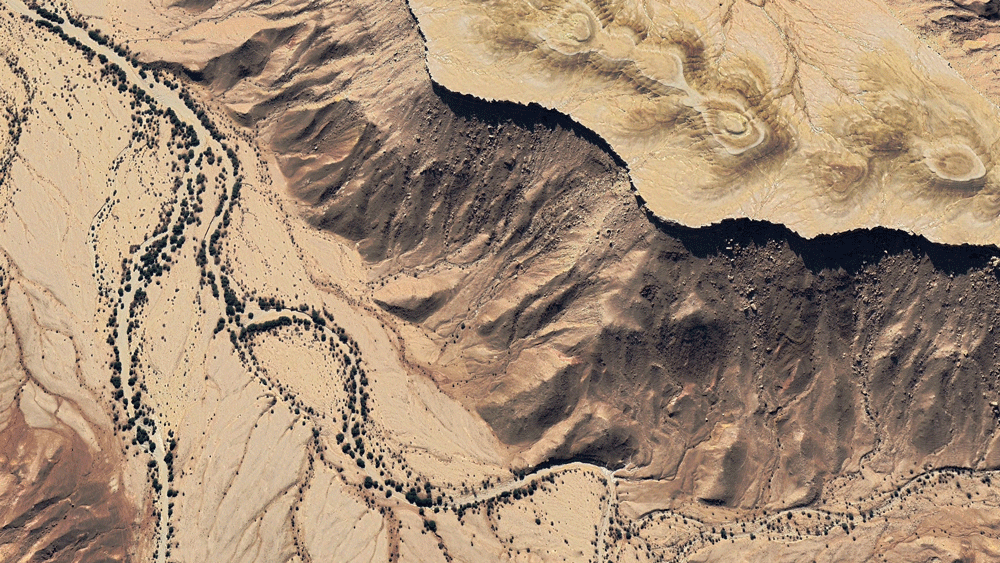
Dubai is pushing ahead with a further 1,000MW of solar, adding to the 200MW already under development.
Egypt is promoting bids around wind and solar projects and Saudi Arabia is looking to diversifying feedstock in power generation beyond fossil fuels.
Morocco has first mover advantage, as it prepares to commission a 150MW wind farm at Taza in 2017, under the first phase of the Integrated Programme for Wind Energy.
The kingdoms utility, Office National de lElectricite et de lEau Potable (ONEE) has this year invited developers to submit commercial bids for the contract to develop five wind farms with a total capacity of 850MW.
Diversified feedstock
| Morocco planned installed power capacity, 2020 | % share |
|---|---|
| Coal | 26 |
| Oil | 14 |
| Wind | 14 |
| Solar | 14 |
| Hydro | 14 |
| Gas | 11 |
| Other | 7 |
| Source: Masen | |
Solar is equally important to Rabats feedstock diversification drive.
The government aims to install 2GW of solar and 2GW of wind generation by 2020. Amina Benkhadra, director general of the Office National des Hydrocarbures et des Mines, told the Morocco Energy Exchange in Edinburgh on 12 October this was to meet annual increases in primary energy demand of 7 per cent.
It expects 42 per cent (equivalent to about 6W) of its total energy mix to come from solar, wind and hydroelectric sources by 2020, equally divided between 2GW each.
Renewables has quickly embedded itself into the fabric of the countrys industrial landscape, with cement companies now generating increase volumes of energy from renewable sources.
Solar projects are getting headway in Morocco, in both concentrated solar power (CSP) and photovoltaic (PV).
The Morocco Solar Plan (MSP) aims to contribute around 14 per cent of the energy mix in the countrys electricity supply by 2020, through construction of five solar complexes that will require an estimated $9bn investment.
In January 2015, Moroccan Solar Agency (Masen) awarded contracts for the Noor 2 and three CSP projects, with combined capacity of 350MW. At Ouarzazate, work is underway on plans to supply over 500MW from Africas single largest solar complex.
As Said Mouline, CEO of Aderee, the Moroccan Agency for the Development of Renewable Energy and Energy Efficiency tells MEED, renewable energy offers particular added value to Morocco as it can extend beyond the confines of the domestic economy.
With renewables you have projects that go beyond the local market. We hope to export electricity, and become an energy hub for Africa and southern Europe, he says.
There is talk albeit in the early stages of feeding wind and solar-generated electricity to the European electricity grid via an existing interconnection to Spain.
CSP projects have dominated the kingdoms energy mix, thanks to its ability to provide baseload capacity, with the storage enabling electricity to feed into the grid at off-peak times.
There is also a significant cost advantage, say advocates.
The Moroccans have driven down the cost of renewables, especially in the CSP sector, says Kevin Sara, CEO of Nur Energie which is developing CSP and PV power plants and has bid in Masen solar tenders.
The Moroccan CSP programme was designed to push down prices as fast as possible.
They have a very aggressive public tender process, with very strict procedures, and its working. The prices have gone down beyond anyones expectations, says Sara.
The first MSP project, Ouarzazate 1 saw the winning Saudi-Spanish consortium, led by Acwa Power, offer a $0.184 tariff that was 25 per cent lower than initial cost projections.
That enabled a reduction in the revenue subsidy from the forecast $60m to $20m.
Acwa Power took just four months to reach financial close on the second and third phases of the Ouarzazate Project, confirming the $2bn projects as highly bankable developments.
Morocco has another ace up its sleeve in that CSPs feasibility is one that other sunny countries may struggle to replicate, with the direct solar radiation allowing the deployment of a variety of technologies to concentrate the electricity.
If you moved southern Spain a couple of hundred kilometres south to Morocco, studies have shown you would get a 30 per cent increase in output for the same capital expenditure. What that does to the economics of a project is a no-brainer, says Sara.
Despite the success of CSP, PV is also on the agenda in Morocco. In the next phase, Noor PV 1, will consist of three projects with an overall capacity of 170MW, located at Ouarzazate, Laayoune and Boujdour.
| Installed wind turbine capacity, MW | |||||
|---|---|---|---|---|---|
| 2010 | 2011 | 2012 | 2013 | 2014 | |
| Egypt | 552 | 552 | 552 | 634 | 694 |
| Iran | 90 | 91 | 91 | 131 | 131 |
| Morocco | 263 | 292 | 394 | 495 | 795 |
| Tunisia | 247 | 277 | 277 | 305 | 305 |
| Other Middle East | 11 | 13 | 19 | 19 | 26 |
| Source: BP Statistical Review 2015 | |||||
Across the continent, Egypt is aiming at a renewable energy target of 20 per cent of the total energy mix by 2022, ahead of a long-term plan for renewables to comprise 30-40 per cent of the mix by 2035 and to 65 per cent by 2050.
Cairos initial focus is to bring online 4,300MW of solar and wind capacity, split into 2,000MW of wind, 2,000MW of solar and 300MW of solar rooftop projects.
The countrys feed-in tariffmodel qualification round has to date attracted more than 135 developers.
Saudi Arabias MTMM Consortium has signed a memorandum of understanding (MoU) with the Egyptian government to invest in up to 4,000MW of renewables projects, split evenly between solar and wind.
| Renewable energy targets | |||
|---|---|---|---|
| Algeria | 6% of electricity generation by 2015; 15% by 2020; 40% by 2030, of which 37% is solar (PV and CSP) and 3% is wind | ||
| Morocco | 42% of installed power generation capacity by 2021 | ||
| Libya | 3% of electricity generation by 2015; 7% by 2020; 10% by 2026 | ||
| Tunisia | 11% of electricity generation by 2016; 25% by 2030; 16% of installed power capacity by 2016; 40% by 2031 | ||
| Egypt | 20% of electricity generation by 2020, of which 12% is wind | ||
| Jordan | 7% of primary energy by 2015; 10% by 2021 | ||
| Lebanon | 12% of electrical and thermal energy by 2021 | ||
| Palestinian Territories | 25% of energy from renewables by 2020; 10% (or at least 240 GWh) of electricity generation by 2021 | ||
| Iraq | 2% of electricity generation by 2017 | ||
| Bahrain | 5% by 2021 | ||
| Kuwait | 5% of electricity generation by 2015; 10% by 2021 | ||
| Oman | 10% of electricity generation by 2021 | ||
| Qatar | At least 2% of electricity generation from solar energy sources by 2021 | ||
| Saudi Arabia | 50% of electricity from non-hydrocarbon resources by 2032: 54GW from renewables (of which: 41GW from PV and CSP, 9GW wind, 3GW waste-to-energy, 1GW geothermal, 17.6GW from nuclear) | ||
| UAE | Dubai: 5% of electricity by 2030; Abu Dhabi: 7% of electricity generation capacity by 2021 | ||
| Yemen | 15% of electricity generation by 2026 | ||
| Source: Oxford Energy | |||
Saudi renewables
Saudi Arabia itself is targeting solar.
In September 2015, Saudi Electricity Company (SEC) launched a tender for a 3,780MW integrated solar combined cycle (ISCC) at Taiba.
This has encouraged renewables developers about the kingdoms seriousness of intent, albeit on a much smaller scale than some of its neighbours.
The kingdom has considered dropping solar from its first two planned ISCC schemes, Duba and Waad al-Shamal due to rising costs, although it now looks like SEC will move ahead with the renewables element on these schemes. And it pulled back from the more ambitious KA-Care programme target of having 54GW of renewable energy by 2032.
But the tendering underway on Taiba suggests momentum is returning.
Saudi progress would provide greater impetus to other Gulf states with renewable ambitions.
Dubai has already made headway with its PV projects, with the launch of the 800MW third phase of the Mohammed bin Rashid al-Maktoum (MBR) solar park, the worlds largest single-phase solar plant.
The progress in awarding the contract for phase three, with 95 expressions of interest submitted by the 29 September deadline, confirms the robust appetite for the emirates solar plans.
Dubais momentum has superseded neighbouring Abu Dhabis, which commissioned the 100MW Shams 1 CSP plant in 2013, but has experienced delays in the tendering of another 100MW solar project, Noor 1.
Outside the Gulf, Jordan like Morocco, another energy import dependent kingdom is seeing measured progress with its 12 solar PV projects in the first round of its renewable energy feed-in tariff scheme having now secured financing.
Such moves are helping to steadily build the case for infusing non-fossil fuel energies into the mix is across Mena, though progress is uneven with budget constraints and unfamiliarity with relatively untested technologies affecting project timings.
Pioneers like Morocco have demonstrated the economic case for feedstock diversification.
This energy transition will take time, says Aderees Mouline. Were starting with our own requirements but that will enable us to develop wider plans and eventually have countries in the north buying our green electricity.
Morocco joins the LNG queue
Even renewable energy pace setters like Morocco acknowledge there is still a need for natural gas in future power generation pans. ONEE launched a tender in October 2015 seeking advisers for projects to build a liquefied natural gas (LNG) import terminal as part of a $4.6bn gas-to-power project at Jorf Lasfar launched in December 2014.
The terminal will have a 7 billion cubic metre (bcm) capacity, with a cost of $800m.
The gas would feed four planned 600MW gas-fired combined-cycle generation plants. About 5bn bcm of gas needed by 2025 would be for power generation, with 1.5bn bcm earmarked for industrial users.
An adviser to the Energy minister says the government has held talks with 25 potential gas suppliers. We need 5 bcm by 2025, and we dont want to put all our eggs in one basket, says the advisor. We want to diversify sources and contracts, and that means having at least two or three LNG suppliers.
Morocco plans to have about 80 per cent of its LNG secured under long-term contracts. The remainder would be in the form of short-term contracts and spot purchases.
The timing may be fortuitous for Moroccos debut foray into the global LNG market. Its an excellent time to be doing it, David Drury, a gas consultant at Gas Strategies told the Morocco Energy Exchange. Two years ago LNG was being sucked out of the Atlantic Basin, but now the market has changed and there is some 140m tonnes of LNG capacity under construction, so its a good time to be a buyer. It creates the opportunity to be flexible.
You might also like...
Read the March 2026 MEED Business Review
03 March 2026
Firms prepare Port of Duqm consultancy bids
03 March 2026
Iran war impacts and outlook for oil and gas sector
03 March 2026
Oman seeks consultants for transmission projects
03 March 2026
A MEED Subscription...
Subscribe or upgrade your current MEED.com package to support your strategic planning with the MENA region’s best source of business information. Proceed to our online shop below to find out more about the features in each package.
Take advantage of our introductory offers below for new subscribers and purchase your access today! If you are an existing client, please reach out to your account manager.