


SHARAKAT’s batch procurement model consolidates small sewage treatment plants into a national portfolio opportunity that is structured, financeable and open to private participation
Expanding wastewater treatment coverage across the kingdom is one of Saudi Arabia’s core water infrastructure priorities. SHARAKAT’s sewage treatment portfolio, covering both large and small plants, is projected to grow from 1.04 million cubic metres a day (cm/d) in 2025 to 2.61 million cm/d by 2030. Central to that growth is a procurement model designed for both infrastructure delivery as much as commercial accessibility.
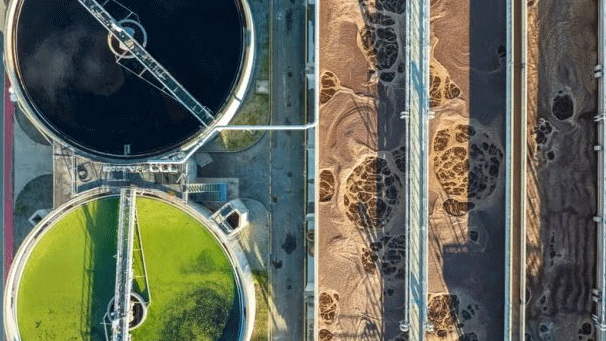
Small sewage treatment plants (SSTPs), defined as those with a capacity of under 25,000 million cm/d, address decentralised sewage handling. Individually, they are too small to attract private financing on their own. SHARAKAT responded strategically by bundling 139 proposed SSTPs into seven regional clusters across the Jazan, Western, Eastern, Northern, North-Western, Central and Southern regions. This transformed fragmented infrastructure demand into financeable transactions large enough to attract broader market participation.


Batch vs traditional
Delivering that coverage across a country the size of Saudi Arabia is where the real complexity lies, and where the batch model was designed to serve. Saudi Arabia spans approximately 2.15 million square kilometres, making it the largest country in the Middle East. Its population extends well beyond its major cities, with smaller towns and peri-urban communities distributed across vast distances. For these communities, the answer is not large independent sewage treatment plants (ISTPs) but localised infrastructure: built close, sized right and integrated with the networks that serve them.
In SHARAKAT’s model, a batch is not a single procurement but a group of projects under one scope, timetable and bid process, while sitting within a standardised overall procurement framework. In practice, this means multiple projects are bundled into a defined cluster and announced together.
This gives developers, contractors and financiers a visible, forward pipeline rather than a series of standalone tenders, making procurement efficient for both sides. It also allows developers and contractors to plan resources, teams and capital across a defined set of related projects in a single cycle.
Saudi Arabia’s first integrated SSTP/CN private contract
The Jazan cluster – the first to reach market – established the template. SSTPs and collection networks (CNs) were brought together under a single private sector contract, a structural first for this asset class in the kingdom. The scope covers the full treatment system: from inlet works and primary treatment through to tertiary processing, pumping facilities, and all associated civil, mechanical and electrical infrastructure.
Collection networks are the pipe systems that gather wastewater from homes, businesses and streets and convey it to the treatment plant. Previously, plants and their collection networks were procured separately, often managed by different entities.
By bundling both into one agreement, the developer holds full accountability. Alkhorayef Water & Power Technologies, selected as the preferred bidder for the Jazan cluster, will develop 12 treatment plants alongside a 166km collection network – all under a single concession, with commercial operations targeted for Q4 2028.
Still to be awarded
With Jazan awarded, the remaining six clusters are entering procurement in two waves – Western, Eastern,and Northern forming the first wave, followed by North-Western, Central and Southern.
Each of the remaining six clusters follows the same 25-year build, own, operate, transfer (BOOT) concession model backed by a guaranteed offtake and the same financing features as SHARAKAT’s larger transactions: secure contracts and predictable revenue streams that meet international project financing criteria.
For developers building a long-term presence in the Saudi water sector, the SSTP pipeline offers a sequenced, predictable path in.
Together, the seven clusters represent a programme of national scale. The batch model does not just deliver pipes and plants; it creates a repeatable PPP framework that transforms wastewater into a national portfolio opportunity. With prequalified developers and an open bidding pipeline, Saudi Arabia’s decentralised infrastructure era has begun.
SHARAKAT prequalification programme
SHARAKAT’s prequalification programme is open to both local and international developers across all projects, with the aim of streamlining the qualification process. The programme establishes a list of prequalified developers and bidders with requests for proposals (RFPs) for upcoming projects issued directly to those on the list. Once qualified, developers can participate across all clusters or wider projects without reapplying for each, reducing the cost and time of market entry. The programme also provides visibility of other prequalified developers and bidders, giving the teams the information they need to identify potential consortium partners early, a critical advantage in structuring competitive bids and meeting project financing requirements.
In a market built on repeat participation, prequalification is less a gateway and more a foundation –t he key to positioning across all projects, not just one.
The programme reopens periodically, with the next registration window expected in Q3 2026. For the latest project announcements and tender updates, developers can follow SHARAKAT’s official website at www.sharakat.com.sa, social media and other media outlets
You might also like...






A MEED Subscription...
Subscribe or upgrade your current MEED.com package to support your strategic planning with the MENA region’s best source of business information. Proceed to our online shop below to find out more about the features in each package.
Take advantage of our introductory offers below for new subscribers and purchase your access today! If you are an existing client, please reach out to your account manager.