



The use of solar power is being considered by industry experts as a viable option for energy-efficient desalination
With the GCC population approaching 53 million people and expected to reach about 65 million by 2050, governments are facing significant investment requirements to keep up with the demand for clean water.
The growth in water demand is driven not just by the regions burgeoning population, but also by its affluence and therefore high usage habits.
Groundwater in one of the globes most water-scarce regions is being replenished far slower that its rate of withdrawal, and so energy-intensive desalination must meet the demand. Two obvious effects of increased desalination are that more carbon dioxide is emitted and that the Gulfs seawater salinity rises, which is exacerbated by high evaporation levels due to the local temperatures.

The GCC is estimated to account for more than 40 per cent of total desalination capacity globally, and according to a recent report by the Abu Dhabi-based International Renewable Energy Agency (Irena), 30 per cent of energy consumption in Oman and the UAE is for desalination purposes. Within the UAE, only about 6 per cent of tap water consumption is for drinking. Much of the desalinated water produced is used in bottling plants for the water we ultimately drink.
Inadequate infrastructure
But the infrastructure to keep up with demand is not yet in place. According to regional projects tracker MEED Projects, governments are expected to spend about $28.1bn on desalination schemes between 2016 and 2020 to boost the regions existing infrastructure.
Tackling the desalination problem will take a range of approaches. Setting aside the obvious to encourage a reduction in consumer and industry consumption so that less water needs to be desalinated experts are proposing initiatives to help bring down the energy requirements of desalination.
Among the regions water professionals, there is an acute awareness of the high energy requirements to purify the water we drink and an even greater understanding of the environmental costs that come with desalination. With the growth of renewable energy and the introduction of nuclear power, water experts are also thinking about how to meet desalination demands as power and water decouple.

Solar powered water projects
| GCC solar desalination projects | |||||
|---|---|---|---|---|---|
| Project | Country | Status | Estimated value ($m) | Award date | Expected completion |
| Solar-powered IWP | Saudi Arabia | Study | 500 | 2018 | 2020 |
| Al-Khafji solar-powered desalination plant | Saudi Arabia | Execution | 130 | 2015 | 2017 |
| Solar-powered desalination plant | UAE | Bid evaluation | 1 | 2016 | 2017 |
| IWP=Independent water project. Source: MEED Projects | |||||
Dubai has said it is considering options around geothermal technology for desalination (and potentially power generation). Any plans are at an early stage and it is not clear if it will be seen through to a completed development. However, the use of solar is being considered by industry experts as a viable option for energy-efficient desalination.
Solar desalination
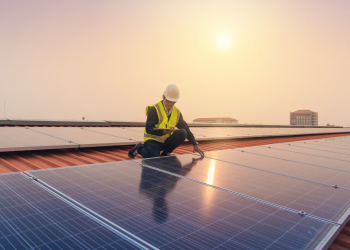
There are several planned solar desalination schemes in Saudi Arabia and Dubai, as well as pilot projects under way to test the technology. Several are happening in the UAE, with a pilot solar operation in the Ghantoot area of Abu Dhabi, and experiments being run by the Research & Innovation Centre at the American University of Ras al-Khaimah. It has been investigating small-scale membrane distillation technology using photovoltaic solar for the past few years.
The need for energy-efficient desalination will rise up the political agenda as the reliance on it increases, particularly as each GCC country committed to reducing its carbon footprint during the climate change talks in Paris late last year.
Pressure will grow on the industry to find solutions, but speaking with industry professionals, it is obvious their thinking is well advanced on how to bring down the energy requirements.
There are hurdles to overcome, such as the willingness to invest in new technologies and the speed at which change can happen. The answer will not be found in a single approach. There clearly is a need, for instance, to decrease water consumption per head of population. But solar has the potential to contribute to the desalination mix, and as energy and water become increasingly decoupled, it is an approach that will take on greater importance.
You might also like...

Ewec targets 30GW solar capacity by 2035
19 May 2026





A MEED Subscription...
Subscribe or upgrade your current MEED.com package to support your strategic planning with the MENA region’s best source of business information. Proceed to our online shop below to find out more about the features in each package.
Take advantage of our introductory offers below for new subscribers and purchase your access today! If you are an existing client, please reach out to your account manager.