


The Iran war has raised new questions around force majeure and sanctions as the UAE reshapes its energy and trade infrastructure


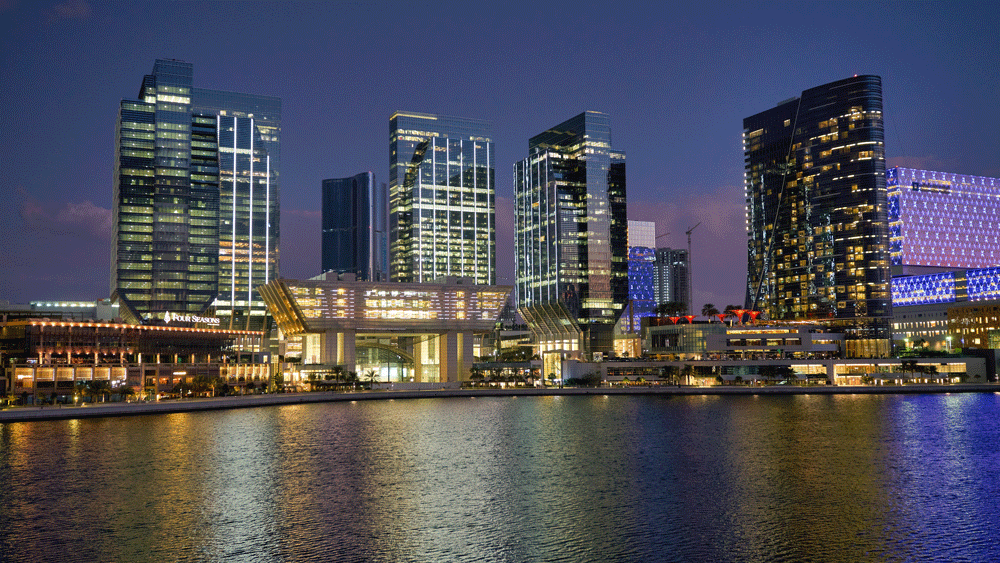
The wind-down of ICE Futures Abu Dhabi (IFAD) – the Abu Dhabi-based futures exchange operated by US-based global exchange and clearing house operator Intercontinental Exchange (ICE) – on 31 July 2026 was the end of an era. It was also the opening move in a transformation whose legal consequences will keep the Abu Dhabi Global Market (ADGM) Courts, Dubai International Financial Centre (DIFC) Courts and London arbitral tribunals occupied for years.

One strategy
On 31 July, Abu Dhabi National Oil Company (Adnoc) announced that all four of its crude grades would move from IFAD pricing to a Platts Dubai prompt-month mechanism in November. ICE published its wind-down circular the same day.
The Iran war was the catalyst: the official selling price of Murban, Adnoc’s flagship crude grade, surged from $63 a barrel in February to $110.75 in May, and Asian refiners – managing their margins against a crude price set two months ahead of loading – demanded a more straightforward mechanism.
But the IFAD wind-down must be read alongside three other key decisions. On 1 May, the UAE withdrew from oil producers’ group Opec, freeing Adnoc from quota constraints that had capped production at 3.4 million barrels a day against a capacity of 4.85 million. On 6 July, Adnoc launched a global liquefied natural gas marketing and trading platform in the ADGM, targeting 47 million tonnes a year by 2035. Then, on 22 July, DP World signed a 50-year concession with the Fujairah Ports Authority to develop the Al-Rugaylat and Dibba terminals on the Gulf of Oman coast.
Together, these decisions constitute a coherent strategic architecture: a Hormuz-independent, Fujairah-centred, Indian Ocean-facing trade infrastructure designed to serve the markets where commodity demand will be most durable over the next 30 years.
Force majeure battleground
The legal consequences of the Iran war are immediate and novel. The most contested issue is force majeure.
IFAD was established within ADGM, which applies English common law, and was regulated by the ADGM Financial Services Regulatory Authority (FSRA). Under English law, there is no freestanding right to invoke force majeure, and the threshold is demanding. General disruption or increased costs do not suffice. The question is whether performance has become legally or physically impossible.
When Iranian strikes damaged the Fujairah Oil Industry Zone, the sole IFAD delivery point, and vessel traffic through Hormuz fell from over 100 ships a day to fewer than 14, the impossibility argument strengthened materially. But a critical distinction separates parties whose non-delivery was attributable to the physical closure of Hormuz from those whose non-delivery reflected elevated war risk premiums and unavailable insurance: the latter falls short of legal impossibility under English law.
The governing law of each contract is therefore significant. Under UAE civil law, statutory provisions address both impossibility and the court’s discretion to reduce obligations. A party whose contract is governed by English law faces a harder test, even on identical facts.
This asymmetry is generating an uptick in advisory work as trading houses assess their positions across portfolios of contracts with different governing law provisions.
The sanctions picture adds further complexity: the successive reimposition of US sanctions following ceasefire collapses has affected the legality of positions that were fully compliant when established, raising questions for which English law provides no settled answer.
The legal consequences of the Iran war are immediate and novel
Legal infrastructure
The FSRA’s regulatory framework has demonstrated resilience during the crisis. Its Recognised Investment Exchange licensing regime, under which IFAD operated, and its Environmental Instrument classification, making ADGM the first jurisdiction in the world to regulate voluntary carbon credits as financial instruments, remain available to new market entrants.
ADGM Courts, applying English common law, has developed a strong body of legal precedent over 11 years. And London-based ICE Clear Europe’s relationship with IFAD provides a model for how future exchange infrastructure in ADGM might access London clearing capability while remaining regulated in Abu Dhabi.
With the 31st UN Climate Change Conference Cop31 opening in Antalya on 9 November 2026 and Cop32 scheduled for Addis Ababa in 2027, the Article 6 Paris Agreement carbon market framework is developing rapidly. The FSRA’s Environmental Instrument classification positions ADGM as a natural regulatory home for the Gulf-Africa carbon market infrastructure that neither London nor Singapore is positioned to provide. The DP World concession, with its East African port network providing the physical verification layer that carbon credit integrity requires, reinforces that positioning.
Legal practitioners who develop expertise in this intersection of English common law, FSRA regulation, DIFC financial services law and international commodity trading before the IFAD delivery disputes are resolved and before the replacement infrastructure is announced, will be well placed in a jurisdiction growing at 57% annually by assets under management. The story of what follows IFAD has barely begun.

You might also like...

Petrokemya selects turbine supplier for cogeneration plant
24 September 2026

Elegancia wins Qatar data centre deal
24 September 2026

The hidden costs of city-scale fit-out
24 September 2026
Hormuz risk reshapes Gulf port investment
24 September 2026


A MEED Subscription...
Subscribe or upgrade your current MEED.com package to support your strategic planning with the MENA region’s best source of business information. Proceed to our online shop below to find out more about the features in each package.
Take advantage of our introductory offers below for new subscribers and purchase your access today! If you are an existing client, please reach out to your account manager.