

The expansion of Jebel Ali port and creation of a state-of-the-art logistics hub at Dubai World Central will transform the southwestern region of the emirate.
Until the late 1970s, the small dhow sailing boats loading and unloading along the banks of Dubai Creek symbolised the emirate’s historical role as a trading hub between the Arabian Gulf, the Indian sub-continent and East Africa. But over the past 30 years, the dhows have been replaced by container ships, and Dubai’s centre of gravity has shifted to the southwest, away from the creek towards Jebel Ali.
In 1976, Sheikh Rashid bin Saeed al-Maktoum, then ruler of Dubai, decided to develop Jebel Ali into a modern container port. After the port came Jebel Ali Free Zone (Jafza), launched in 1985 to attract inward investment and develop Dubai as a cargo hub. This drift of trade towards the southwest will gather pace in the coming years, focusing on developing a state-of-the-art logistics hub at Dubai World Central (DWC), Jebel Ali, 40km southwest of Dubai city centre.
Handling capacity
Although Dubai’s real estate and tourism ambitions create international headlines, the emirate’s wealth is anchored in trade. While the emirate is the Middle East’s leading hub for sea and air freight, Jebel Ali generates most of Dubai’s trade and commerce. Jafza employs one in every seven of the emirate’s residents, and generates one in 10 of its air freight consignments.
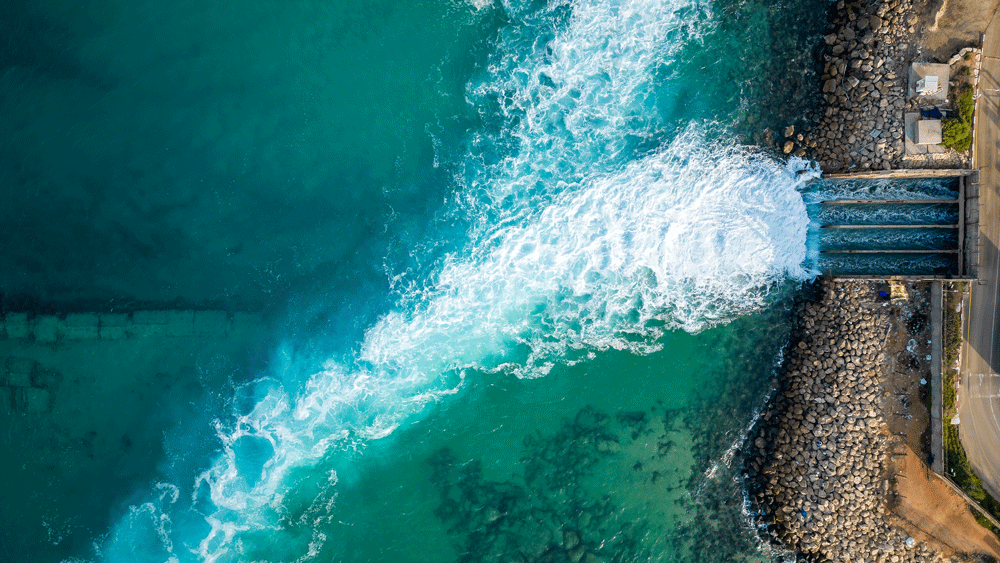
In 2007, Jafza companies generated $68.8bn worth of external trade - 37 per cent of Dubai’s total non-oil trade. In 1985, Jafza began with 19 tenants. Today, 6,400 companies are based there, including 154 Fortune Global 500 firms. They include: oil giants such as the UK/Dutch Shell group, the UK’s BP and France’s Total; carmakers such as India’s Tata and the US/German Daimler-Chrysler; communications and electronics firms such as Germany’s Siemens, Taiwan’s Acer and Japan’s Sony; and consumer goods manufacturers such as Switzerland’s Nestle and the UK/Dutch Unilever.
Jafza’s growth reflects the development of Jebel Ali port. Some 77 per cent of the free zone’s occupants are trading companies, involved in importing and re-exporting goods across the world via Dubai. Of the remainder, 20 per cent are involved in manufacturing and 3 per cent are service companies.
Dubai’s ports, managed by DP World, handled more than 10.3 million 20-foot equivalent units (TEUs) in 2007, following annual growth of more than 19 per cent, which lifted it from eighth-largest port in the world to seventh.
The closure of the inner-city Port Rashid to commercial shipping in 2007 means that all container and general cargo traffic is funnelled through Jebel Ali, contributing to the shift from Dubai Creek as the emirates’ trading hub. Both Jafza and DP World, sister companies within the Dubai World portfolio, have expanded globally, through acquisitions and management concessions outside the Middle East.
Having turned Jebel Ali into the largest port between Rotterdam and Singapore, DP World is planning for future growth. The first phase of Container Terminal 2 opened last year, and the second phase is due for completion shortly. Six further planned terminals will increase Jebel Ali’s capacity to 55 million TEUs by 2030, from 14 million today.
“DP World UAE has put together a strategic plan looking at expansion up until 2030,” says Mohammed al-Muallem, senior vice-president and managing director for the UAE at DP World. “This consists of 14 stages, with every expansion subject to the increase in demand to cope with the growing market, and to be always ahead of demand.”
Big ambitions
In November 2007, DP World went public when Port & Free Zone World floated 23 per cent of its shares in the company on the Dubai International Financial Exchange in the region’s largest initial public offering to date, raising $4.96bn.
DP World’s growth has continued. Despite talk of global recession, its half-year profits of $287m for 2008 are nearly double the $129m recorded in the first half of 2007.
But Dubai’s ambitions do not stop with the port and free zone. The Jebel Ali district is the epicentre of a $33bn plan to upgrade the emirate’s infrastructure, securing inward flows of cargo, people and investment. DWC will bring together Jebel Ali port, Dubai Logistics City (DLC) and the new Al-Maktoum International airport in a three-pronged initiative.
DWC will be one of the largest integrated logistics hubs in the world, serving 2 billion people in the Middle East, Africa and Asia. The market is vast and potentially hugely lucrative - the countries of the Middle East and Indian Ocean rim import $150bn worth of goods a year.
Able to handle up to 120 million passengers a year, the $10bn Al-Maktoum International airport will be bigger than the US’ Chicago O’Hare and the UK’s London Heathrow airports combined. On completion in 2015, it will handle 12 million tonnes of cargo a year, with six parallel runways, two main terminals and a smaller terminal for budget carriers, linked by light rail.
Paul Griffiths, chief executive officer of Dubai Airports, describes the project as a catch-up operation, arguing that the scale of the project is necessary to cope with projected trade and passenger growth. “With new, longer-haul aircraft, the region will become the joining point for every major pair of cities in the world,” he says.
Integrating transport
Although Jebel Ali has built its reputation as a sea-air hub, it is a long drive from the port to Dubai International airport, on the far side of Dubai Creek. In future, freight will transfer from the port to the new Al-Maktoum International airport within four hours, says Al-Muallem. This is DLC’s unique selling point and 50 global logistics providers have already signed up as tenants.
“The development of the Jebel Ali area will help to create one of the world’s most exciting logistics areas,” says Al-Muallem. “It will connect the largest man-made port, one of the largest free zones and the worlds’ largest airport.
“The combined Jebel Ali area is expected to host in excess of 20,000 companies, with forecast trade exceeding $50bn [and] a population of 2.5 million. In 10 or 20 years, these figures will be even more staggering, giving Dubai an even greater strategic advantage.
“In the coming years, the free zone where Jebel Ali port is located will grow into a huge new city centred around efficient provision of supply chain services...Al-Maktoum International airport and DLC [will create] the world’s first integrated logistics and multimodal transport platform.
“The airport is designed to handle more than 12 million tonnes of air cargo annually in up to 16 air cargo terminals, allowing cargo to be moved from ship to aircraft in less than 20 minutes.
“This will enhance Jebel Ali’s position as one of the world’s most vital ports, and as a regional hub for shipping and logistics.”
DLC’s marketing focuses on flexibility: the availability of land to create customised warehousing, and industrial buildings for everything from light assembly to forwarding. It offers airside access for airline supply companies, and for the big integrators such as the United Parcel Service of America (UPS), Germany’s DHL and the US’ FedEx, as well as shared warehousing for small distribution and forwarding companies.
Strategic advantage
DWC will become a city within a city state. Plans for the development include 850 high-rise office buildings, private housing for 250,000 people, and accommodation for 40,000 support staff. Projections suggest 1 million people will live in the development by 2050. The project is an umbrella for several mini developments: residential, commercial, aviation and golf cities.
Some observers see DWC as a rival to Jafza, with its additional space and customised facilities. But Ibrahim al-Janahi, senior vice-president for sales and marketing at Jafza, says they are very different.
“Jafza caters to a niche market,” says Al-Janahi. “Excellent sea-based connectivity is one of its exclusive selling propositions. Most international trade, 80 per cent of the total trade by volume, is still carried by sea. DWC, on the other hand, is largely focused on air connectivity.
“DWC and Jafza will therefore complement each other...The Jebel Ali projects under way, with an extensive highway network, will boost operations and give Jafza an even greater strategic advantage.”
As construction continues at DWC, Jafza is also expanding. Jafza South Zone will cover 27.8 million square metres, creating two clusters for the chemicals and food and beverage industries.
Construction has begun on a AED2.5bn convention centre, with two 34-storey office buildings, an exhibition hall, a five-star hotel with 322 rooms and a 700-seat auditorium. It is due for completion in 2010.
It remains to be seen how the southward shift will affect Dubai’s traditional urban centre along the creek. It is unclear whether the existing airport will continue to handle commercial flights, or whether demand is sufficient for two airports.
“We want to start transferring operations to the new airport, which will quickly reach capacity, next year,” says Griffiths. “We will not have to make a decision on whether to have one or two airports for some time, and it is likely that we will continue with both. But we do not yet know how the operation will be configured.”
Meanwhile, with recession deepening overseas, there are few signs of expansion slowing at Jebel Ali, or of any crisis of confidence, in the home market at least. “We expect a few hiccups, but overall it will be business as usual,” says Al-Janahi. “Jafza, for the most part, will not be affected by the economic slowdown in a big way.
“We expect new development to bring a host of advantages to the [Jebel Ali] area, including better infrastructure and improved standards of living... Jafza and DWC are part of the larger vision for Dubai. Jafza will be close to the world’s largest airport and the world’s largest man-made port, enhancing its global connectivity.”
The growth of Dubai's Free Trade Zones
Building on its historic reputation as a regional trading hub, Dubai’s free trade zones have proved successful to the extent that they have provided a template for the rest of the UAE and the wider region.
The appeal of the free trade zone is in its legal simplicity. The zones are a physically defined area, in which 100 per cent foreign ownership of a company is allowed. Outside Dubai’s free zones, foreigners are allowed a stake of no more than 49 per cent in a company, and must have an Emirati national as a partner in any new business.
There is also an exemption on import and export taxes, and all profits and capital can be repatriated, a provision that has helped attract more than 2,200 companies and 40,000 workers from 70-plus countries to the Jebel Ali Free Zone (Jafza).
Creating zones
No corporate tax is levied for 15 years, and this exemption is renewable for an additional 15 years. Free zone employers are also offered government help with sponsorship and housing.
Jafza was the first free zone created in Dubai. A Dubai government decree in 1985 established the zone, which is now the largest commercial and industrial zone in the Middle East.
The success of Jafza led to the creation of similar zones throughout Dubai, and the governments of the six other emirates soon followed. The government has invested about $3bn in the zone, upgrading its deep-sea harbour to continue attracting container ships.
Since Jafza was established 23 years ago, the government has created a series of industry-themed free zones. For faster sea and air transport links, the Dubai Airport Free Zone, set up in 1996, serves as a logistics hub and houses more than 300 companies with 7,000 employers. More recently, Knowledge Village and Dubai Internet City have been established, to build Dubai’s reputation in the information technology and services industry. Connected to these technology-focused projects are other free zones that will develop and manufacture technology.
The Mohammed bin Rashid Technology Park aims to act as a research, technology and manufacturing park for sectors including biotechnology and pharmaceuticals.
Dubai Silicon Oasis aims to be a hi-tech centre for advanced electronics design, development and manufacturing, focusing on micro-electronics and semi-conductors.
Eroding benefits
The blueprint for the financial services free zone, Dubai International Financial Centre (DIFC), which opened in September 2004, is particularly bold, establishing a new financial marketplace to serve the region and act as a catalyst to regional growth.
Dubai’s free zones: Existing
Dubai Cars & Automotive City Free Zone
Dubai Airport Free Zone
Dubai Dragon Mart
Dubai Flower Centre Free Zone
Dubai Industrial City
Dubai International Financial Centre
Dubai Internet City
Dubai Logistics City
Dubai Healthcare City
Dubai Media City
Dubai Silicon Oasis
Dubai Textile Village
Gold & Diamond Park Free Zone
International Humanitarian City
International Media Production Zone
Jebel Ali Free Zone
Knowledge Village
Metals & Commodities Free Zone
Dubai’s free zones: Planned or under development
Dubai Auto Parts City
Dubai Biotechnology & Research Park
Dubai Carpet Free Zone
Dubai Maritime City
Dubai Outsource Zone
Heavy Equipment & Trucks Zone
Mohammed bin Rashid Technology Park
Techno Park Dubai
Since launching, 763 companies - banks, wealth and fund managers, law firms and consultants - have registered in the DIFC.
With the UAE’s foreign ownership laws under review, the advantages of operating in a free zone could diminish. The government has promised reform of foreign ownership limits on companies. In March this year, it said that majority foreign ownership would soon be allowed in some sectors, possibly financial services. An update on the new law is still pending. If the ownership limits are lifted, this may deter companies from setting up in the newer free zones.
Fast Fact
The value of external trade generated by Jebel Ali Free Zone companies in 2007 - $68.8 bn
You might also like...
Saudi Arabia and UAE lead Gulf projects index gains
23 September 2026
Middle East contract awards: August 2026
23 September 2026
Saudi delivery enters a new phase
23 September 2026
Egypt plans $3bn PPP projects
23 September 2026
A MEED Subscription...
Subscribe or upgrade your current MEED.com package to support your strategic planning with the MENA region’s best source of business information. Proceed to our online shop below to find out more about the features in each package.
Take advantage of our introductory offers below for new subscribers and purchase your access today! If you are an existing client, please reach out to your account manager.