As-Samra wastewater treatment plant capacity to increase by 97,800 cubic metres a day
Jordan’s Water and Irrigation Ministry has signed an agreement with the sponsors of the As-Samra wastewater treatment plant.
The expansion will increase the capacity of the project from 267,000 cubic meters a day (cm/d) to 364,800 cm/d and will be constructed and maintained under a 25-year build-operate-transfer (BOT) contract.
The project will cost $184.3m, of which $93m will be provided through a grant from the US government’s Millennium Challenge Corporation (MCC). The remainder will be provided by France’s Suez Environment, the US’ Infilco Degremont and the US’ Morganti Group and a syndicate of lenders led by Jordan’s Arab Bank.
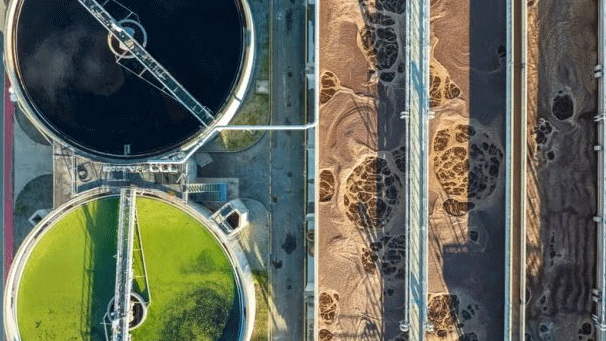
The project will serve residential populations of Amman and Zarqa governorates and will assist agricultural farmers in the area. The plant’s expansion is expected to take 36 months and will begin in August.
In addition to the capacity expansion, the new project will be capable of “[handling] suspended solids and biological materials, among other critical treatment requirements”, according to Basem Telfah, project management unit director, Water and Irrigation Ministry.
Payments from the project are based on availability and treatment. A minimum payment is guaranteed by the water ministry for availability of 160,000 cm/d for the existing plant and 220,000 cm/d once the expansion project becomes operational. A treatment payment is paid on top of this value. The payments are guaranteed by the Finance Ministry.
The original As-Samra wastewater project comprised a series of waste stabilisation ponds in 1985 with a capacity of 67,000 cm/d. The government decided to replace the plant with a more technologically-advanced structure with a greater capacity.
The government tendered for the construction of a 267,000 cm/d wastewater treatment plant in early 2001. The plant was offered as a 25-year concession with a build-own-transfer structure. The project cost $169m to build, around half of which was supplied by the US Agency for International Development ($78.1m). The remainder came from government resources ($13.9m), the project company ($17m) and banks ($60m).
Construction began in 2004 and finished in April 2008. While the existing project has a capacity of 267,000 cm/d, it currently cannot treat more than 220,000 cm/d.
The expansion project was announced in early 2009. An advisory group comprising the Netherlands’ KPMG, the UK’s Atkins and UK-based firm Allen & Overy was selected to work on the expansion project at the end of 2009.
You might also like...

Activity ramps up in Syria’s oil and gas sector
03 June 2026
Aramco and Emerson partner for corrosion management
03 June 2026
Aramco issues tender for offshore pipeline work
03 June 2026

Big Tech struggles to deliver data centre promises
03 June 2026

A MEED Subscription...
Subscribe or upgrade your current MEED.com package to support your strategic planning with the MENA region’s best source of business information. Proceed to our online shop below to find out more about the features in each package.
Take advantage of our introductory offers below for new subscribers and purchase your access today! If you are an existing client, please reach out to your account manager.