

The use of refuse-derived fuel in Egypts cement industry is growing
Waste is a significant problem in Egypt. As of 2011, the country produced about 21.1 million tonnes of municipal solid waste a year, with this quantity forecast to rise 3.4 per cent annually, according to Germanys state-owned development company Deutsche Gesellschaft fur Internationale Zusammenarbeit (GIZ). The organisation estimates only 60 per cent of refuse is collected, and only 20 per cent of that is recycled or properly disposed of.
To improve this performance, the Egyptian government has set up the National Solid Waste Management Programme (NSWMP), in conjunction with EU and German development organisations, including GIZ. The programme aims to provide technical assistance to help establish a framework for improving waste management in Egypt.
RDF standards
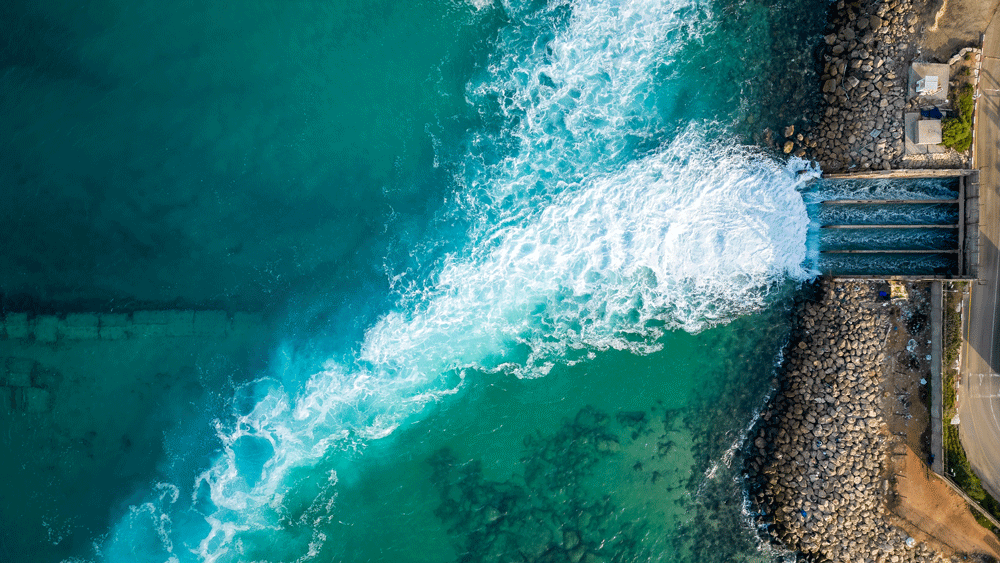
One aspect is the production of refuse-derived fuel (RDF) as an alternative energy source for cement kilns in Egypt. Here, technical specifications and standards for RDF have been developed, which facilitate business relations between producers of RDF and cement factories. They are in the process of approval by the National Standardisation Authority, says Joachim Stretz, programme coordinator for NSWMP at GIZ.
According to Stretz, the cement industry presents a significant potential market for RDF producers. Depending on the market prices and availability of other energy sources for the cement industry, RDF projects can prove a viable business opportunity for companies interested in entering the market of waste management, he says.
From our perspective, it is an important element of integrated solid-waste management, using the non-organic, non-recyclable parts of waste as an alternative, CO2-neutral energy source. Thus RDF projects can contribute to solving the huge problem of dealing with waste and addressing the current shortage of energy sources for the cement companies. Experiences supported by GIZ in other countries comparable to Egypt have shown that RDF projects are helping to improve solid waste management.
As one of the most energy-intensive and therefore potentially polluting industrial sectors, the cement industrys use of RDF means producers can reduce their greenhouse gas production. RDF is CO2-neutral, because if the waste were not used for fuel it would otherwise be buried or incinerated, releasing its carbon back into the atmosphere however it is disposed of.
Egypt has a number of RDF projects supplying cement producers, including one in the Governorate of Qalubeya, which has been extended with support from the German government and the Bill and Melinda Gates Foundation.
The facility can process up to 200 tonnes of municipal waste and produces up to 40 tonnes of RDF a day. It also provides support to informal waste recyclers, who now sell their RDF production to cement companies, according to Stretz.
Lafarge subsidiary
Cement producer Lafarge Egypt has also entered the field of RDF production, through its Ecocem subsidiary. Since 2013, Lafarge says it has used about 450,000 tonnes of RDF in its cement production, with alternative fuels, including RDF, making up 24 per cent of its fuel mix this year. The company claims this has cut CO2 production by 620,000 tonnes in total, and created about 3,000 jobs for refuse sorters and processors.
Lafarge says it will spend about $4.4m this year to develop its alternative fuel capacity in its cement production lines, and is investing about $18.7m in a waste treatment plant, with a planned capacity to produce 800,000 tonnes of RDF a year.
As it is a relatively new market, reliable prices for RDF are not yet established and might change quickly
Joachim Stretz, GIZ
But despite the potential the company sees in the sector, general manager of Ecocem Amr el-Kady told a recent MEED event in Cairo it faced a number of challenges around RDF, including high market costs, low production volumes and an uncertain regulatory environment.
Stretz agrees, and says the first key challenge for RDF in Egypt is economic feasibility. RDF competes with other energy sources and has to prove that it is a viable alternative, especially against conventional fuels such as natural gas and now coal. As it is a relatively new market, reliable prices for RDF are not yet established and might change quickly.
He adds, Second, the current environment for establishing a business in waste management still poses some challenges. Important are long-term contractual arrangements for the supply of waste to the RDF facility and its integration into a sustainable and adequately financed waste management system.
High potential
Egypt amended its environmental law in April this year to encompass the use of alternative fuels in cement production, and is working on a framework to address waste-to-energy technologies, particularly RDF.
Given the success of RDF in other countries with the necessary legal framework, the massive energy demand of cement producers and their widespread support for RDF, Stretz sees high potential for the sector in Egypt.
He still adds a note of caution, though, saying, From my perspective, all factors that promote RDF projects in Egypt are currently developing: interest from the cement industry is growing, there are significant efforts by the government to provide an adequate framework, and good first experiences exist on the ground. However, the future development of market prices for RDF, and therefore its economic feasibility, is difficult to predict.
You might also like...
Caution governs Jordanian bank lending
12 June 2026

Trump touts Iran settlement after fresh hostilities
12 June 2026
A MEED Subscription...
Subscribe or upgrade your current MEED.com package to support your strategic planning with the MENA region’s best source of business information. Proceed to our online shop below to find out more about the features in each package.
Take advantage of our introductory offers below for new subscribers and purchase your access today! If you are an existing client, please reach out to your account manager.